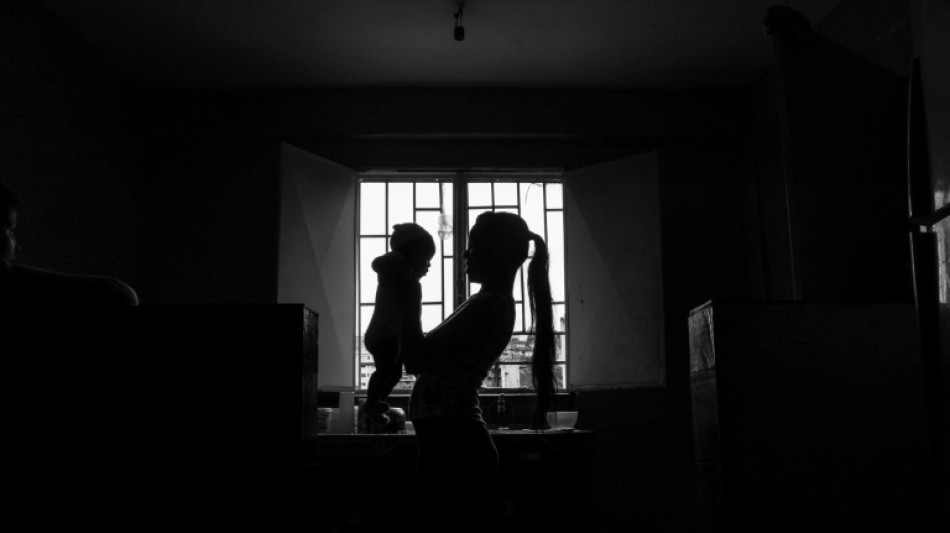
Five minute walks best way to comfort crying babies, says study / Photo: © AFP/File

 Houthis target Red Sea shipping as US hits Iran

 Record-equalling Red Sox streak halted at 15 wins

 Messi-less Miami beat Fire 3-2 to spoil Lewandowski's MLS debut

 Mercedes expect Hungary challenge from Hamilton and Ferrari

 In Ghana, one man's race to save critically endangered fish

 Wilson captain, Slipper absent in Kiss's first Wallabies squad

 New Mideast fighting puts eurozone rate-setters on alert

 Venezuelans search for animal companions lost in the quakes

 Argentine Football Association says US did not detain its president

 June heatwave cost UK economy more than £1bn: study

 Google-parent Alphabet beats expectations, cloud revenue nearly doubles

 US announces civilian nuclear deal with Saudi Arabia

 Tesla shares dip after profit misses expectations

 Red Sox tie club record with 15th straight MLB win

 US eyes offshore nuclear reactors

 The Sterling Announces Luxury Cocktail Lounge Concept and Investor Showcase in Orlando

 Inter Miami signs Brazil veteran Casemiro but MLS probes deal

 White House accuses China's Moonshot of stealing Anthropic AI

 Pogacar sweating on Yates's fitness ahead of Tour Queen stage

 Ukrainian soldiers and civilians welcome new army commander

 UK fintech Revolut valuation soars to $115 bn: source

 German FM, on Africa tour, eyes business ties amid US, China pressure

 Rubio says at ASEAN meeting he expects 'positive' US visit by China's Xi

 Philipsen wins Tour de France 17th stage

 DonnaPro Introduces AI-Trained Executive Assistants for European CEOs

Science has perfected the answer to calming a crying baby: Hold and walk with them for five minutes.
The evidence-based soothing strategy was derived from experiments carried out in Japan and Italy, which were analyzed and published in the journal Current Biology on Tuesday.
The paper's authors said they hoped the finding could benefit stressed parents, particularly the inexperienced.
"I have raised four children," senior author Kumi Kuroda of the RIKEN Center for Brain Science in Japan said in a video statement.
"But even I couldn't foresee the key results of this study until the statistical data came up," she added.
The team had previously studied the "transport response" in mammals that give birth to young that are unable to care for themselves, such as mice, dogs, monkeys and humans.
When these animals pick up their babies and start walking, the young become quiet and docile, and their heart rates slow.
Kuroda and colleagues wanted to explore this further in humans, and to compare the effect against other comforting behaviors such as rocking in one spot.
They recruited 21 mother-baby pairs aged 0-7 months, and tested them under four conditions: carrying while moving, held still by their sitting mothers, lying in a still crib, or lying in a rocking cot.
Crying decreased and heart rates slowed within 30 seconds when infants were transported. There was a similar effect when they were rocked, but not when held motionless.
This suggested that, contrary to assumptions, maternal holding was insufficient to calm a child, and the transport response was an important factor.
Next, they looked at the impact of carrying infants for five minutes, finding that the activity put 46 percent of them to sleep, and an additional 18 percent fell asleep in the minute after.
This showed that not only did carrying stop crying, it also promoted sleep.
But there was a wrinkle: when infants were put to bed, more than one-third became alert within 20 seconds.
Electrocardiogram readings showed the babies' heart rates rose the second they were detached from their mother's bodies.
However, when the babies were asleep for a longer period of time before being put down, they were less likely to awaken.
Kuroda said she found this surprising, as she had assumed other factors like the way they were placed in bed or their posture would play a role, but this was not the case.
"Our intuition is very limited, that is why we need science," she said.
Based on the totality of their findings, they recommended a protocol for soothing and promoting sleep: hold and walk the baby five minutes, then sit and hold them for another five to eight minutes, before putting them to sleep.
This provides immediate comfort as opposed to other methods like letting a baby cry themselves to sleep, but more work will be needed to understand if it can train infant sleep in the long term.
O.Krause--BTB