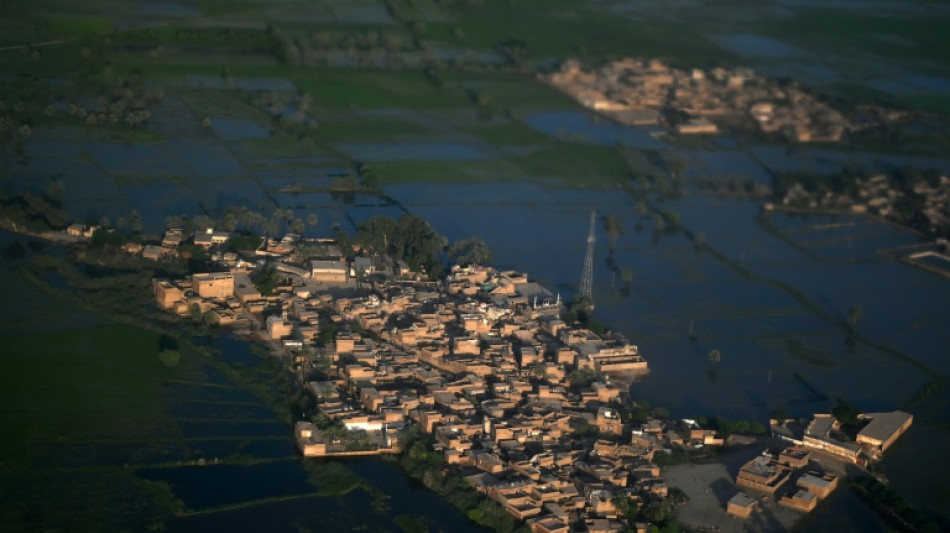
UN chief 'never seen climate carnage' like Pakistan floods / Photo: © AFP

 Houthis target Red Sea shipping as US hits Iran
 Record-equalling Red Sox streak halted at 15 wins

 Messi-less Miami beat Fire 3-2 to spoil Lewandowski's MLS debut
 Mercedes expect Hungary challenge from Hamilton and Ferrari

 In Ghana, one man's race to save critically endangered fish
 Wilson captain, Slipper absent in Kiss's first Wallabies squad
 New Mideast fighting puts eurozone rate-setters on alert

 Venezuelans search for animal companions lost in the quakes
 Argentine Football Association says US did not detain its president

 June heatwave cost UK economy more than £1bn: study

 Google-parent Alphabet beats expectations, cloud revenue nearly doubles
 US announces civilian nuclear deal with Saudi Arabia

 Tesla shares dip after profit misses expectations

 Red Sox tie club record with 15th straight MLB win

 US eyes offshore nuclear reactors

 The Sterling Announces Luxury Cocktail Lounge Concept and Investor Showcase in Orlando

 Inter Miami signs Brazil veteran Casemiro but MLS probes deal

 White House accuses China's Moonshot of stealing Anthropic AI

 Pogacar sweating on Yates's fitness ahead of Tour Queen stage

 Ukrainian soldiers and civilians welcome new army commander

 UK fintech Revolut valuation soars to $115 bn: source

 German FM, on Africa tour, eyes business ties amid US, China pressure

 Rubio says at ASEAN meeting he expects 'positive' US visit by China's Xi

 Philipsen wins Tour de France 17th stage

 DonnaPro Introduces AI-Trained Executive Assistants for European CEOs

United Nations Secretary-General Antonio Guterres said Saturday that he has "never seen climate carnage" on such a scale as he toured parts of Pakistan hit by floods, blaming wealthier countries for the devastation.
Nearly 1,400 people have died in flooding that covers an area the size of the United Kingdom and has wiped out crops and destroyed homes, businesses, roads and bridges.
Guterres has said he hopes his visit will galvanise support for Pakistan, which has put the provisional cost of the catastrophe at more than $30 billion, according to the government's flood relief centre.
"I have seen many humanitarian disasters in the world, but I have never seen climate carnage on this scale," he said at a press conference in the port city of Karachi after witnessing the worst of the damage in southern Pakistan.
"I have simply no words to describe what I have seen today."
Pakistan receives heavy -- often destructive -- rains during its annual monsoon season, which is crucial for agriculture and water supplies.
But downpours as intense as this year's have not been seen for decades, while rapidly melting glaciers in the north have for months heaped pressure on waterways.
"Wealthier countries are morally responsible for helping developing countries like Pakistan to recover from disasters like this, and to adapt to build resilience to climate impacts that unfortunately will be repeated in the future," Guterres said, adding that G20 nations cause 80 percent of today's emissions.
Pakistan is responsible for less than one percent of global greenhouse gas emissions, but is eighth on a list compiled by the NGO Germanwatch of countries most vulnerable to extreme weather caused by climate change.
- 'Insanity and suicide' -
Around 33 million people have been affected by the floods, which have destroyed around two million homes and business premises, washed away 7,000 kilometres (4,300 miles) of roads and collapsed 500 bridges.
Guterres has lamented the lack of attention the world has given to climate change -- particularly industrialised nations.
"This is insanity, this is collective suicide," he said after arriving in Pakistan on Friday.
The effect of the torrential rain has been twofold -- destructive flash floods in rivers in the mountainous north, and a slow accumulation of water in the southern plains.
"All the children, men and women are roasting in this scorching heat. We have nothing to eat, there is no roof on our heads," Rozina Solangi, a 30-year-old housewife living in a displacement camp near Sukkur, told AFP on Friday.
"He must do something for us poor," she said of the UN chief's visit.
The meteorological office said Pakistan has received five times more rain than normal in 2022. Padidan, a small town in Sindh province, has been drenched by more than 1.8 metres (71 inches) since the monsoon began in June.
Thousands of temporary campsites have mushroomed on slivers of high ground in the south and west -- often roads and railway tracks in a landscape of water.
With people and livestock crammed together, the camps are ripe for outbreaks of disease, with many cases of mosquito-borne dengue reported, as well as scabies.
During his speedy tour, Guterres stopped at some of these makeshift camps and met with desperate flood victims, including a woman who gave birth overnight.
Wearing an Ajrak shawl with a traditional Sindhi block print, he later inspected the 4,500-year-old UNESCO world heritage site Mohenjo-daro, which has suffered water damage from the relentless monsoon rain.
D.Schneider--BTB