Data centre command hub keeps AI up and running / Photo: © AFP

 Singer Ed Sheeran says Gaza situation 'unjustifiable' following controversy

 In 'Tenzing', a Sherpa mountaineer gets his due

 Ed Sheeran set to return to stage after Palestinian controversy

 Toulouse edge Vannes, Lyon beat Pau to take Top 14 summit

 Germans arrested for Louvre stunt in Mona Lisa hall

 Saudi-led coalition says Houthis fired ballistic missile at Riyadh

 France's debt climbs to highest since 1978: ministry

 McIlroy two shots off the lead at Wentworth after eagle on 18

 Martinez brace saves Inter in Serie A top-two clash with Roma

 Rosenior abused but guides Paris FC past old club Strasbourg

 Seven-try Lyon beat Pau, climb to Top 14 summit

 Brighton defeat a 'big lesson' against complacency for Arsenal, says Arteta

 Thousands protest inaction over climate crisis in Switzerland

 Carapaz out of cycling world championships

 'Fragile' Tottenham beaten by Aston Villa despite late rally

 Mourinho hails Real Madrid grit before Atletico derby clash

 Martin wins Austrian MotoGP sprint after Acosta crash

 Japan edge Fiji to win Pacific Nations Cup

 Black smoke, flames rising near Riyadh airport: residents to AFP

 UK actor Naomi Watts honoured at Spain film festival

 Japan emperor declares Asian Games open after turbulent build-up

 Asian Games open with unity message after troubled build-up

 Denmark hails 'binding' Greenland deal with Trump

 We don't want Games host Japan losing money, says Asian Olympic official
 Ed Sheeran returns to stage after Palestinian controversy

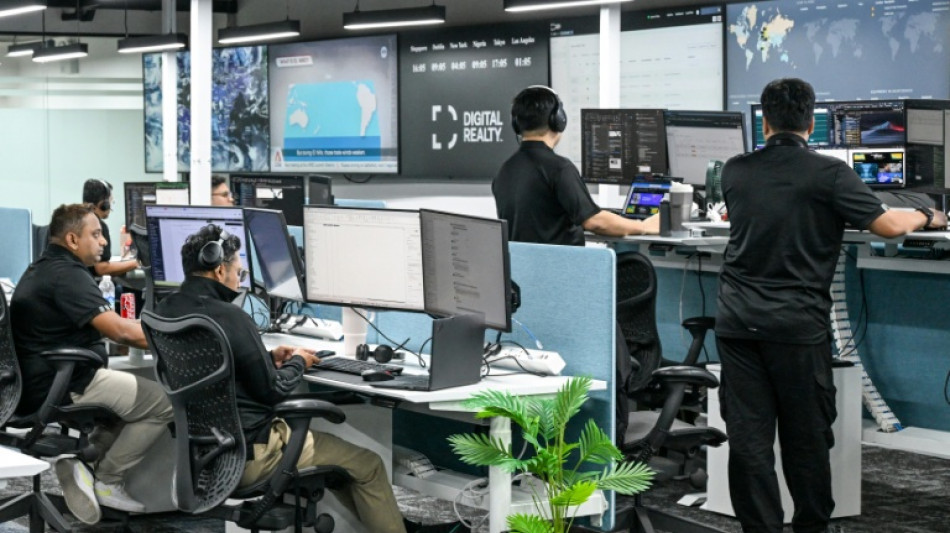
A steady nerve is crucial when keeping watch over hundreds of data centres worldwide, facilities essential to the frictionless online banking, messaging and AI services that society relies on.
Analysts sit surrounded by digital maps and dashboards at the Singapore command centre of US firm Digital Realty, a major global operator of the warehouse-like sites filled with whirring servers.
The goal is not simply to react when something breaks, but to detect warning signs, such as a sudden rise in temperature, early enough to prevent disruption.
Daniel Naing, 37, and his colleagues handle thousands of system alerts flagging signs of trouble each week.
"If I panic, my team members will panic. So even though inside I may be nervous, I cannot show it," he told AFP.
The command centre and its two sister hubs, in Europe and the United States, provide round-the-clock oversight of more than 300 data centres across six continents.
Digital Realty rents its server space to around 6,000 companies big and small, with power disruptions and equipment failure the most common issues faced.
There are also detailed protocols for earthquakes and typhoons, and an approaching storm thousands of kilometres away is enough to put the team on standby.
Booming demand for data centres is a political hot potato in many places, as tech companies race to develop artificial intelligence tools that require massive amounts of computing power.
But without them "nothing works" in our high-tech world, said Serene Nah, managing director and head of Asia Pacific at Digital Realty.
Data centres are essential infrastructure -- a matter "almost like national security", she said.
"We need to be up running all the time."
Nah said, however, that "our business is very misunderstood" and has little support from the public, who believe data centres emit "a lot of carbon or heat" or "use up a lot of water".
"Yet everyone's scrolling their phones every day," and for each swipe "the data needs to go somewhere".
The company is prioritising renewable energy such as solar panels and closed-loop server cooling systems that continuously recycle water, Nah said.
- False positives -
The vulnerabilities of the sector were highlighted this year, when data centres run by Amazon's cloud arm were struck during the Middle East war.
Data centres operate 24 hours a day, so Naing and his colleagues take the 7 am to 7 pm shift in Singapore before handing over to Europe.
Engineers must attend to an alert within minutes. The teams liaise with those on the ground and call on a global network of experts to help, while keeping clients updated.
Digital Realty is one of the biggest providers of data centre server space along with rivals like Equinix, also a US company.
Meanwhile tech giants from Microsoft to Alibaba are racing to build their own data centres to train and run AI models -- part of a global buildout costing trillions of dollars.
Digital Realty's Global Command Centre in Singapore is housed inside one of three data centres that the company runs in the city-state.
Most areas of the data centre, whose roof is lined with solar panels, are off-limits for security reasons.
But AFP was shown a room where rows of black server cabinets formed long, narrow corridors, with bundles of yellow cables running overhead and the computer servers' high-velocity fans emitting a soft hum.
AI is accelerating the growth and complexity of data centres, but for operations at the command centre, humans remain indispensable, said Terence Tang, head of the Asia Pacific global command centre.
"We still need human intervention to really look at whether or not those are genuine outages, genuine alerts and alarms, because sometimes AI or automation can give you false positives," Tang told AFP.
L.Meier--VB