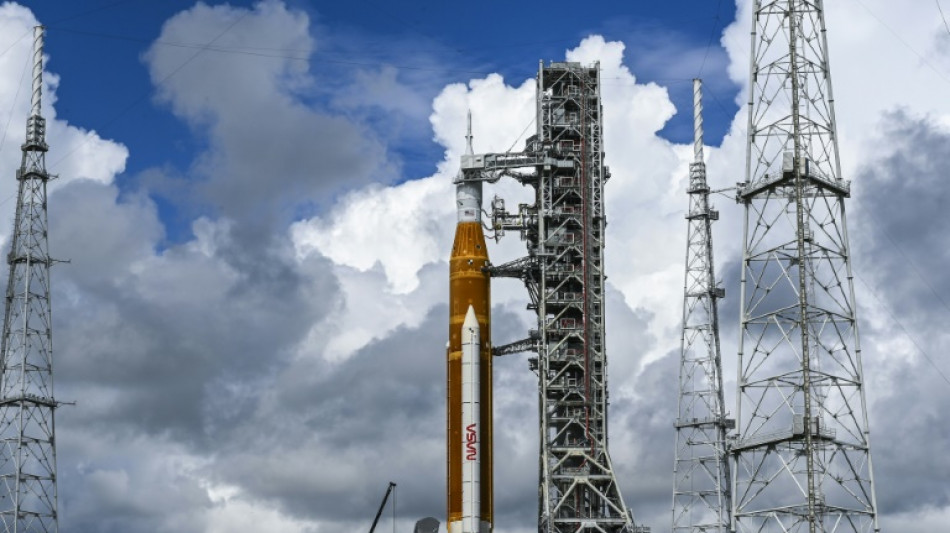
New launch attempt Saturday for NASA's Moon rocket / Photo: © AFP/File

 Houthis target Red Sea shipping as US hits Iran

 Record-equalling Red Sox streak halted at 15 wins

 Messi-less Miami beat Fire 3-2 to spoil Lewandowski's MLS debut

 Mercedes expect Hungary challenge from Hamilton and Ferrari

 In Ghana, one man's race to save critically endangered fish

 Wilson captain, Slipper absent in Kiss's first Wallabies squad

 New Mideast fighting puts eurozone rate-setters on alert

 Venezuelans search for animal companions lost in the quakes

 Argentine Football Association says US did not detain its president
 June heatwave cost UK economy more than £1bn: study

 Google-parent Alphabet beats expectations, cloud revenue nearly doubles

 US announces civilian nuclear deal with Saudi Arabia

 Tesla shares dip after profit misses expectations

 Red Sox tie club record with 15th straight MLB win

 US eyes offshore nuclear reactors

 The Sterling Announces Luxury Cocktail Lounge Concept and Investor Showcase in Orlando

 Inter Miami signs Brazil veteran Casemiro but MLS probes deal

 White House accuses China's Moonshot of stealing Anthropic AI

 Pogacar sweating on Yates's fitness ahead of Tour Queen stage

 Ukrainian soldiers and civilians welcome new army commander

 UK fintech Revolut valuation soars to $115 bn: source

 German FM, on Africa tour, eyes business ties amid US, China pressure

 Rubio says at ASEAN meeting he expects 'positive' US visit by China's Xi

 Philipsen wins Tour de France 17th stage

 DonnaPro Introduces AI-Trained Executive Assistants for European CEOs

NASA will make a second attempt to launch its powerful new Moon rocket on Saturday, after scrubbing a test flight earlier in the week, an official said.
The highly anticipated uncrewed mission -- dubbed Artemis 1 -- will bring the United States a step closer to returning astronauts to the Moon five decades after humans last walked on the lunar surface.
Blastoff had been planned for Monday morning but was canceled because a test to get one of the rocket's four RS-25 engines to the proper temperature range for launch was not successful.
Mike Sarafin, mission manager of Artemis 1, announced the date for the new launch attempt during a media briefing on Tuesday, and NASA later tweeted that the two-hour launch window on Saturday would begin at 2:17 pm (1817 GMT).
The goal of Artemis 1, named after the twin sister of Apollo, is to test the 322-foot (98-meter) Space Launch System rocket and Orion crew capsule that sits on top.
Mannequins equipped with sensors are standing in for astronauts on the mission and will record acceleration, vibration and radiation levels.
Tens of thousands of people -- including US Vice President Kamala Harris -- had gathered to watch the launch, 50 years after Apollo 17 astronauts last set foot on the Moon.
Ahead of the planned Monday launch, operations to fill the orange-and-white rocket with ultra-cold liquid hydrogen and oxygen were briefly delayed by a risk of lightning.
A potential leak was detected during the filling of the main stage with hydrogen, causing a pause. After tests, the flow resumed.
NASA engineers later detected the engine temperature problem and decided to scrub the launch.
- Orbiting the Moon -
The Orion capsule is to orbit the Moon to see if the vessel is safe for people in the near future. At some point, Artemis aims to put a woman and a person of color on the Moon for the first time.
During the 42-day trip, Orion will follow an elliptical course around the Moon, coming within 60 miles (100 kilometers) at its closest approach and 40,000 miles at its farthest -- the deepest into space by a craft designed to carry humans.
One of the main objectives is to test the capsule's heat shield, which at 16 feet in diameter is the largest ever built.
On its return to Earth's atmosphere, the heat shield will have to withstand speeds of 25,000 miles per hour and a temperature of 5,000 degrees Fahrenheit (2,760 degrees Celsius) -- roughly half as hot as the Sun.
NASA is expected to spend $93 billion between 2012 and 2025 on the Artemis program, which is already years behind schedule, at a cost of $4.1 billion per launch.
The next mission, Artemis 2, will take astronauts into orbit around the Moon without landing on its surface.
The crew of Artemis 3 is to land on the Moon in 2025 at the earliest.
And since humans have already visited the Moon, Artemis has its sights set on another lofty goal: a crewed mission to Mars.
The Artemis program aims to establish a lasting human presence on the Moon with an orbiting space station known as Gateway and a base on the surface.
Gateway would serve as a staging and refueling station for a voyage to the Red Planet that would take a minimum of several months.
F.Müller--BTB