World Bank warns developing countries to embrace AI or be left behind / Photo: © AFP

 Falcons hand 49ers first defeat of NFL season, Vikings remain unbeaten

 Lula, Bolsonaro in virtual tie halfway through Brazil vote count

 Antonelli looks to seal title 'in style' after US Grand Prix win

 Real Madrid century 'just a detail' for Mbappe after Clasico win

 Mbappe double helps Real Madrid stun Barca in La Liga Clasico

 Antonelli wins US Grand but title triumph has to wait another week

 Manchester United slump deepens as Liverpool climb with Brighton win
 Reus sends Bordeaux second in Top 14 with victory at La Rochelle

 Serbia's student movement ousts longtime leader in parliament poll

 Kuwait minister urges focus on investment quality and development impact

 Descendants of British slave-owning families support reparations campaign

 Aleksandar Vucic: Serbia's veteran ruler felled by student-led movement

 Obama attacks Trump record while campaigning in Ohio and Michigan

 Brazil voting extended in tight race between Lula, Bolsonaro

 'Marine has to win': Le Pen supporters fear for France's future

 QNB expands cross-border funding for AI and digital infrastructure

 France's Le Pen launches presidential bid vowing to restore 'rule of law'

 Qatar Charity delivers Braille Qurans to blind readers in Kosovo and Albania

 Houthis say attacked Riyadh airport hours after flights resume

 Monaco hold Lille as Rennes go top of Ligue 1

 Thousands gather in Prague to protest licence fee plans

 Pease spins to floor gold as US tops gymnastics medal table

 Marchant back in England training squad ahead of Nations Championship fixtures

 French skater Siao Him Fa soars to victory in season-opener at home

 Embattled Albanian PM vows fines for violent protesters

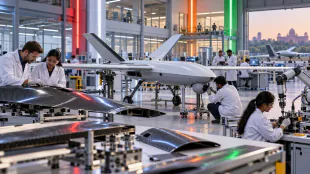
The World Bank on Tuesday called on developing countries to embrace artificial intelligence technology tools to deliver better governance outcomes, warning that they risked being left behind if they failed to do so.
"AI has thrown developing economies a lifeline, and they should seize it," Indermit Gill, chief economist of the World Bank Group, said as the organization launched its annual World Development Report.
"They do not need large models or big data centers to reap its benefits," he added, advocating for the adaptation of lower-cost AI tools to local conditions to deliver results in the health, education, justice and agricultural sectors.
Advanced AI models -- largely developed in the United States and China -- offer the ability to quickly analyze data and automate many tasks that otherwise take skilled humans longer to do.
These AI models, however, require huge data centers and large amounts of complex computing power, using massive amounts of electricity and water -- with implications for climate change.
"Developing economies today are in the midst of their weakest average growth performance in three decades," said a World Bank statement accompanying the report.
"AI could significantly boost that performance before the end of the 2020s while delivering tangible benefits to people."
The report calls for countries to use AI to "help extend otherwise costly medical, legal, educational, and agricultural services to underserved billions -- doing in a decade what might otherwise take a century."
- Shock after shock -
Lower-income countries have struggled through the 2020s, hit by a series of successive shocks that saw the World Bank earlier this year dub it a "lost decade" for their economic growth.
The Bank has lowered its 2026 global growth forecast to its lowest level since the pandemic, with the economic fallout of the Iran war battering countries around the world.
The shock has hit low-income and developing countries hardest, with Asia the worst-affected region.
The Bank's new report advocates for developing countries to start working with localized AI tools and solutions now, and to invest in electricity generation and distribution; expand access to computing power; and improve the availability of local data.
"The window to get this right is narrow," said Gaurav Nayyar, director of the report.
"AI presents a once-in-a-lifetime opportunity to solve problems that have resisted solutions for generations," he added.
For the 6.8 billion people -- 83 percent of humanity -- who live in low-income and developing countries, AI tools will need to be adapted to meet their needs.
The report shares examples of AI applications in governance, such as to increase diabetes screening volumes in Bangladesh, or in reducing costs for Indian farmers through advanced weather forecasts.
The solutions, the report stresses, will need to meet people where they are.
"For example, AI solutions will need to be delivered through voice calls on basic mobile phones for those who cannot read or afford smartphones," it says.
"Simply importing an AI model does not mean it will work well locally."
- Stark warning -
The report calls for policymakers to also build public trust as they expand AI use.
"Improved public services and better learning outcomes in schools will reinforce trust -- but if AI embeds bias in government decisions or erodes data privacy, that trust will be difficult to recover," said the statement.
The report delivers a stark warning, too: "AI could widen gaps between countries, increase inequality within them, concentrate market power, weaken trust in public institutions, and create new risks for safety, rights, and social cohesion."
And while risks to employment in developing countries are low at the moment, it warns that in the long run AI tools could cut off economic mobility by eliminating many of the middle-class jobs that enable it.
The report was written with the aid of several of the world's most advanced AI tools, including offerings from OpenAI, DeepSeek, Google and Anthropic, according to a disclosure.
S.Leonhard--VB