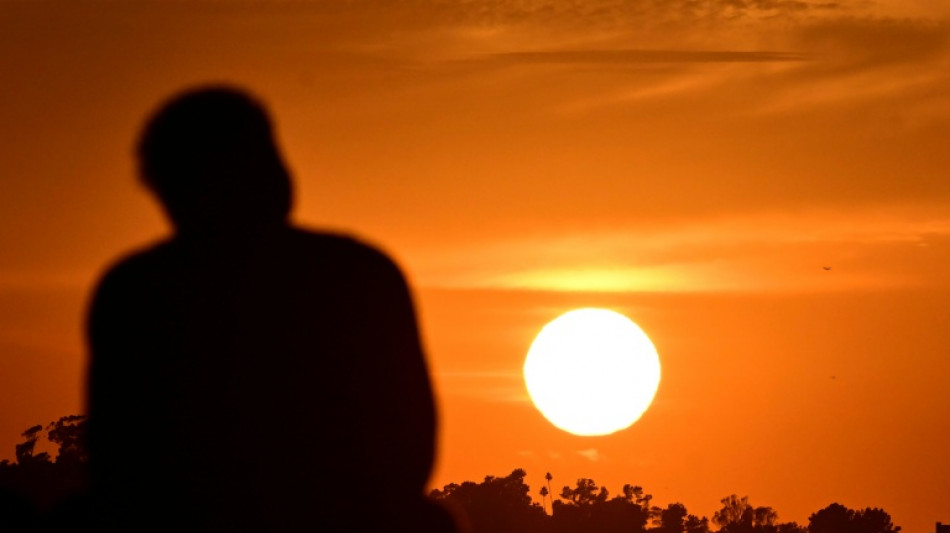
Dangerous 'heat stress' has surged worldwide, study shows / Photo: © AFP/File

 Colombian judge bans strikes on guerrillas if minors are present

 Khachanov shocks ailing Auger-Aliassime, Swiatek and Osaka advance at US Open

 Lone juror blocking verdict in US mother's child murder trial: defense

 'Kinda chic' - Williams sisters set to launch US Open doubles bid

 Volkswagen says cutting 100,000 jobs by end of decade

 Russia slaps curfew on charity director over army criticism

 Ailing Auger-Aliassime upset by Khachanov at US Open

 Richarlison omitted from Tottenham's Premier League squad

 How El Nino is choking the Panama Canal

 Hamilton drives his Ferrari dream at Monza

 Senegal has an IMF loan, now what?

 Auger-Aliassime upset by Khachanov at US Open

 Hugging Face, the French start-up that became AI's warehouse

 World Cup winner Llorente retires from Spain team at 31

 Osaka squeezes into US Open third round

 Apple faces £2 bn lawsuit in UK over app privacy feature

 Former champ Swiatek eases into US Open third round

 DR Congo latest to promise moving Israel embassy to Jerusalem

 War criminal Mladic's body returns to Serbia with military honours

 Pierre Cardin museum brings designer's futurist style to Venice

 Slovenian rookie Omrzel triumphs as Mas extends Vuelta lead

 British, French leaders talk migrants, EU relations

 Heading for Ferrari's home race, Leclerc still dreams of world title
 Cafe at centre of Israel culture clash agrees to shut on Sabbath

 Spacecraft bound for Mercury begins 'tricky' arrival

The number of people exposed to dangerous heat stress worldwide has risen sharply over the last half century propelled by climate change, according to a study released on Monday as Europe sweltered through a punishing heatwave.
Heat stress -- the name given to the hazardous build-up of body heat caused by soaring temperatures, humidity and other factors -- is one of the most common ways that weather kills people.
The new study, published in the journal Nature Climate Change, tracked how heat stress levels surged between the 1970s and 2024.
"On every continent, strong to extreme heat stress is now more frequent," lead study author Rebecca Emerton, of the European Centre for Medium-Range Weather Forecasts, told AFP.
In the 1970s, for example, 16 percent of the world's population experienced at least one day of extreme heat stress -- when the "feels-like" temperature was at least 46C.
Fifty years later, the rate has risen to 22 percent.
"That might not sound like so much," Emerton said.
"But that's an extra approximately one billion people that are seeing at least some extreme heat stress now that wouldn't have done in the 1970s," she added.
The study used the Universal Thermal Climate Index (UTCI), which represents the temperature it "feels like", by including factors such as humidity, wind, radiation and how the human body responds to heat.
The daily average UTCI has been rising as heat stress events become more frequent, severe and longer-lasting due to human-driven global warming, the research found.
Some countries, including Spain, Portugal, Italy and France, are now experiencing "feels-like" temperatures up to five degrees hotter than they did in the 1970s, Emerton said.
In France on Monday, two children died during the country's second exceptionally intense heatwave of the year.
Heat stress is also "expanding into areas of the globe where historically it's not been experienced", Emerton said.
For example, very strong heat stress with a "feels-like" temperature of at least 38C has now reached parts of North America, the UK and Scandinavia, she said.
The researchers also tracked the global rise of unrelentingly hot nights.
During nights when "you can't get any relief, and your body can't cool down, that becomes very dangerous for people's health, particularly for vulnerable people", Emerton said.
Most of the world has seen increases in the number of tropical nights, when the "feels-like" temperature does not get below 20C, the researchers found.
The study only looked at data up to 2024, however Emerton said the heatwaves already pummelling Europe this year suggest the trend has been continuing.
R.Braegger--VB