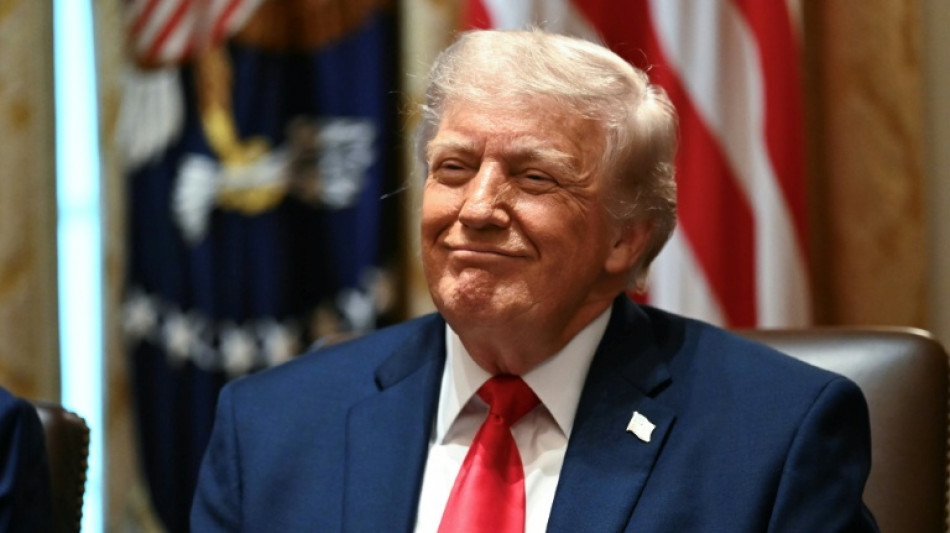
As Trump cheerleads for AI, some in MAGA world fret / Photo: © AFP

 Colombian judge bans strikes on guerrillas if minors are present

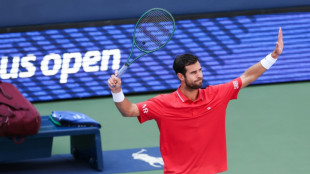
 Khachanov shocks ailing Auger-Aliassime, Swiatek and Osaka advance at US Open

 Lone juror blocking verdict in US mother's child murder trial: defense

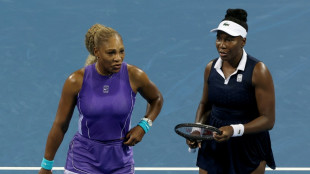 'Kinda chic' - Williams sisters set to launch US Open doubles bid

 Volkswagen says cutting 100,000 jobs by end of decade

 Russia slaps curfew on charity director over army criticism

 Ailing Auger-Aliassime upset by Khachanov at US Open
 Richarlison omitted from Tottenham's Premier League squad
 How El Nino is choking the Panama Canal

 Hamilton drives his Ferrari dream at Monza

 Senegal has an IMF loan, now what?

 Auger-Aliassime upset by Khachanov at US Open
 Hugging Face, the French start-up that became AI's warehouse

 World Cup winner Llorente retires from Spain team at 31

 Osaka squeezes into US Open third round
 Apple faces £2 bn lawsuit in UK over app privacy feature

 Former champ Swiatek eases into US Open third round

 DR Congo latest to promise moving Israel embassy to Jerusalem

 War criminal Mladic's body returns to Serbia with military honours

 Pierre Cardin museum brings designer's futurist style to Venice

 Slovenian rookie Omrzel triumphs as Mas extends Vuelta lead

 British, French leaders talk migrants, EU relations

 Heading for Ferrari's home race, Leclerc still dreams of world title

 Cafe at centre of Israel culture clash agrees to shut on Sabbath
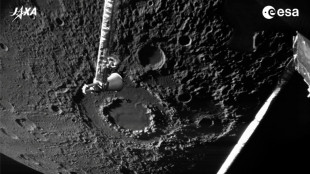 Spacecraft bound for Mercury begins 'tricky' arrival

President Donald Trump is an enthusiastic advocate for swift AI development in America, dismissing regulation as a curb on competing with China.
But some of Trump's supporters in the MAGA world are skeptical of the new technology threatening to upend society with the possibility of machines replacing humans in many walks of life.
Amy Kremer, president of a group named Humans First, says US conservatives need to wake up to what she called the danger posed by artificial intelligence.
She also argues that many lawmakers who sit back and do nothing to regulate the exploding AI sector are actually being paid off by its monied tech executives.
"There are more regulations on a ham sandwich that I can buy at a street corner in New York City or Washington, DC, than there is on AI," said Kremer, a long-standing supporter of Trump and his Make America Great Again movement.
Dozens of activists, most of them conservatives, reached out recently to Trump in a letter initiated by Humans First and published by the news outlet Axios.
"America did not become the greatest nation in the world by allowing unelected elites to experiment on the public without safeguards or accountability," the letter says.
The signatories included Kremer, who has supported Trump since his first White House win in 2016, and former Trump adviser Steve Bannon.
- A Trump about-face -
Bannon is one of the ideological gurus of the coalition that rose up around Trump as he went from flashy real estate mogul to norm-busting politician.
Bannon has called AI "the most dangerous technology in the history of mankind."
He and other signatories of the letter urged Trump to make a decree mandating that new AI models undergo government testing before they are released to the public.
In a last-minute turnabout on May 21, Trump dropped the planned signing of a watered-down executive order on powerful AI models. The text called for voluntary industry controls on AI.
Fingers pointed at the president's allies in Silicon Valley who oppose government oversight of the technology.
The 79-year-old billionaire has positioned himself as an advocate for rapid AI development.
He dismisses regulation as a constraint on US competitiveness with China, even as more and more Americans come out angrily against AI and the huge energy-consuming data centers needed to power it.
This revolt by people in both of American's main parties is reminiscent of people protesting against the construction of low-income housing projects in their neighborhoods, said UCLA political science professor Megan Mullin.
- Rural anger -
But what makes this new movement different, she says, is that these data centers are often going up in rural areas where people are very attached to their communities and already feel "ignored or neglected by regular politics."
In rural MAGA patches, the appearance of massive data centers which can gorge on water and electricity and create few new jobs "is activating that feeling of siege and resentment for folks who live in rural communities," said Mullin.
Ever since he entered politics, Trump has sought to capitalize on the anger and frustration of such people who feel left behind by leaders they see as haughty, far-away political elites.
In the last three presidential elections, Trump triumphed in 90 percent of all rural counties in America, according to the Economic Innovation Group, a think tank.
His share of the rural vote has grown from 59% in 2016 to 65% in 2020 and then 69% in 2024, according to Pew Research data.
But Trump's fervent support for AI so far has been enough to alienate his most enthusiastic backers.
- 'Simmering roots' -
Kremer still praises Trump, saying his leadership has been "absolutely amazing" and that "I know his heart and soul is with the American people."
Rather than blaming the president, she turned her anger toward tech companies and their lobbyists.
"They have built a moat around the White House," she said, and this keeps Trump insulated from people's worries about AI.
Mullin said she sees "some simmering roots of an AI backlash" but not a strong one yet, so it is hard to foresee how this anger will play out and affect the way people vote.
Alex Dray, a 23-year-old activist who is wary of AI, is convinced it will soon become a key issue for young voters who he said fret about the technology's effects on mental health, jobs and the cost of living.
Dray says his organization, called the Young People's Alliance, is bipartisan and signed the Axios letter to Trump.
"I think there's going to be a reckoning in the next couple months," he told AFP.
T.Ziegler--VB