Houston, we have a problem ... with the toilet / Photo: © NASA/AFP

 Andy Burnham set to take over as new British PM
 Survivors warn of loopholes in Hong Kong sexual offence reforms

 Ferry capsizes off Guyana, authorities still searching for 66

 Spain win World Cup after Messi's Argentina fall flat

 Spain deserved to win World Cup: Argentina's Scaloni

 Mbappe retains World Cup Golden Boot crown

 Messi denied dream farewell as abject Argentina lose World Cup final

 Mbappe wins World Cup Golden Boot

 Spain beat Argentina to win World Cup

 Trump basks in World Cup final spotlight

 Madonna, Shakira, Bieber and The Muppets light up World Cup half-time show

 Ukraine blames Russia for deadly strike on Turkish cargo ship

 New Zealander Fox birdies last hole for 'surreal' British Open win

 Italy's Mazzoli wins US PGA Dominican Republic title

 Evenepoel wins Tour stage, Vingegaard crashes out after night-time control

 New Zealander Fox wins British Open on final hole

 Three-team NBA trade sends Dort to Hawks, Risacher to Mavs: reports

 Left knee issues will keep Ohtani off the mound for now

 Floating igloo leaves France for polar exploration mission

 Young charges into British Open lead as Scheffler comes up short

 Olympic champ Evenepoel wins Tour de France 15th stage

 Kim leads British Open as Young charges into clubhouse lead
 Antonelli takes sixth win of the season with victory at Belgian Grand Prix

 Red and yellow sweep Madrid before World Cup final

 Russell out of Belgian GP after colliding with Hamilton on lap one

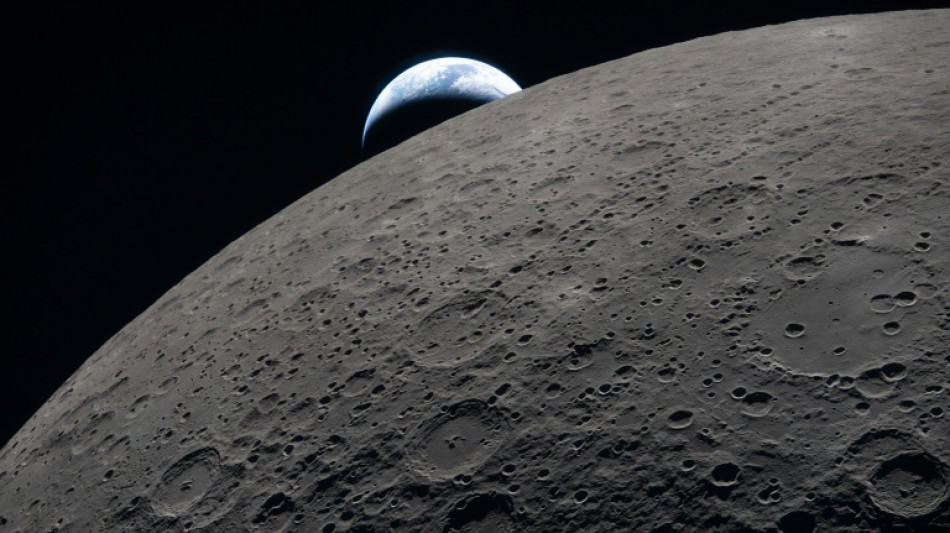
After a successful trip around the Moon, everything has been going smoothly on the Orion spacecraft’s journey back to Earth – except for the $23 million toilet, which has gotten clogged.
The system designed to flush wastewater into space is malfunctioning, and NASA believes that a chemical reaction in the urine treatment system is the culprit.
The fecal disposal system, in a separate conduit, is working properly.
Astronaut Christina Koch said the so-called Universal Waste Management System was giving off "a burning heater smell."
Rick Henfling, flight director for the Artemis II mission, stressed Tuesday that "the toilet remains operational. The challenge that we're working through is evacuating the wastewater tank," he said. "So we're having to fall back to some other alternate means."
Under Plan B, the four astronauts are using personal reusable containers called "collapsible contingency urine disposal devices."
The toilet problem was reported just hours after liftoff from Cape Canaveral, Florida. Koch adjusted the system's controls, restarted them with the help of mission control, and that appeared to resolve the issue.
"I'm proud to call myself a space plumber,” Koch said in her first briefing from the spacecraft, which is to splash down in the Pacific Ocean on Friday. She called the toilet “probably the most important piece of equipment on board."
However, the problem has persisted. The astronauts are unable to flush the wastewater into space.
The issue has been a constant topic of discussion at press conferences held at the Johnson Space Center in Houston, Texas.
This is the same center that in 1970 received astronaut Jack Swigert's message: "Houston, we've had a problem," after an oxygen tank explosion aborted Apollo 13’s Moon landing, starting a harrowing emergency that eventually brought those three astronauts back to Earth safely.
- Chemicals, not ice -
NASA initially thought the toilet problem might be due to freezing in the filters.
But Henfling said that the problem was not ice. The spacecraft has been rotated to face the sun to "bake off any ice" and heaters have been activated, "and we still see blockage," he said.
"The latest theory is related to some of the chemistry that goes into ensuring that the wastewater doesn't develop any biofilms," or microorganisms, he said. The chemical reaction may be generating some debris that's "getting clogged in a filter.”
The toilet on board Orion is similar to the one on the International Space Station, but this is the first time it has been used on a crewed deep-space mission.
The Apollo astronauts didn't have a toilet and used special bags for waste.
On the Orion spacecraft, which is five meters in diameter and a little over three meters high, the toilet is located beneath the floor – the only place on board where the astronauts can be alone.
The cramped toilet space is very noisy inside, so they must protect their ears. It has suction systems to compensate for microgravity.
Feces are placed in disposable bags that compact and will be brought back to Earth.
Lori Glaze, associate administrator of NASA's Exploration Systems Development Mission Directorate, said that "as soon as we get this down on the ground, we'll be able to get inside and we will get to the root" of the problem.
S.Leonhard--VB