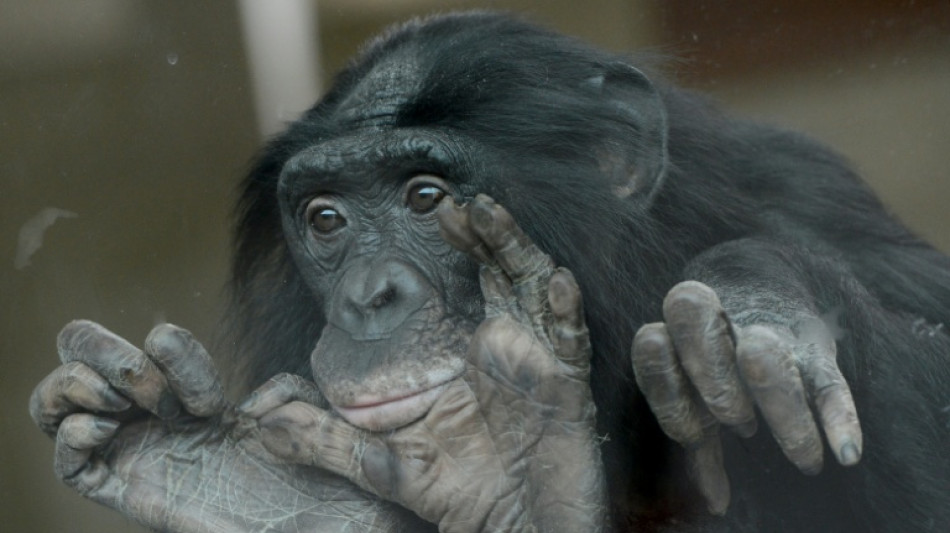
Despite reputation, bonobos are aggressive, particularly toward males: study / Photo: © DPA/AFP

 Argentina represented themselves in 'best possible way' at World Cup: Fernandez

 Philippines, China summon ambassadors over clash in disputed waters

 'White elephant': Colombia's anti-corruption activist turned senator

 Stock markets, oil prices climb

 South Africa's anti-migrant unrest sparks smalltown suspicion, fear

 Tour de France hit by new wave of anti-doping tests

 Afghans search for dozens missing after devastating flood

 Novartis says buoyed by new treatments in second quarter

 Great Barrier Reef at risk of 'collapse', scientists warn

 India's 'Cockroach' movement vows to protest until education minister resigns

 South Korea president urges regulator action on leveraged stock funds

 For Ukraine's drones, names are part of the battle

 Countries move to ban social media for children

 Asia stocks up as chip stocks recover, oil eases

 Desperate Rohingya risk deadly voyages as trafficking surges

 French lawmakers expected to approve social media ban for under-15s

 'All these rashes': chickenpox surges in Gaza camps

 Australia's Cummins, Hazlewood, Lyon back for Bangladesh Test series

 Rubio in Philippines as US condemns 'dangerous' China actions

 Unnatural physique turns Evenepoel into a Tour de France contender

 'Sit down!' Australian politician berates dog on live TV

 Argentina squad returns, without Messi, after World Cup final loss

 New strikes as Trump warns Iran will pay for US troop deaths

 Spain stars lap up adulation of estimated two million on World Cup parade

 Business of Dance Mentees and Enola Bedard Join Shakira for the FIFA World Cup Halftime Show

Historically considered a more peaceful species than their chimpanzee cousins, bonobos are actually just as aggressive -- but target their ire most often at males, according to a study published Wednesday.
Living in matriarchal societies, the gentle-eyed primates once dubbed "hippy apes" are far from violence-free, a group of European researchers reported in the journal Science Advances.
They studied 13 groups of bonobos and nine groups of chimpanzees -- who conversely live in patriarchal systems and are well known for their aggressivity -- in zoos, seeking to find out which is more prone to attacks.
Measuring different types of aggressive behavior, both physical and not -- such as throwing objects, intimidation, or biting and slapping -- they found "no overall differences in absolute aggression rates between the two species."
However, differences emerged "in how the aggression is distributed among group members," co-author Nicky Staes told AFP.
"In chimpanzees aggression mostly comes from males and is directed towards both males and females, whereas in bonobos aggression levels are quite equal in both sexes but are mostly directed at males," she said.
Emile Bryon, another co-author, said that, as bonobos live in female-dominant groups, the fact that both females and males direct most of their aggression toward males surprised researchers.
"Dominant individuals compete amongst each other for resources," he said, so "one could expect aggression among bonobo females. But our study says otherwise."
The relative lack of aggression among female bonobos could be explained by the species' well-studied use of sex to defuse conflicts, or the aggression may be "redirected towards males, who become buffers in the females' competitive dynamics," Bryon said.
- Aggressive ancestors? -
The authors noted limitations to their findings due to the apes living in captivity, where food is not as much of a source of tension, but highlighted the variability of aggressiveness in both species.
Some groups of bonobos and chimpanzees appeared particularly prone to violence and others more peaceful, which "suggests that limiting our understanding of a species to a handful of groups can prevent grasping the full species-wide diversity in behavioral expressions," said Bryon.
As our closest primate relatives, the behavior of chimpanzees and bonobos are of particular interest to science.
"There is big debate in evolutionary anthropology whether humans descended from a violent ape or a more cooperative, peaceful one," Staes explained.
The new study suggests that "aggression was likely present in the common ancestor of humans, chimpanzees, and bonobos."
They also show that aggression can vary widely among apes, said Bryon.
"Recognizing this variation and understanding its roots suggests that it can be better understood, managed, and even reduced."
J.Sauter--VB