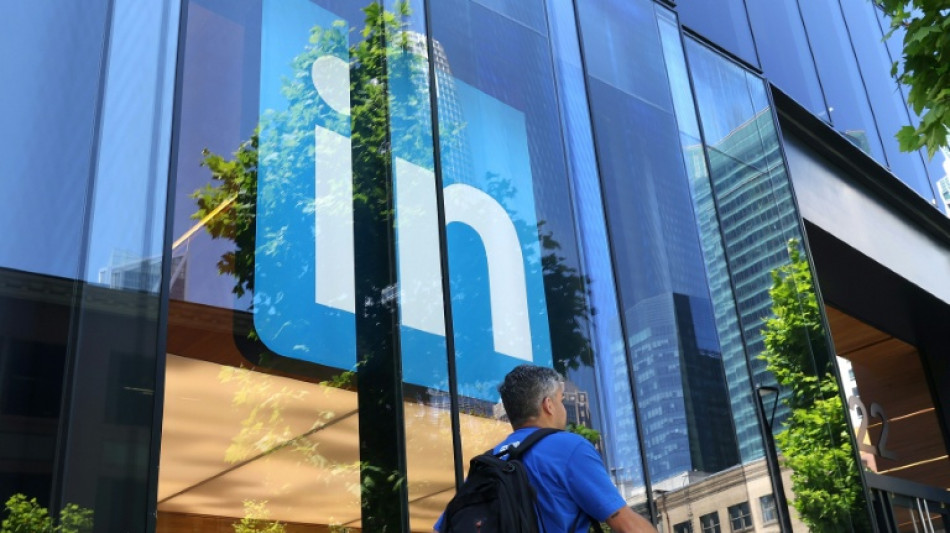
Women don fake mustaches in LinkedIn 'gender bias' fight / Photo: © GETTY IMAGES NORTH AMERICA/AFP/File

 Chelsea win as Bayern and Madrid draw in Women's Champions League
 Made with munitions from the Falklands War, a 'Chalice of Peace' for the pope
 Pioneering US labor leader Dolores Huerta dies at 96

 Italian PM slams 'shameful' release of alleged protest organiser

 Hollywood producer Kennedy to head LA28 Olympic ceremony plans

 Djokovic wins Basel opener to boost ATP Finals bid

 US Fed holds interest rates steady despite surging inflation
 Chiefs sign ex-Ravens kicker suspended over sex allegations

 Inglis and Carey put Australia in command of South Africa decider

 92-year-old US judge handling Maduro case dies
 Perez extends Cadillac deal to 2029
 Arab Israelis proud of high election turnout, uncertain for future

 Inglis, Carey put Australia in command of South Africa decider

 French firm Safran helps build aircraft wings of the future in UK factory

 Ceasefire in Russia-occupied Ukrainian city holds for second day

 Canada hikes rates to contain oil price surge caused by Iran war

 World Bank warns of worsening food insecurity as commodity prices soar
 Mona Lisa scrubbed from Syrian textbooks as critics slam conservative drift
 Bolsonaro flees Brazil for US after election defeat: AFP
 Brazil's Bolsonaros: between power, prison, and exile

 Israel president urges against new vote despite inconclusive result

 Eala recovers to move into Tokyo quarter-finals
 COPs 'bunch of baloney' says Panama as it vies to host nature summit

 Denmark mulls banning turbo chickens

 Nintendo producer 'all nervous' as Zelda classic remake hits shelves
Flipping their gender setting to "male" and even posting photos with fake mustaches, a growing number of women on LinkedIn have posed a provocative challenge to what they allege is an algorithmic bias on the platform.
Last month, female users began claiming that adopting a male identity had dramatically boosted their visibility on the professional networking site, setting off a chain reaction.
Women adopted male aliases -- Simone became Simon -- swapped their pronouns for he/him, and even deployed AI to rewrite old posts with testosterone-laden jargon to cultivate what they describe as an attention-grabbing alpha persona.
To add a dash of humor, some women uploaded profile photos of themselves sporting stick-on mustaches.
The result?
Many women said their reach and engagement on LinkedIn soared, with once-quiet comment sections suddenly buzzing with activity.
"I changed my pronouns and accidentally broke my own LinkedIn engagement records," wrote London-based entrepreneur and investor Jo Dalton, adding that the change boosted her reach by 244 percent.
"So here I am, in a stick-on moustache, purely in the interest of science to see if I can trick the algorithm into thinking I am a man."
- 'Gendered discrepancies' -
When a female AFP reporter changed her settings to male, LinkedIn's analytics data showed the reach of multiple posts spiked compared to a week earlier.
The posts cumulatively garnered thousands more impressions compared to the previous week.
Malin Frithiofsson, chief executive of the Sweden-based Daya Ventures, said the LinkedIn experiment reflected "gendered discrepancies" that professional women have felt for years.
"We're at a point where women are changing their LinkedIn gender to male, swapping their names and profile photos, even asking AI to rewrite their bios as 'if a man wrote them,'" Frithiofsson said.
"And their reach skyrockets."
LinkedIn rejected accusations of in-built sexism.
"Our algorithms do not use gender as a ranking signal, and changing gender on your profile does not affect how your content appears in search or feed," a LinkedIn spokesperson told AFP.
However, women who saw their engagement spike are now calling for greater transparency about how the algorithm -- largely opaque, like those of other platforms -- works to elevate some profiles and posts while downgrading others.
- 'More successful' -
"I don't believe there's a line of code in LinkedIn's tech stack that says 'if female < promote less,'" Frithiofsson wrote in a post on the site.
"Do I believe gendered bias can emerge through data inputs, reinforcement loops, and cultural norms around what a 'professional voice' sounds like? Yes. Absolutely."
LinkedIn's Sakshi Jain said in a blog post that the site's AI systems and algorithms consider "hundreds of signals" -- including a user's network or activity -- to determine the visibility of posts.
Rising volumes of content have also created more "competition" for attention, she added.
That explanation met with some skepticism on the networking site, where more visibility could mean enhanced career opportunities or income.
Rosie Taylor, a Britain-based journalist, said the boost her profile got "from being a 'man' for just one week" saw unique visitors to her newsletter jump by 161 percent compared to the previous week.
That led to an 86 percent spike in new weekly subscriptions via LinkedIn.
"Who knows how much more successful I might have been if the algorithm had thought I was a man from the start?" Taylor said.
burs-ac/msp/iv
E.Burkhard--VB