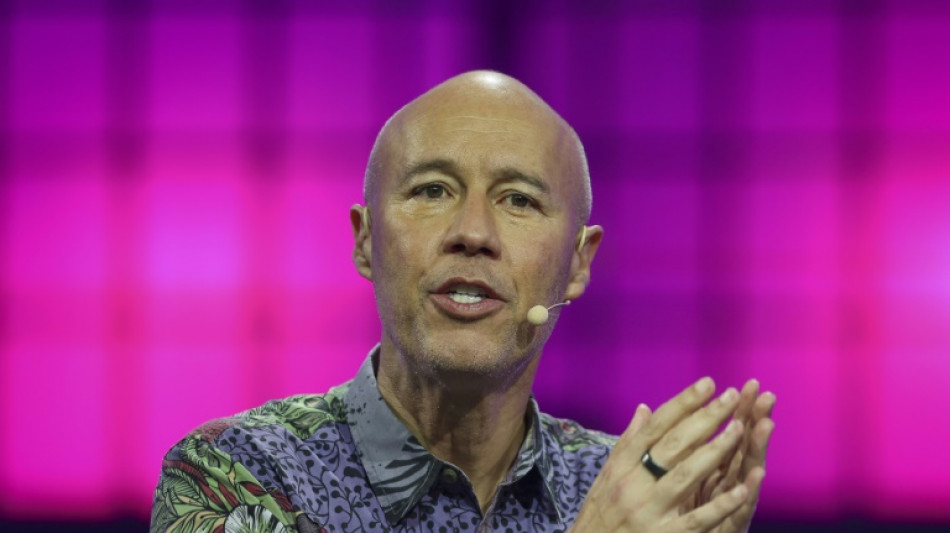
Big platforms chart gradual path to self-driving at Web Summit / Photo: © AFP

 Tesla shares fall as Musk touts ambitious -- and costly -- plans

 Houthis claim Red Sea tanker strikes as US hits Iran again

 Wildfires ravage parts of southern France, Italy and Spain
 Alphabet beats expectations in second quarter, cloud revenue nearly doubles
 Trump threatens Iran infrastructure, Tehran vows 'eye for eye'

 US teen withdraws lawsuit against Meta over social media addiction
 Lebanon PM says Beirut working for 'complete Israeli withdrawal'

 EU conditionally clears Paramount bid for Warner Bros.

 Philipsen snaps 'horrible' drought with Tour de France stage 17 victory
 US trial of Venezuela's Maduro set for June 2027

 New UK PM Burnham gets early boost as inflation dips

 Samsung launches new, more expensive foldable smartphones
 Philipsen ends 'horrible' drought with Tour de France 17th stage victory

 Hungary's Orban says graft case is 'pretext' to target his party
 South African tycoon Motsepe rules out presidential bid

 Trump threatens Iran bridges, power as payback for Hormuz attacks

 Germany's Merz replaces leader ousted over surrogacy row
 CAF chief Motsepe backs Infantino despite criticism

 Evacuees from Spain's wildfire struggle with scale of devastation

 Ancient Lebanese city of Tyre added to heritage danger list

 Extreme heatwave grips Tunisia as wide power cuts fuel frustration

 'Beautiful game' provides Venezuelans with welcome distraction in wake of tragedy
 Oil prices surge on Mideast war, stock markets diverge

 Fury says 'best yet to come' ahead of Thailand fight

 Japan suffers heat 'disaster as cities hit by 'cruelly hot' days

Major Western ride-hailing platforms like Uber and Lyft sketched a gradual path towards introducing self-driving cars at this week's Web Summit in Lisbon, with infrastructure, developing regulation and passengers' preference for human contact weighing on the brakes.
Building autonomous vehicles many times safer than human drivers is "almost largely solved", Uber's operations chief Andrew Macdonald told Web Summit attendees on Tuesday.
"Now what you have is a commercialisation question."
"In five years, if (autonomous driving) achieves even ten percent of our business, that would be enormously successful," Lyft chief David Risher told AFP in a Wednesday interview.
In today's terms, that would represent around $500 million of the just under $5 billion of gross bookings Lyft reported in its fourth quarter.
That was a fraction of the roughly $50 billion reported by Uber for the same period, albeit on a broader slate of activities including food delivery.
For now, Lyft -- which accounts for around 30 percent of the US market and recently bought leading European taxi-hailing app FreeNow -- is planning pilot schemes in individual cities.
It expects to partner from next year on a Nashville project with Californian startup Waymo -- which already offers self-driving rides in San Francisco -- and with Chinese tech giant Baidu in Germany and Britain.
Those two countries have been the fastest in Europe to launch official application schemes to run self-driving pilots, FreeNow boss Thomas Zimmermann told AFP.
Uber's Macdonald said Tuesday that Germany and the UK were also first in line for European pilots from the sector's juggernaut.
- Across US-China divide -
A thicket of partnerships has sprung up in autonomous driving, with Uber also working with Waymo in US cities Austin and Atlanta, and with China's WeRide in Gulf locations such as Abu Dhabi.
Lyft has joined forces with American developers like Tensor and May Mobility and US-Israeli firm Mobileye.
Where American and Chinese companies are competing fiercely in sectors like AI and semiconductors, collaborations are more common in autonomous vehicles.
Geopolitical tensions mean China's manufacturers are unlikely to push to conquer the American car market with their self-driving offerings for the time being, Risher said.
And in markets like Europe, where they may lack local contacts and knowledge, "Chinese companies have a view that they need a partnership with a company like ours to commercialise their technology," he added.
Familiarity with each market is vital, as beyond getting cars on the road "you need supportive regulatory frameworks... you need to figure out ownership and infrastructure models and that means financing, it means real estate, it means power, and you need a hell of a lot of power," Uber's Macdonald said.
"This is not something that you do sitting at a desk 10,000 miles away," Risher said.
Web Summit kicked off with a warning from organiser Paddy Cosgrave that "the era of Western tech dominance is fading".
But in self driving, technology levels are comparable enough that "I wouldn't say this is an area where the Chinese have a particular advantage," Risher said.
- Human touch -
Both the heavyweight platforms say that human drivers will be operating most of their rides for the foreseeable future.
"This is gonna be a delicate transition going from fully human labour to AI in the physical world in the form of autonomous vehicles," Macdonald said.
"Our network, I think, will help us feather in these vehicles and make that transition work".
For now, "there's just not enough autonomous vehicles in the world to satisfy all the demand," Risher said.
What's more, "there are plenty of times when people are going to want help with their luggage or a kind word at the end of the day" from a human driver.
R.Kloeti--VB