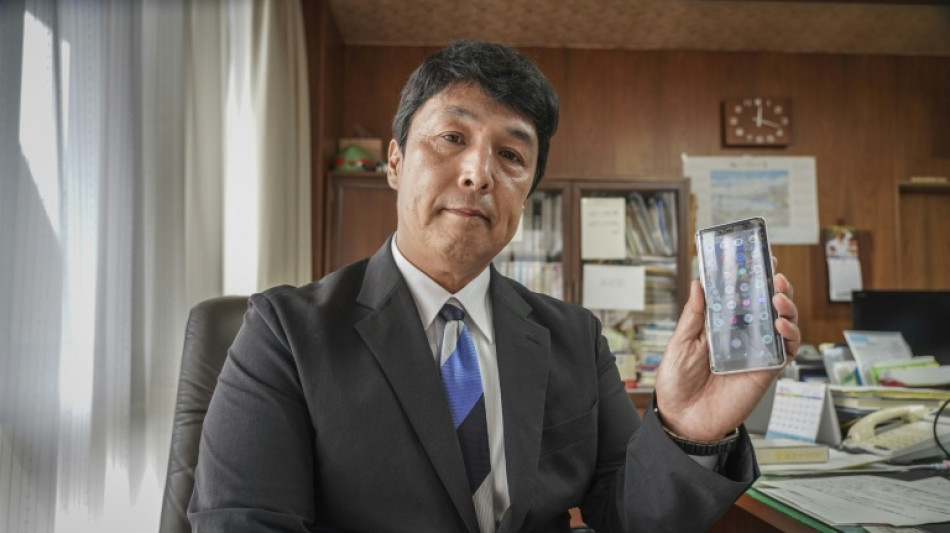
'Time runs away': Japan's city with a two-hour cap on phone use / Photo: © AFP

 Houthis target Red Sea shipping as US hits Iran

 Record-equalling Red Sox streak halted at 15 wins
 Messi-less Miami beat Fire 3-2 to spoil Lewandowski's MLS debut

 Mercedes expect Hungary challenge from Hamilton and Ferrari

 In Ghana, one man's race to save critically endangered fish

 Wilson captain, Slipper absent in Kiss's first Wallabies squad

 New Mideast fighting puts eurozone rate-setters on alert

 Venezuelans search for animal companions lost in the quakes

 Argentine Football Association says US did not detain its president

 June heatwave cost UK economy more than £1bn: study

 Google-parent Alphabet beats expectations, cloud revenue nearly doubles

 US announces civilian nuclear deal with Saudi Arabia

 Tesla shares dip after profit misses expectations

 Red Sox tie club record with 15th straight MLB win

 US eyes offshore nuclear reactors

 The Sterling Announces Luxury Cocktail Lounge Concept and Investor Showcase in Orlando

 Inter Miami signs Brazil veteran Casemiro but MLS probes deal

 White House accuses China's Moonshot of stealing Anthropic AI

 Pogacar sweating on Yates's fitness ahead of Tour Queen stage

 Ukrainian soldiers and civilians welcome new army commander

 UK fintech Revolut valuation soars to $115 bn: source

 German FM, on Africa tour, eyes business ties amid US, China pressure

 Rubio says at ASEAN meeting he expects 'positive' US visit by China's Xi

 Philipsen wins Tour de France 17th stage

 DonnaPro Introduces AI-Trained Executive Assistants for European CEOs

Police won't be rounding up people glued to phones in Japan's Toyoake, but the mayor believes his two-hour limit can help residents find a healthier relationship with their screens.
Masafumi Kouki told AFP he has worried for many months about the "negative effects of excessive smartphone use, especially the sharp decrease in direct human communication".
"Even on trains, everyone just stares at their phones, and no one talks anymore," he said.
"I don't believe this should be considered normal, so I wanted to create an opportunity for our residents to reflect on whether they might be overusing their smartphones."
A local ordinance on the appropriate use of phones, laptops and tablets came into force last week in Toyoake, a largely grey, concrete suburb of the industrial metropolis Nagoya.
There are no penalties for exceeding its recommended two-hour limit, which applies to adults and children alike and was approved by the city council in a 12-7 vote.
Instead, the aim is to encourage self-regulation.
"It's certainly a rare step -- we know that," said the 56-year-old Kouki, whose own phone screen has multiple cracks.
When the ordinance was first proposed, "opposition was almost universal".
But many citizens came round to the idea, he said, when they learned that the daily cap does not include work or study time and is meant as a guideline, not a strict rule.
- 'Overreach' -
Among Toyoake's population of nearly 68,000, not everyone is convinced.
"Nowadays... we do everything -- studying, hobbies, communication -- through a single smartphone," said 22-year-old law student Shutaro Kihara.
So the ordinance is "rather meaningless or ineffective" for young people, he said.
City lawmaker Mariko Fujie, 50, voted against Kouki's decree.
Excessive smartphone use is a social problem that needs addressing, she told AFP.
But "I feel a strong resistance to regulating people's personal free time through an ordinance", she said.
"It feels like an overreach."
Ikka Ito, a middle school student playing a video game near a local station, uses his phone for four to five hours a day.
"I've been voluntarily cutting back compared to before the ordinance was announced," without his parents telling him to, he said.
But there are downsides, too.
"If you reduce smartphone time, you can't stay in touch" with friends, Ito said.
One goal is to improve citizens' health by helping them get more sleep.
Toyoake's ordinance urges elementary school students to avoid smartphones after 9 pm, while junior high students and older are advised not to use them after 10 pm.
- Sleepy citizens -
Surveys have found that people in Japan get less sleep than those in other developed economies, often due to long working hours.
Toyoake resident Kokuka Hirano, 59, said she is "sleep-deprived" because of her phone.
"I want to research various things I don't understand, so I end up watching news from different countries," she said.
"Time runs away from me."
Hirano wants to limit her smartphone use to devote more time to exercise and cooking.
But "three or four hours would be more reasonable... two hours feels too strict".
Studies show that as well as smartphones interfering with sleep, which can affect mental health, heavy use of social media is linked with loneliness, depression and anxiety.
Global efforts to limit potential harm to children include an upcoming Australian ban on social media for under-16s.
Mayor Kouki has two children aged 10 and seven who don't own smartphones, although the 10-year-old borrows his wife's without permission.
Kouki said he likes using his phone to watch Japanese baseball highlights, but the family now shuns screens during mealtimes.
Yumi Watanabe, a 36-year-old mother-of-three in Toyoake, said most parents she knows let their children explore freely online, which is "scary".
Even so, the ordinance "wasn't really necessary", she said.
"It's something each person can judge for themselves as they go."
R.Fischer--VB