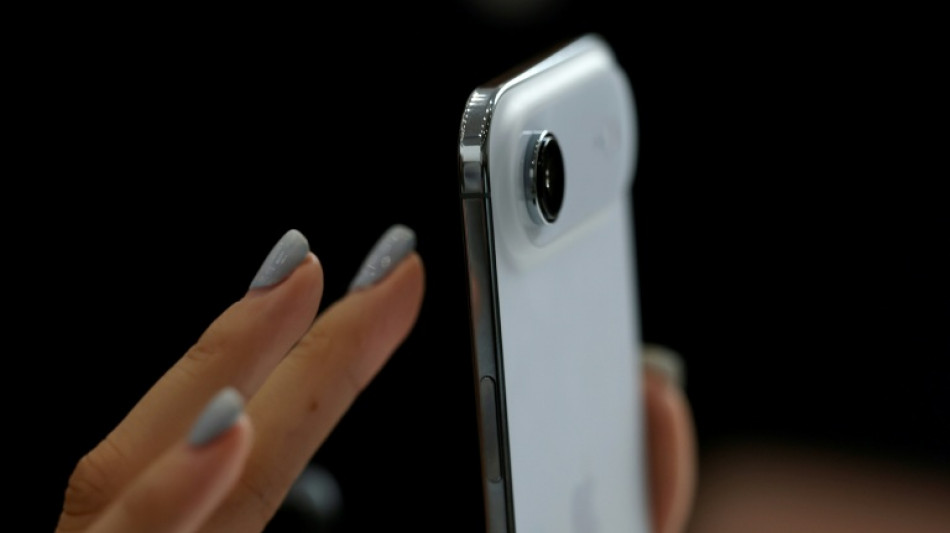
Germans turn to health apps as insurers foot the bill / Photo: © GETTY IMAGES NORTH AMERICA/AFP

 Modi vows punishment for exam fraud fuelling India protests

 Six candidates in race to lead UN set for televised debate

 Comic-Con kicks off with Marvel's return

 Dutch riders dreaming of crazy party corner of Alpe d'Huez

 Houthis target Red Sea shipping as US hits Iran

 Record-equalling Red Sox streak halted at 15 wins

 Messi-less Miami beat Fire 3-2 to spoil Lewandowski's MLS debut

 Mercedes expect Hungary challenge from Hamilton and Ferrari

 In Ghana, one man's race to save critically endangered fish

 Wilson captain, Slipper absent in Kiss's first Wallabies squad

 New Mideast fighting puts eurozone rate-setters on alert

 Venezuelans search for animal companions lost in the quakes

 Argentine Football Association says US did not detain its president

 June heatwave cost UK economy more than £1bn: study

 Google-parent Alphabet beats expectations, cloud revenue nearly doubles

 US announces civilian nuclear deal with Saudi Arabia

 Tesla shares dip after profit misses expectations

 Red Sox tie club record with 15th straight MLB win
 US eyes offshore nuclear reactors

 The Sterling Announces Luxury Cocktail Lounge Concept and Investor Showcase in Orlando

 Inter Miami signs Brazil veteran Casemiro but MLS probes deal

 White House accuses China's Moonshot of stealing Anthropic AI

 Pogacar sweating on Yates's fitness ahead of Tour Queen stage

 Ukrainian soldiers and civilians welcome new army commander

 UK fintech Revolut valuation soars to $115 bn: source

German doctors are increasingly prescribing smartphone health apps alongside pills and therapy to patients, marking a growing trend towards digital healthcare.
Civil servant Mona Noe, 30, has long kept close watch over her diet in order to reduce cramps and bloating caused by irritable bowel syndrome.
Noe managed to persuade her doctor to prescribe her the app Cara Care, where she receives wellness tips and keeps a food diary to identify her pain triggers.
"It is difficult to do it by yourself," she said, preparing a vegetable stir fry without peppers or tomatoes at her home in Schleiden in western Germany, as per the app's instructions.
"The app has transformed my cooking by helping me avoid certain foods."
Applications that help patients quit smoking, fight obesity or improve their mental health often cost hundreds of euros a month, but insurance companies are helping by footing the bill.
The programme Noe uses is one of 56 now covered by German health insurers, signalling the country's turn towards digital health over traditional pen and paper options.
- 'Around the clock' -
The digital health tools, known as "DiGA" in Germany, have been available on prescription since 2020, typically on three-month renewable subscriptions.
In the five years since the programme began, more than one million prescriptions have been written, according to a study by digital healthcare sector association SVDGV.
Nearly 60 percent of doctors in Germany have prescribed at least one DiGA, and the number of prescriptions written for them in 2024 was up by 85 percent from the previous year.
Johannes Patze, a doctor in Frankfurt, said he prescribes them "almost daily" -- particularly for mental health support while patients are on a waiting list for a therapy appointment.
The apps provide patients with personalised mood tracking, online consultations with professionals, meditation sessions and motivational notifications.
The benefit, Patze said, is that "they're available around the clock, 24/7".
But they come with a cost. A three-month health app subscription costs 600 euros ($705) on average.
Health insurers have paid out 234 million euros for subscription services since 2020.
- 'Easing the burden' -
Germany's Association of Statutory Health Insurance Funds has criticised "excessive" application pricing and warns that there is little hard evidence to back up how effective they are.
But Patze told AFP that the apps could prove a reliable way of lowering healthcare costs in years to come.
Germany spent 326.9 billion euros on healthcare in 2024 -- higher than in previous years and partly due to an ageing population.
"The costs are probably lower in the long run since patients are better taken care of," said Patze.
Digital health consultant Henrik Matthies agreed.
"It's an upfront cost," he said, "but it helps patients get back to work sooner, easing the burden on the healthcare system."
The success of health apps in Germany is partly down to a fast-track approval process that is unusual in a country often mocked for its tedious bureaucracy.
App developers can obtain provisional approval for a programme within three months of applying. They then have a year to demonstrate its clinical effectiveness.
This speedy process "was a catalyst" for the system, Matthies said. Of 228 applications made in the past five years, 43 have received full approval and 13 are still under review.
R.Flueckiger--VB