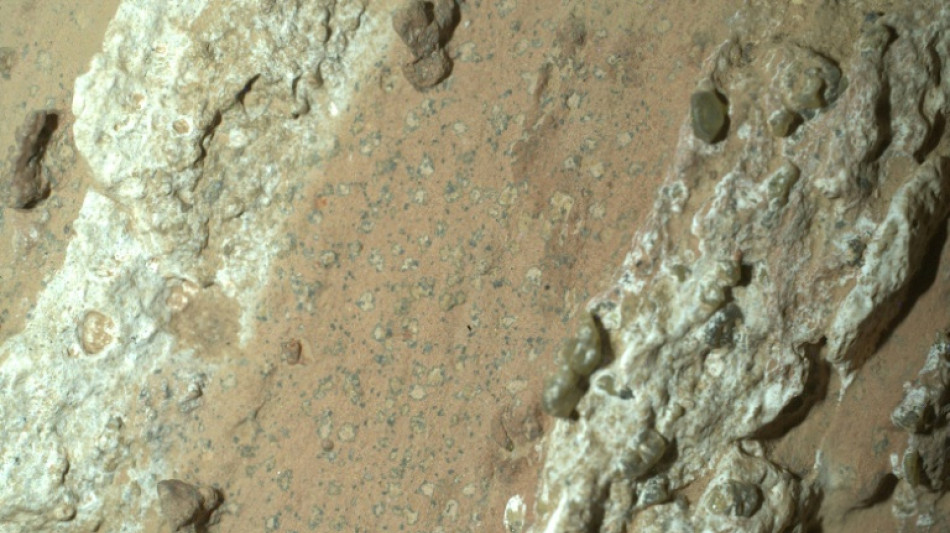
Martian rocks offer clues that might indicate ancient life / Photo: © NASA/JPL-Caltech/MSSS/AFP

 No penalty practice? No problem for Man City in shoot-out win

 Microsoft beats expectations fueled by Azure cloud business

 Chelsea win as Bayern draw with Madrid in Women's Champions League

 Kane watches as Bayern cruise into German Cup last 16

 Bayern boss Kompany out of hospital after meningeal irritation

 Shares in Google owner Alphabet sink on profit miss, ad slowdown

 Chelsea win as Bayern and Madrid draw in Women's Champions League

 Made with munitions from the Falklands War, a 'Chalice of Peace' for the pope

 Pioneering US labor leader Dolores Huerta dies at 96

 Italian PM slams 'shameful' release of alleged protest organiser

 Hollywood producer Kennedy to head LA28 Olympic ceremony plans

 Djokovic wins Basel opener to boost ATP Finals bid

 US Fed holds interest rates steady despite surging inflation

 Chiefs sign ex-Ravens kicker suspended over sex allegations

 Inglis and Carey put Australia in command of South Africa decider

 92-year-old US judge handling Maduro case dies

 Perez extends Cadillac deal to 2029

 Arab Israelis proud of high election turnout, uncertain for future

 Inglis, Carey put Australia in command of South Africa decider

 French firm Safran helps build aircraft wings of the future in UK factory

 Ceasefire in Russia-occupied Ukrainian city holds for second day

 Canada hikes rates to contain oil price surge caused by Iran war

 World Bank warns of worsening food insecurity as commodity prices soar

 Mona Lisa scrubbed from Syrian textbooks as critics slam conservative drift

 Bolsonaro flees Brazil for US after election defeat: AFP

Colorful, speckled rocks found on the surface of Mars have offered among the most encouraging evidence yet of ancient life on our neighboring planet, scientists at NASA announced Wednesday.
The Perseverance Mars rover collected the "Sapphire Canyon" rock samples in July 2024 from what's thought to be an ancient lakebed, and its poppyseed and leopard-esque spots pointed to potential chemical reactions that piqued the interest of researchers.
If the features resulted from microbial activity that created minerals in the way they do on Earth -- well, that might point to life on Mars.
It's far too soon for scientists to say that definitively, but the findings, which were detailed in research published in the journal Nature, are alluring, scientists said.
"It's kind of the equivalent of seeing like leftover fossils, you know, leftovers from a meal, and maybe that meal has been excreted by a microbe. And that's what we're seeing in this sample," Nicky Fox, administrator of NASA's Science Mission Directorate, told journalists.
When those kinds of mineral and textured features form in sediment on Earth, it's frequently the product of reactions from mud and organic matter, explained the study's lead author Joel Hurowitz -- a potential "biosignature," or sign of life.
Specifically, Perserverance's instruments identified the minerals vivianite and greigite. On Earth, vivianite is often found in sediments, peat bogs, and around decaying organic matter. Some forms of microbial life on Earth can produce greigite.
"But there are non-biological ways to make these features that we cannot completely rule out on the basis of the data that we collected," Hurowitz said.
Still, the findings are "exciting," he told journalists, explaining that researchers would need to analyze the sample in person to better understand if microbial activity had created the "fantastic textures" and colors including blue and green.
- Return to Earth -
That's no small feat, particularly in light of President Donald Trump administration's plans to cancel the Mars Sample Return program -- a robotic mission planned for the 2030s to bring Perseverance's samples back to Earth.
Asked by journalists if that was still the plan, acting director of NASA Sean Duffy was non-committal, hinting the samples might be brought back by a future crewed mission instead.
"We care about resources, we care about the timeframe, we believe there's a better way to do this, a faster way to get these samples back. And so that is the analysis that we've gone through. Can we do it faster? Can we do it cheaper? And we think we can," he said.
"We're going to actually figure out a different way to bring it back again, and we think we can do it faster and more cost effectively."
There are several rovers ambling across Mars -- Perseverance has been there since 2021 -- seeking signs of life that could have existed millions to billions of years ago, when the planet was thought to have been more habitable.
Evidence that ancient rivers and lakes carved into the planet's surface would indicate that water once flowed there.
And the latest discovery, said Fox, brought researchers "one step closer" to answering the burning question: "Are we truly alone in the universe?"
G.Haefliger--VB