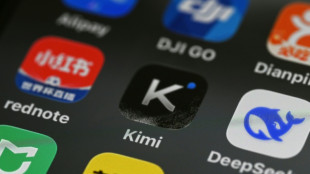
Anxious parents face tough choices on AI / Photo: © AFP

 Repsol says profit more than triples on higher oil prices

 TotalEnergies says profit doubled on Mideast war

 Giant swing on Swiss peak aims to boost summer tourism as Alps warm

 ASEAN to call for open straits as US-Iran war casts shadow

 AI catches up with humans to score 100% at top maths contest

 South Korea election office raided in fake turnout figures probe: investigators

 Killer whales: orcas blow fish to bits 'for fun', study finds

 Deadly wildfires force thousands from homes in parts of Europe

 Tech bounce lifts Asia stocks, oil extends gains on US-Iran fears

 Surrounded by militias, Sudanese fear endless cycle of war

 Commonwealth Games 'where champions are made' despite slimmed down model, argues president

 Trump family project in Albania has already caused 'irreparable' damage: NGOs

 Bollywood blast master keeps it real with fire and fury

 Tearful fights, edible offerings: A glimpse into the Maradona trial

 What's the deal with peptides? The hyped market under US review

 Tesla shares fall as Musk touts ambitious -- and costly -- plans

 Houthis claim Red Sea tanker strikes as US hits Iran again
 Wildfires ravage parts of southern France, Italy and Spain
 Alphabet beats expectations in second quarter, cloud revenue nearly doubles

 Trump threatens Iran infrastructure, Tehran vows 'eye for eye'

 US teen withdraws lawsuit against Meta over social media addiction

 Lebanon PM says Beirut working for 'complete Israeli withdrawal'

 EU conditionally clears Paramount bid for Warner Bros.

 Philipsen snaps 'horrible' drought with Tour de France stage 17 victory
 US trial of Venezuela's Maduro set for June 2027

When it comes to AI, many parents navigate between fear of the unknown and fear of their children missing out.
"It's really hard to predict anything over five years," said Adam Tal, an Israeli marketing executive and father of two boys aged seven and nine, when describing the post-generative AI world.
Tal is "very worried" about the future this technology holds for his children -- whether it's deepfakes, "the inability to distinguish between reality and AI," or "the thousands of possible new threats that I wasn't trained to detect."
Mike Brooks, a psychologist from Austin, Texas, who specializes in parenting and technology, worries that parents are keeping their heads in the sand, refusing to grapple with AI.
"They're already overwhelmed with parenting demands," he observed -- from online pornography and TikTok to video games and "just trying to get them out of their rooms and into the real world."
For Marc Watkins, a professor at the University of Mississippi who focuses on AI in teaching, "we've already gone too far" to shield children from AI past a certain age.
Yet some parents are still trying to remain gatekeepers to the technology.
"In my circle of friends and family, I'm the only one exploring AI with my child," remarked Melissa Franklin, mother of a 7-year-old boy and law student in Kentucky.
"I don't understand the technology behind AI," she said, "but I know it's inevitable, and I'd rather give my son a head start than leave him overwhelmed."
- 'Benefits and risks' -
The path is all the more difficult for parents given the lack of scientific research on AI's effects on users.
Several parents cite a study published in June by MIT, showing that brain activity and memory were more stimulated in individuals not using generative AI than in those who had access to it.
"I'm afraid it will become a shortcut," explained a father of three who preferred to remain anonymous. "After this MIT study, I want them to use it only to deepen their knowledge."
This caution shapes many parents' approaches. Tal prefers to wait before letting his sons use AI tools. Melissa Franklin only allows her son to use AI with her supervision to find information "we can't find in a book, through Google, or on YouTube."
For her, children must be encouraged to "think for themselves," with or without AI.
But one father -- a computer engineer with a 15-year-old -- doesn't believe kids will learn AI skills from their parents anyway.
"That would be like claiming that kids learn how to use TikTok from their parents," he said. It's usually "the other way around."
Watkins, himself a father, says he is "very concerned" about the new forms that generative AI is taking, but considers it necessary to read about the subject and "have in-depth conversations about it with our children."
"They're going to use artificial intelligence," he said, "so I want them to know the potential benefits and risks."
The CEO of AI chip giant Nvidia, Jensen Huang, often speaks of AI as "the greatest equalization force that we have ever known," democratizing learning and knowledge.
But Watkins fears a different reality: "Parents will view this as a technology that will be used if you can afford it, to get your kid ahead of everyone else."
The computer scientist father readily acknowledged this disparity, saying "My son has an advantage because he has two parents with PhDs in computer science, but that's 90 percent due to the fact that we are more affluent than average" -- not their AI knowledge.
"That does have some pretty big implications," Watkins said.
B.Baumann--VB