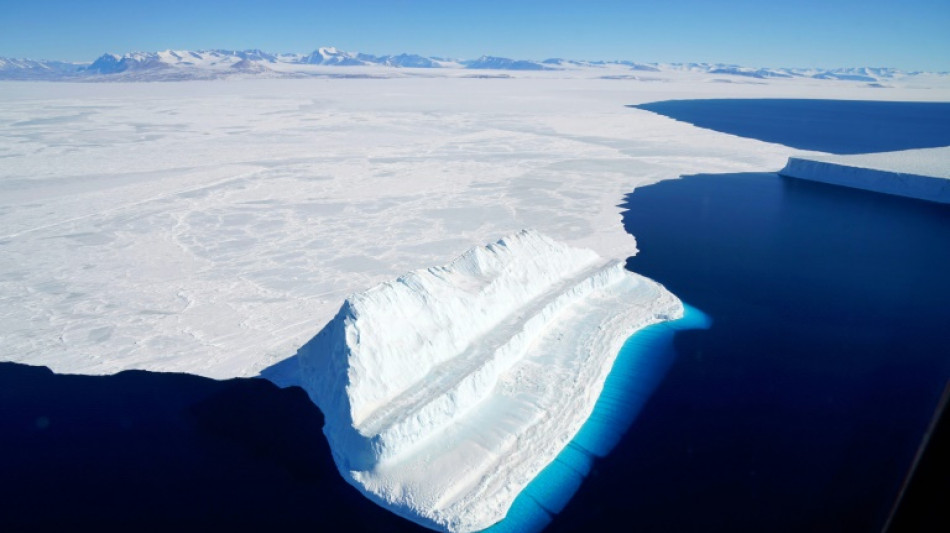
How did life survive 'Snowball Earth'? In ponds, study suggests / Photo: © NASA/AFP/File

 EU fines Google 890 mn euros, risking US fury

 France evacuates thousands of tourists as fire rages in pine forest

 French Jewish DJ sues after activists disrupt stage show: lawyer

 Nokia says AI, cloud boosted sales in second quarter

 Repsol says profit more than triples on higher oil prices

 TotalEnergies says profit doubled on Mideast war

 Giant swing on Swiss peak aims to boost summer tourism as Alps warm

 ASEAN to call for open straits as US-Iran war casts shadow

 AI catches up with humans to score 100% at top maths contest

 South Korea election office raided in fake turnout figures probe: investigators

 Killer whales: orcas blow fish to bits 'for fun', study finds

 Deadly wildfires force thousands from homes in parts of Europe

 Tech bounce lifts Asia stocks, oil extends gains on US-Iran fears

 Surrounded by militias, Sudanese fear endless cycle of war

 Commonwealth Games 'where champions are made' despite slimmed down model, argues president

 Trump family project in Albania has already caused 'irreparable' damage: NGOs

 Bollywood blast master keeps it real with fire and fury

 Tearful fights, edible offerings: A glimpse into the Maradona trial

 What's the deal with peptides? The hyped market under US review

 Tesla shares fall as Musk touts ambitious -- and costly -- plans

 Houthis claim Red Sea tanker strikes as US hits Iran again

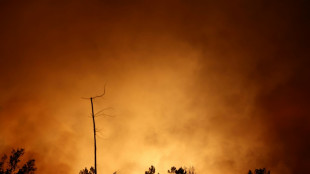 Wildfires ravage parts of southern France, Italy and Spain

 Alphabet beats expectations in second quarter, cloud revenue nearly doubles

 Trump threatens Iran infrastructure, Tehran vows 'eye for eye'

 US teen withdraws lawsuit against Meta over social media addiction

Earth has not always been so hospitable to live. During several ice ages, the planet's surface was almost completely frozen over, creating what has been dubbed "Snowball Earth".
Liquid water appears to be the most important ingredient for life on any planet, raising the question: how did anything survive such frosty, brutal times?
A group of scientists said Thursday that they had found an astonishing diversity of micro-organisms in tiny pools of melted ice in Antarctica, suggesting that life could have ridden out Snowball Earth in similar ponds.
During the Cryogenian Period between 635 and 720 million years ago, the average global temperature did not rise above -50 degrees Celsius (-58 Fahrenheit). The climate near the equator at the time resembled modern-day Antarctica.
Yet even in such extreme conditions, life found a way to keep evolving.
Fatima Husain, the lead author of a new study published in Nature Communications, told AFP there was evidence of complex life forms "before and after the Cryogenian in the fossil record".
"There are multiple hypotheses regarding possible places life may have persisted," said Husain, a graduate student at the Massachusetts Institute of Technology.
Perhaps it found shelter in patches of open ocean, or in deep-sea hydrothermal vents, or under vast sheets of ice.
The tiny melted ice pools that dotted the equator were another proposed refuge.
These ponds could have been oases for eukaryotes, complex organisms that eventually evolved into multicellular life forms that would rise to dominate Earth, including humans.
- Could aliens be hiding in ponds? -
Melted ice ponds still exist today in Antarctica, at the edges of ice sheets.
In 2018, members of a New Zealand research team visited the McMurdo ice shelf in east Antarctica, home to several such pools, which are only a few metres wide and less a metre deep.
The bottom of the ponds are lined with a mat of microbes that have accumulated over the years to form slimy layers.
"These mats can be a few centimetres thick, colourful, and they can be very clearly layered," Husain said.
They are made up of single-celled organisms called cyanobacteria that are known to be able to survive extreme conditions.
But the researchers also found signs indicating there were eukaryotes such as algae or microscopic animals.
This suggests there was surprising diversity in the ponds, which appears to have been influenced by the amount of salt each contained.
"No two ponds were alike," Husain said. "We found diverse assemblages of eukaryotes from all the major groups in all the ponds studied."
"They demonstrate that these unique environments are capable of sheltering diverse assemblages of life, even in close proximity," she added.
This could have implications in the search for extraterrestrial life.
"Studies of life within these special environments on Earth can help inform our understanding of potential habitable environments on icy worlds, including icy moons in our Solar System," Husain said.
Saturn's moon Enceladus and Jupiter's Europa are covered in ice, but scientists increasingly suspect they could be home to simple forms of life, and several space missions have been launched to find out more about them.
H.Gerber--VB