Echoes of WWI in Ukraine war's artillery duels and trenches / Photo: © AFP/File

 India's 'Cockroach' movement vows to protest until education minister resigns
 South Korea president urges regulator action on leveraged stock funds
 For Ukraine's drones, names are part of the battle
 Countries move to ban social media for children
 Asia stocks up as chip stocks recover, oil eases
 Desperate Rohingya risk deadly voyages as trafficking surges

 French lawmakers expected to approve social media ban for under-15s
 'All these rashes': chickenpox surges in Gaza camps

 Australia's Cummins, Hazlewood, Lyon back for Bangladesh Test series
 Rubio in Philippines as US condemns 'dangerous' China actions
 Unnatural physique turns Evenepoel into a Tour de France contender
 'Sit down!' Australian politician berates dog on live TV
 Argentina squad returns, without Messi, after World Cup final loss
 New strikes as Trump warns Iran will pay for US troop deaths
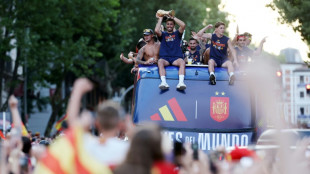 Spain stars lap up adulation of estimated two million on World Cup parade

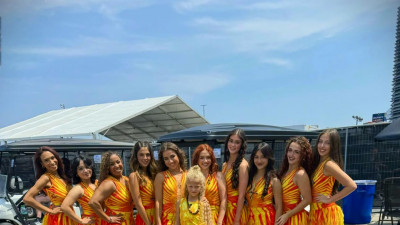 Business of Dance Mentees and Enola Bedard Join Shakira for the FIFA World Cup Halftime Show
 "The pain is immense," says Messi of World Cup defeat
 US judge suspends Paramount's acquisition of Warner Bros.
 Chess legend Judit Polgar rejects becoming Hungary's president
 Ceferin skipped World Cup final reportedly to show disapproval of FIFA
 Judge approved night-time Tour de France doping tests
 Chile declares state of emergency over deadly rainfall
 Kevin Keegan: The 'Mighty Mouse' who conquered Europe
 'Not another one': UK voters fatigued by seventh PM in a decade
 DeChambeau threatened to call Trump over British Open penalty: reports
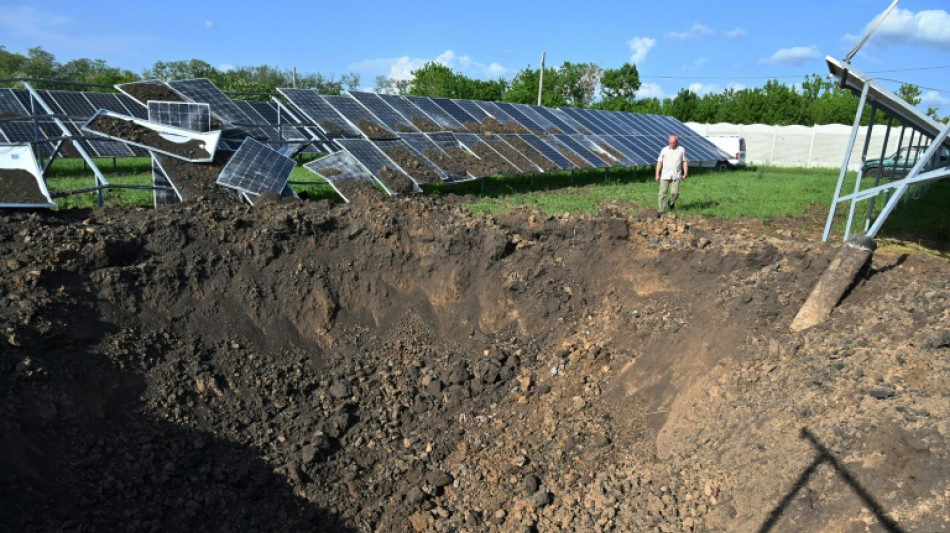
Looking at the shell-blasted, trench-marked landscapes of the front lines in Russia's invasion of Ukraine from above, it's easy to see why experts and leaders have drawn parallels with World War I.
Satellite images like those from US firm Maxar portray "war landscapes comparable to those visible during the First World War, totally destroyed villages all along the front line," said Nicolas Beaupre, a board member at a French association for research into the 1914-18 conflict.
Pictures taken last week showed fields strewn with vast craters near the town of Sloviansk and evidence of shell blasts along the Siverskyi Donets river.
But beyond the visual similarities, the hopes and fears stoked internationally by the conflict and its difference from recent fighting elsewhere bear comparison with the "Great War" -- even if the thousands of casualties in Ukraine over four months fall far short of the thousands per day seen over 100 years ago.
In 2022, many thought the fighting would be over in days or weeks as Russian forces advancing from Belarus threatened the capital Kiev -- recalling the WWI mantra that things would be "over by Christmas".
A quick war would have been in line with recent battles around the Russian periphery, including Moscow's 2008 attack on Georgia, its 2014 occupation of Crimea or the Armenian-Azerbaijani conflict of 2020 over the Nagorno-Karabakh region.
But determined defence by the Ukrainians pushed back repeated assaults, forcing the attackers to reorient towards the present grinding war of attrition in the eastern Donbas region.
Those early days of the war generated their own heroic tales, like the defiant soldiers of Snake Island radioing expletives to a Russian warship demanding their surrender, or the legendary fighter pilot dubbed the "Ghost of Kyiv".
In filling a need for a popular story to boost morale, these are not unlike the fleet of commandeered Paris taxis who supposedly helped save the capital by ferrying soldiers to the 1914 Battle of the Marne.
Evoking another French national memory, Ukrainian President Volodymyr Zelensky has compared the scene in his country's east with "the ruins of Verdun", the bitter 1916 defence against a German offensive that became a symbol for the entire war.
- Fear of escalation -
Meanwhile, a top preoccupation of leaders in Western capitals like Berlin has been avoiding an escalation that would lead to open conflict between Russia and NATO.
Some German politicians have even cited by name Christopher Clark's book "The Sleepwalkers" on the causes of the First World War, fearing a rerun of the spiral of military move and counter-move resulting from the killing of Austrian Archduke Franz Ferdinand in June 1914.
Russian President Vladimir Putin has put a modern twist on the escalation scenario with his early, public order to place Russian nuclear forces on high alert -- raising the spectre of the ultimate tit-for-tat with the West.
Citing reports about unease over the war among Putin's entourage, Australian historian Clark told German broadcaster Deutsche Welle in May that "there's a lot to suggest that the system would be robust enough to avoid such a risk" -- unlike after the 1914 Sarajevo assassination.
The Ukraine war is also seeing the use on European soil, and at large scale, of battlefield weapons that have mostly been used in deployments far overseas.
NATO-made kit including drones and precision artillery systems are being used alongside large formations of tanks and infantry.
Back in WWI, many of the weapons suddenly mowing down European young men in their thousands had only previously been used in anger in colonial settings against technologically outmatched opponents.
Russia has also reached into the past for artillery shells that fling out metal darts known as flechettes, widely used in World War I and rarely since, Britain's Guardian newspaper reported in April.
More broadly, "it's obvious that the Ukraine conflict is on a large scale, with relatively fixed front lines that move slowly and where advances are mostly achieved through artillery duels," said Olivier Kempf of the French Foundation for Strategic Research (FRS) think tank.
- Eternal trenches -
Still, there are huge differences between the two conflicts.
"People see a lot of trenches and tend to make the parallel with World War I, even though trenches are a fortification system seen in many other conflicts" like Nagorno-Karabakh, said war historian Camille Harle Vargas.
"When there's shrapnel flying in all directions, it's best to get your head down, and the best way to do that is to be at ground level," said defence expert Joseph Henrotin.
Modern artillery has also come a long way in the last century, offering much longer ranges and higher precision -- sometimes thanks to drones, which are far more effective than the early spotter planes used in 1914-18.
And with roughly 200,000 men on each side, the conflict remains far smaller.
Ukrainian forces are using up to 6,000 shells a day, according to deputy intelligence chief Vadym Skibitsky, where around 1.5 billion -- or one million per day -- were fired in WWI.
F.Pavlenko--BTB