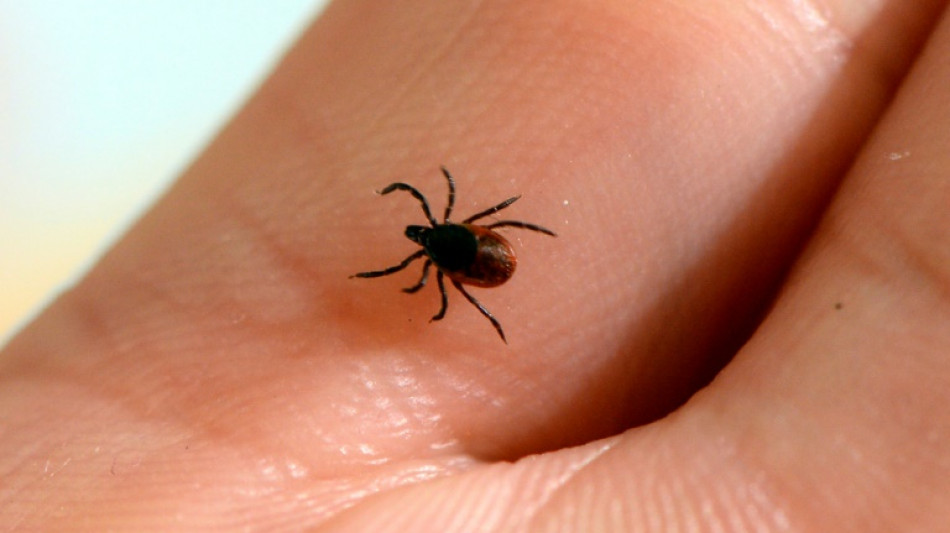
Over 14% of world has had Lyme disease: study / Photo: © AFP/File

 India's 'Cockroach' movement vows to protest until education minister resigns

 South Korea president urges regulator action on leveraged stock funds

 For Ukraine's drones, names are part of the battle

 Countries move to ban social media for children

 Asia stocks up as chip stocks recover, oil eases
 Desperate Rohingya risk deadly voyages as trafficking surges

 French lawmakers expected to approve social media ban for under-15s

 'All these rashes': chickenpox surges in Gaza camps

 Australia's Cummins, Hazlewood, Lyon back for Bangladesh Test series

 Rubio in Philippines as US condemns 'dangerous' China actions

 Unnatural physique turns Evenepoel into a Tour de France contender

 'Sit down!' Australian politician berates dog on live TV

 Argentina squad returns, without Messi, after World Cup final loss

 New strikes as Trump warns Iran will pay for US troop deaths

 Spain stars lap up adulation of estimated two million on World Cup parade

 Business of Dance Mentees and Enola Bedard Join Shakira for the FIFA World Cup Halftime Show

 "The pain is immense," says Messi of World Cup defeat

 US judge suspends Paramount's acquisition of Warner Bros.

 Chess legend Judit Polgar rejects becoming Hungary's president

 Ceferin skipped World Cup final reportedly to show disapproval of FIFA

 Judge approved night-time Tour de France doping tests

 Chile declares state of emergency over deadly rainfall

 Kevin Keegan: The 'Mighty Mouse' who conquered Europe

 'Not another one': UK voters fatigued by seventh PM in a decade

 DeChambeau threatened to call Trump over British Open penalty: reports

More than 14 percent of the world's population has had Lyme disease, the most common tick-borne illness, according to a major review of the available research published on Tuesday.
Central Europe had the highest rate of infection with 20 percent, while men over the age of 50 living in rural areas were most at risk, the study in the journal BMJ Global Health found.
The condition is rarely fatal, but people bitten by an infected tick often get a rash and suffer flu-like symptoms including muscle and joint ache, headache, nausea and vomiting.
To find out how common Lyme disease is across the world, the researchers pooled data from 89 studies.
The bacteria Borrelia burgdorferi (Bb), which causes the disease, was found in the blood of 14.5 percent of the nearly 160,000 total participants.
"This is the most comprehensive and up-to-date systematic review of the worldwide" prevalence of the disease, the researchers said.
After Central Europe, the regions with the highest antibody rates were Eastern Asia with 15.9 percent, Western Europe with 13.5 percent and Eastern Europe with 10.4 percent.
The Caribbean meanwhile had the lowest rate, with just two percent.
Previous research has shown that the prevalence of tick-borne diseases has doubled in the last 12 years.
Reasons for the rise included longer, drier summers due to climate change, animal migration, habitat loss and "increasingly frequent pet contact", the study said.
Farmers and workers who regularly interact with host animals like dogs and sheep were most at risk of getting bitten by an infected tick, the study found.
It warned that the data could be skewed in regions where Lyme disease is endemic, because health workers are more likely to carry out regular antibody tests there compared to regions where it is less common.
The study also said that research using an analytic technique called western blotting was more reliable and that its use "could significantly improve the accuracy" of future studies.
Y.Bouchard--BTB