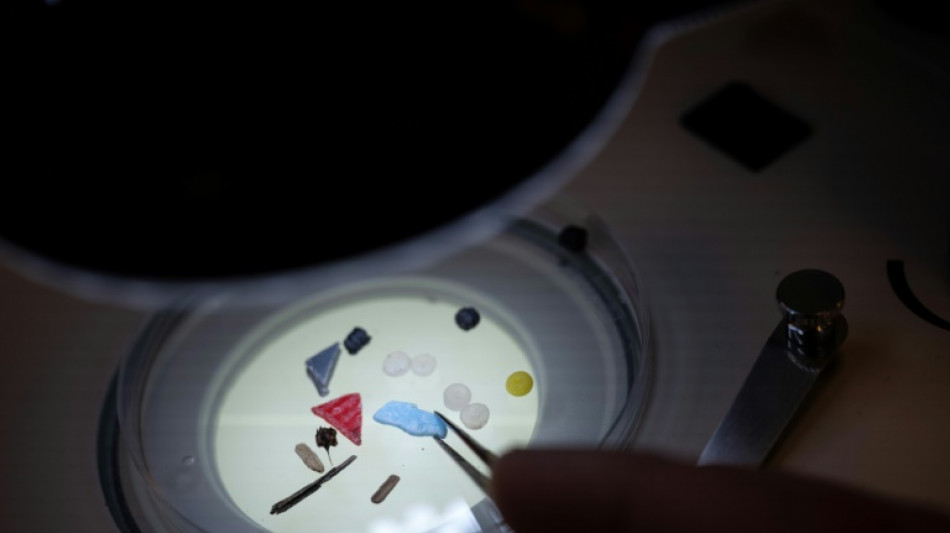
'Alarming' microplastic pollution in Europe's great rivers / Photo: © AFP/File

 ECB opens door to September rate-hike as Iran war flares up
 World Bank estimates Venezuela quakes caused $19.6 bn in damage
 Italy's far-right line up to defend jeweller who killed robbers

 AI-led boom in IPOs raises concerns about a bust

 Klopp expected to be named new Germany coach on Friday

 ECB holds rates as Iran war flare-up threatens to drive prices higher

 MEXC's "Kickoff Fest" Trading Event Concludes with Top Individual Reward of 27,352 USDT
 Oil soars close to $100 on fresh Mideast attacks

 India's angry Gen Z protesters say Modi must fix accountability

 Barca sign Adeyemi from Borussia Dortmund

 EasyJet profits nosedive on Mideast war

 EU fines Google 890 mn euros, risking US fury

 France evacuates thousands of tourists as fire rages in pine forest

 French Jewish DJ sues after activists disrupt stage show: lawyer

 Nokia says AI, cloud boosted sales in second quarter

 Repsol says profit more than triples on higher oil prices

 TotalEnergies says profit doubled on Mideast war

 Giant swing on Swiss peak aims to boost summer tourism as Alps warm

 ASEAN to call for open straits as US-Iran war casts shadow

 AI catches up with humans to score 100% at top maths contest

 South Korea election office raided in fake turnout figures probe: investigators

 Killer whales: orcas blow fish to bits 'for fun', study finds

 Deadly wildfires force thousands from homes in parts of Europe

 Tech bounce lifts Asia stocks, oil extends gains on US-Iran fears

 Surrounded by militias, Sudanese fear endless cycle of war

"Alarming" levels of microplastic have been found in major rivers across Europe according to scientists in 14 studies published simultaneously Monday.
"The pollution is present in all European rivers" studied, said French scientist Jean-François Ghiglione, who coordinated the large-scale operation across nine major rivers from the Thames to the Tiber.
"Alarming" pollution of on average "three microplastics per cubic metre of water" was observed in all of them, according to the results published in the journal of Environmental Science and Pollution Research.
This is far from the 40 microplastics per cubic metre recorded in the world's 10 most polluted rivers -- the Yellow River, Yangtze, Mekong, Ganges, Nile, Niger, Indus, Amur, Pearl and Hai -- which irrigate countries where most plastic is produced or plastic waste is processed.
But this does not take into account the volume of water flowing.
- 3,000 particles per second -
On the Rhone in Valence, France, the fast flow means there are "3,000 plastic particles every second", said Ghiglione. The Seine in Paris has around 900 per second.
"The mass of microplastics invisible to the naked eye is more significant than that of the visible ones," said Ghiglione -- a result that "surprised" researchers. This was confirmed by analytical advances made during the studies, which began in 2019.
"Large microplastics float and are collected at the surface, while invisible ones are distributed throughout the water column and are ingested by many animals and organisms," said Ghiglione, head of research in marine microbial ecotoxicology at the French National Centre for Scientific Research (CNRS).
Samples were collected from the mouths of the rivers Elbe, Ebro, Garonne, Loire, Rhone, Rhine, Seine, Thames and the Tiber by some 40 chemists, biologists and physicists from 19 research laboratories.
The researchers then made their way upstream until they reached the first major city on each of the waterways.
"Microplastics are smaller than a grain of rice," said Alexandra Ter Halle, a chemist at the CNRS in Toulouse, who took part in the analysis.
- 'Mermaid tears' -
The particles are less than five millimetres in size, with the smallest invisible to the naked eye.
These include synthetic textile fibres from washing clothes and microplastics released from car tyres or when unscrewing plastic bottle caps.
Researchers also found virgin plastic pellets, the raw granules used to manufacture plastic products.
One of the studies identified a virulent bacterium on a microplastic in the Loire in France, capable of causing infections in humans.
Another unexpected finding was that a quarter of microplastics discovered in rivers are not derived from waste but come from industrial plastic pellets.
These granules, dubbed "mermaid tears", can also sometimes be found scattered along beaches after maritime incidents.
"What we see is the pollution is diffuse and established" and "comes from everywhere" in the rivers, he added.
"The international scientific coalition we are part of (as part of international UN negotiations on reducing plastic pollution) is calling for a major reduction in the production of primary plastic because we know that plastic production is directly linked to pollution," he said.
G.Schmid--VB