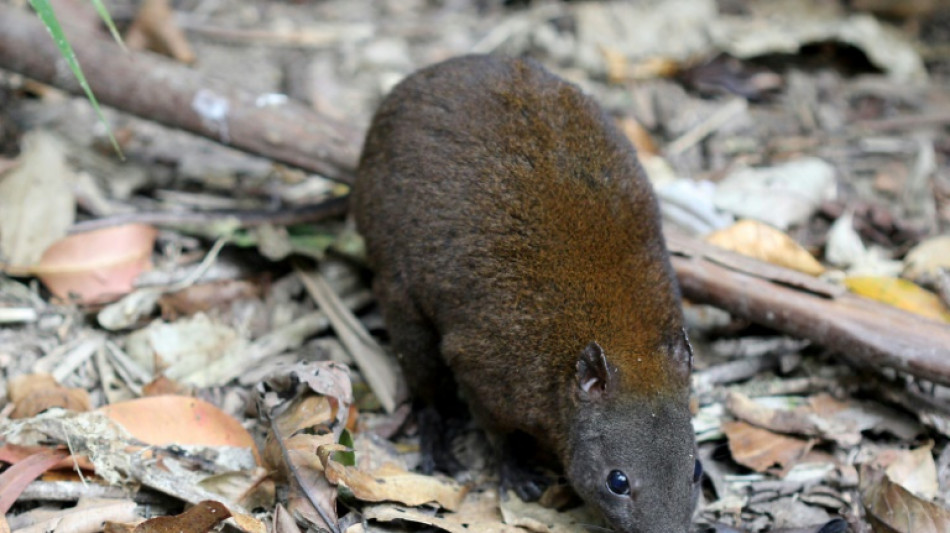
'Musky' marsupial could solve hopping kangaroo mystery / Photo: © FLINDERS UNIVERSITY/AFP

 ECB opens door to September rate-hike as Iran war flares up

 World Bank estimates Venezuela quakes caused $19.6 bn in damage

 Italy's far-right line up to defend jeweller who killed robbers

 AI-led boom in IPOs raises concerns about a bust

 Klopp expected to be named new Germany coach on Friday

 ECB holds rates as Iran war flare-up threatens to drive prices higher

 MEXC's "Kickoff Fest" Trading Event Concludes with Top Individual Reward of 27,352 USDT

 Oil soars close to $100 on fresh Mideast attacks

 India's angry Gen Z protesters say Modi must fix accountability

 Barca sign Adeyemi from Borussia Dortmund

 EasyJet profits nosedive on Mideast war

 EU fines Google 890 mn euros, risking US fury

 France evacuates thousands of tourists as fire rages in pine forest

 French Jewish DJ sues after activists disrupt stage show: lawyer

 Nokia says AI, cloud boosted sales in second quarter

 Repsol says profit more than triples on higher oil prices

 TotalEnergies says profit doubled on Mideast war

 Giant swing on Swiss peak aims to boost summer tourism as Alps warm

 ASEAN to call for open straits as US-Iran war casts shadow

 AI catches up with humans to score 100% at top maths contest

 South Korea election office raided in fake turnout figures probe: investigators

 Killer whales: orcas blow fish to bits 'for fun', study finds

 Deadly wildfires force thousands from homes in parts of Europe

 Tech bounce lifts Asia stocks, oil extends gains on US-Iran fears

 Surrounded by militias, Sudanese fear endless cycle of war

Scientists stalking a small marsupial through a remote Australian rainforest say they may have found a clue to the mystery of why its bigger kangaroo cousins hop instead of walk.
Kangaroos and closely related wallabies are the only large animals to hop upright on two legs, researchers from Australia's Flinders University said Thursday, but why remains a mystery.
They believe the answer may lie with the small musky rat-kangaroo, a bush-dwelling marsupial weighing about the same as a loaf of bread.
Musky rat-kangaroos are a distant ancestor of the larger kangaroo species that famously roam the country's outback.
Researcher Amy Tschirn said musky rat-kangaroos -- named for their pungent scent -- were the only member of the "macropodoid" family that did not hop.
"As the only living macropodoid that doesn't hop, the musky rat-kangaroo provides a crucial insight into how and when the iconic hopping form of locomotion evolved in Australia."
Scientists tracked the creatures, also known as "muskies", through the tropical rainforests of far-northern Queensland state.
They observed the creatures moving in a "bounding" motion -- hopping with their back legs while their front paws remained on the ground.
It suggested a kind of mid-point in the evolutionary journey from walking on all fours to hopping on two, the researchers said.
"These results signal a potential pathway to how bipedal hopping evolved in kangaroos," said Harvard University biologist Peter Bishop, who was involved in the work.
"Perhaps it started with an ancestor that moved about on all fours like other marsupials, then an animal that bounded like the muskies, and finally evolved into the iconic hopping kangaroos we see in Australia today."
Kangaroos and wallabies are the only hopping species heavier than five kilogrammes (11 pounds), the researchers said.
Some smaller species of rodent also hop.
The researchers said they hoped to find fossils of ancient marsupials to better understand the evolution of modern-day kangaroos.
Their findings were published Thursday in peer-reviewed journal Australian Mammalogy.
R.Fischer--VB