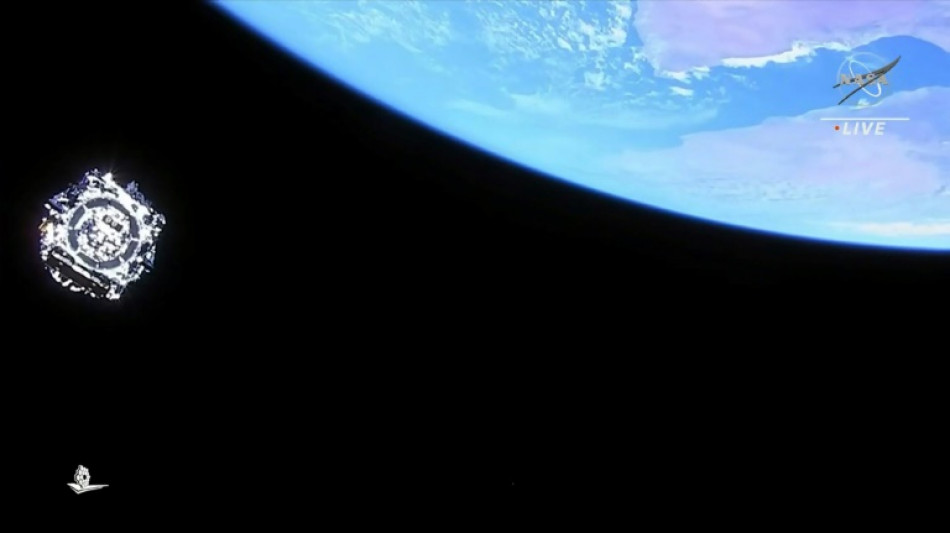
Webb telescope directly observes exoplanet CO2 for first time / Photo: © NASA TV/AFP/File

 Relieved Russell says Mercedes have solved his power problems mystery

 Oil soars above $100 as Middle East fears grow

 Venezuelans turn to scrap collecting in quake-hit beach 'paradise'

 Heptathlon champion Johnson-Thompson joins list of Commonwealth Games absentees

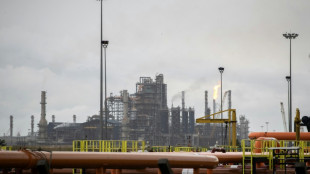 Nigeria's Dangote raises $2.5bn to expand Africa's largest refinery

 Oil soars to $100 on fresh Mideast attacks

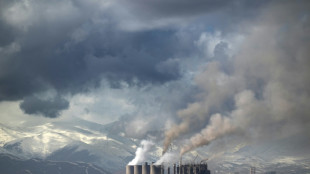 Coal-fired power generation rising globally on Mideast war: IEA

 Premier League champions Arsenal sign Greece winger Tzolis from Brugge

 French Jewish DJ sues after activists disrupt gig: lawyer

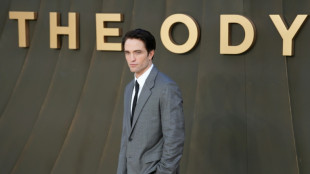 Venice film festival promises Pattinson, Oasis and Musk doc

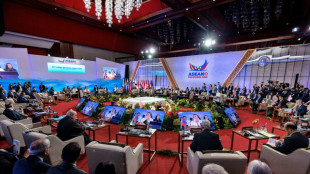 ASEAN calls for open straits as US-Iran war casts shadow

 Ford and Geely to form joint venture at struggling Spain plant

 Russia warns US against Ukraine arms sales in Manila meeting

 New UK PM announces tax cut for struggling pubs

 Supporters flood India's 'cockroach' protesters with food

 Modi vows punishment for exam leaks fuelling India protests

 Norway set to make formal complaint to FIFA over Balogun red card saga
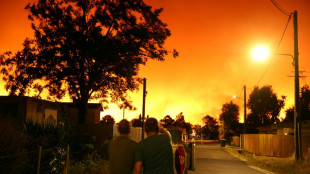
 Floods in northeast India kill at least 41

 Nestle siphons off bottled water business into joint venture

 Hundreds hospitalised in Japan heatwave 'disaster'

 Renault says sales stalled in first half
 EasyJet says profits nosedive on Mideast war

 Modi vows punishment for exam fraud fuelling India protests
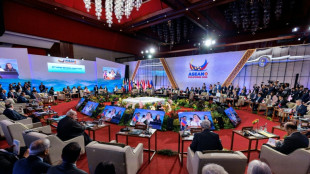
 Six candidates in race to lead UN set for televised debate

 Comic-Con kicks off with Marvel's return

The James Webb Space Telescope has directly observed the key chemical of carbon dioxide in planets outside of our solar system for the first time, scientists announced Monday.
The gas giants are not capable of hosting extraterrestrial life, but do offer clues in a lingering mystery about how distant planets form, according to a study in The Astrophysical Journal.
The HR 8799 system, 130 light years from Earth, is only 30 million years old -- just a baby compared to our solar system's 4.6 billion years.
A US-led team of researchers used Webb to directly detect carbon dioxide in the atmosphere of all four of the system's known planets, according to the study.
They used Webb's coronagraph instruments, which block the light from bright stars to get a better view of the planets revolving around them.
"It's like putting your thumb up in front of the Sun when you're looking up at the sky," lead study author William Balmer, an astrophysicist at Johns Hopkins University, told AFP.
Normally, the Webb telescope only detects exoplanets by glimpsing them when they cross in front of their host star.
This "transiting method" was how Webb indirectly detected CO2 in the atmosphere of the gas giant WASP-39 in 2022.
But for latest discovery, "we're actually seeing the light that is emitted from the planet itself, as opposed to the fingerprint of that light from the host star," Balmer said.
This is not easy -- Balmer compared the process to using a torch to spot fireflies next to a lighthouse.
While these gas giants may not be able to host life, it is possible that they had moons that could, he added.
There are missions currently under way to find out if there could be life in the vast oceans underneath the icy shells of several of Jupiter's moons.
- 'Key piece of proof' -
Carbon dioxide (CO2) is essential for life on Earth, making it a key target in the search for life elsewhere.
Because CO2 condenses into little ice particles in the deep cold of space, its presence can shed light on planetary formation.
Jupiter and Saturn are believed to have first formed from a "bottom up" process in which a bunch of tiny, icy particles came together into a solid core which then sucked in gas to grow into giants, Balmer said.
So the new discovery is a "key piece of proof" that far-off planets can form in a similar way to those in our celestial backyard, Balmer said.
But how common this is throughout the universe remains unclear.
Astronomers have now discovered nearly 6,000 exoplanets, many of them massive -- and none of them known to be habitable.
The "huge leap forward we need to make" is to focus on smaller Earth-sized worlds, Balmer said.
NASA's Nancy Grace Roman space telescope will use a coronagraph to do that just after its planned launch in 2027.
Balmer hopes to use Webb to observe more four-planet systems, but added that future funding was now in question.
Last week the Trump administration announced that NASA's chief scientist has been dismissed, indicating that more cuts were to come for the US space agency.
U.Maertens--VB