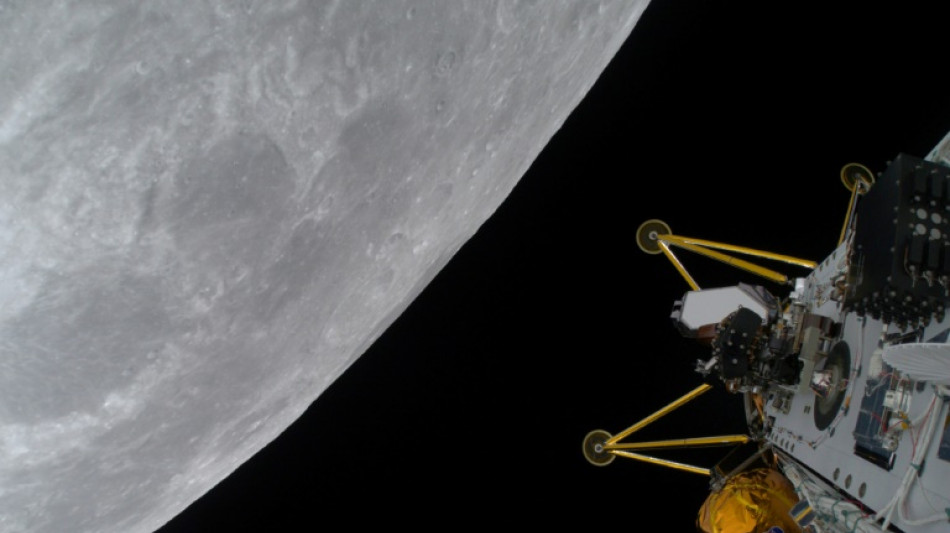
US firm hours away from Moon landing with drill, rovers, drone / Photo: © Intuitive Machines, LLC/AFP

 Relieved Russell says Mercedes have solved his power problems mystery

 Oil soars above $100 as Middle East fears grow
 Venezuelans turn to scrap collecting in quake-hit beach 'paradise'

 Heptathlon champion Johnson-Thompson joins list of Commonwealth Games absentees

 Nigeria's Dangote raises $2.5bn to expand Africa's largest refinery

 Oil soars to $100 on fresh Mideast attacks

 Coal-fired power generation rising globally on Mideast war: IEA

 Premier League champions Arsenal sign Greece winger Tzolis from Brugge

 French Jewish DJ sues after activists disrupt gig: lawyer

 Venice film festival promises Pattinson, Oasis and Musk doc

 ASEAN calls for open straits as US-Iran war casts shadow

 Ford and Geely to form joint venture at struggling Spain plant

 Russia warns US against Ukraine arms sales in Manila meeting

 New UK PM announces tax cut for struggling pubs

 Supporters flood India's 'cockroach' protesters with food
 Modi vows punishment for exam leaks fuelling India protests

 Norway set to make formal complaint to FIFA over Balogun red card saga

 Floods in northeast India kill at least 41

 Nestle siphons off bottled water business into joint venture

 Hundreds hospitalised in Japan heatwave 'disaster'
 Renault says sales stalled in first half
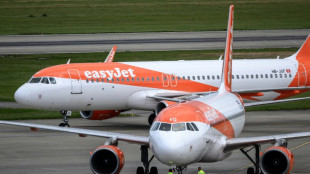 EasyJet says profits nosedive on Mideast war

 Modi vows punishment for exam fraud fuelling India protests

 Six candidates in race to lead UN set for televised debate

 Comic-Con kicks off with Marvel's return

A drill for ice, a 4G network test, three rovers, and a hopping drone: a US company is hours away from its second lunar landing attempt on Thursday, aiming to advance technologies for future human missions.
Houston-based Intuitive Machines, which made history last year as the first private firm to land on the Moon, is targeting a 12:32 pm ET (1732 GMT) touchdown at Mons Mouton, a point nearer the lunar south pole than any robot has ever ventured.
The 15.6-foot (4.8-meter), hexagonal Athena lander -- about the height of a giraffe -- began its descent maneuver earlier, with a webcast set to begin an hour before landing.
Intuitive Machines' milestone landing in February 2024 was partly marred by the lander tipping onto its side -- an outcome the company hopes to avoid repeating.
For the final and trickiest phase, known as terminal descent, Athena will be relying on an Inertial Measurement Unit that senses acceleration, as its cameras and lasers are obscured by lunar dust kicked up by its engines.
"Terminal descent is like walking towards a door and closing your eyes the last three feet. You know you're close enough, but your inner ear must lead you through the door," the company said.
Pressure is high after Texas-based Firefly Aerospace successfully put its Blue Ghost lander on the Moon on Sunday.
Both missions are part of NASA's $2.6-billion CLPS program, designed to partner with private companies to reduce costs and support Artemis -- the effort to return astronauts to the Moon and, eventually, Mars.
- A hopper named Grace -
Athena is targeting highland terrain about 100 miles (160 kilometers) from the Moon's south pole, where it will deploy three rovers and a unique hopping drone named Grace, after late computer science pioneer Grace Hopper.
One of Grace's boldest objectives is a hop into a permanently shadowed crater, a place where sunlight has never shone -- a first for humanity.
While NASA's Ingenuity helicopter proved flight is possible on Mars, the Moon's lack of atmosphere makes traditional flying impossible, positioning hoppers like Grace as a key technology for future exploration.
MAPP, the largest of Athena's rovers and roughly the size of a beagle, will assist in testing a Nokia Bell Labs 4G cellular network linking the lander, itself, and Grace -- technology designed to one day integrate into astronaut spacesuits.
Yaoki, a more compact rover from Japanese company Dymon, is designed to survive drops in any orientation, making it highly adaptable.
Meanwhile, the tiny AstroAnt rover, equipped with magnetic wheels, will cling to MAPP and use its sensors to measure temperature variations on the larger robot.
Also aboard Athena is PRIME-1, a NASA instrument carrying a drill to search for ice and other chemicals beneath the lunar surface, paired with a spectrometer to analyze its findings.
- Sticking the landing -
Before any experiments can begin, Intuitive Machines must stick the landing -- a challenge made harder by the Moon's lack of atmosphere, which rules out parachutes and forces spacecraft to rely on precise thrusts and navigation over hazardous terrain.
Until Intuitive Machines' first mission, only national space agencies had achieved the feat, with NASA's last landing dating back to Apollo 17 in 1972.
The company's first lander, Odysseus, came in too fast, caught a foot on the surface and toppled over, cutting the mission short when its solar panels could not generate enough power.
This time, the company has made critical upgrades, including better cabling for the laser altimeter, which provides altitude and velocity readings to ensure a safe touchdown.
Athena launched last Wednesday aboard a SpaceX Falcon 9 rocket, which also carried NASA's Lunar Trailblazer probe -- but not everything has gone smoothly.
Ground controllers are struggling to re-establish contact with the small satellite, designed to map the Moon's water distribution.
These missions come at a delicate time for NASA, amid speculation that the agency may scale back or even cancel the crewed Moon missions in favor of prioritizing Mars -- a goal championed by President Donald Trump and his advisor Elon Musk.
C.Stoecklin--VB