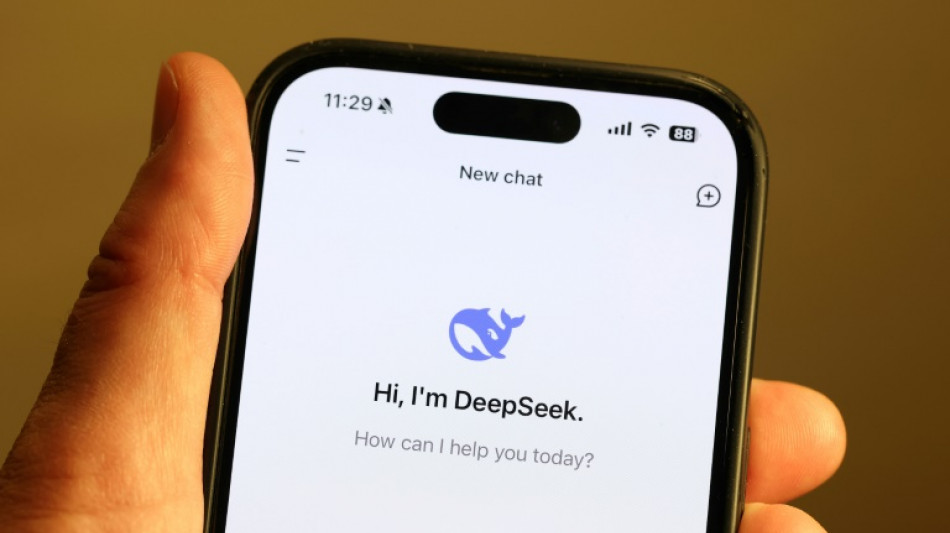
DeepSeek, Chinese AI startup roiling US tech giants / Photo: © GETTY IMAGES NORTH AMERICA/AFP

 Oil passes $100 a barrel again: why it's more serious this time

 Who are the six candidates vying to lead the UN?

 Hamilton proud of recovery after hitting rock bottom a year ago
 Carapaz eyes polkadot mountains jersey after stage win
 Fields medal awarded to four young mathematicians

 Carapaz claims Tour de France stage as Pogacar loses key team-mate

 Alonso welcomes Aston Martin upgrade, warns against unreal expectations
 Anderson declares Man City 'kings of Manchester' after £116 mn move
 Relieved Russell says Mercedes have solved his power problems mystery
 Oil soars above $100 as Middle East fears grow

 Venezuelans turn to scrap collecting in quake-hit beach 'paradise'

 Heptathlon champion Johnson-Thompson joins list of Commonwealth Games absentees

 Nigeria's Dangote raises $2.5bn to expand Africa's largest refinery

 Oil soars to $100 on fresh Mideast attacks

 Coal-fired power generation rising globally on Mideast war: IEA

 Premier League champions Arsenal sign Greece winger Tzolis from Brugge

 French Jewish DJ sues after activists disrupt gig: lawyer

 Venice film festival promises Pattinson, Oasis and Musk doc

 ASEAN calls for open straits as US-Iran war casts shadow

 Ford and Geely to form joint venture at struggling Spain plant

 Russia warns US against Ukraine arms sales in Manila meeting

 New UK PM announces tax cut for struggling pubs

 Supporters flood India's 'cockroach' protesters with food
 Modi vows punishment for exam leaks fuelling India protests

 Norway set to make formal complaint to FIFA over Balogun red card saga

Chinese startup DeepSeek, which has sparked panic on Wall Street with its powerful new chatbot developed at a fraction of the cost of its competitors, was founded by a hedgefund whizz-kid who believes AI can change the world.
Based out of the eastern Chinese city of Hangzhou -- sometimes known as "China's Silicon Valley" -- DeepSeek has come seemingly out of nowhere to release a cutting-edge product.
But in China it was already making waves, last year dubbed the "Pinduoduo of AI" -- a reference to a popular online shopping app that steamrolled big players like Alibaba with its low prices.
DeepSeek has won plaudits for its cost-effectiveness and praise in China for its seeming ability to navigate US sanctions that have aimed to prevent access to the high-tech chips needed to power the AI revolution.
AFP paid visits to the firm's offices in both Hangzhou and the capital Beijing on Tuesday, but offices appeared closed for the Lunar New Year holidays.
The firm is the child of tech and business prodigy Liang Wenfeng, born in 1985 and an engineering graduate of Hangzhou's prestigious Zhejiang University, where he has said he became convinced "artificial intelligence would change the world".
He spent years trying to work out how to apply AI to a number of different fields, according to an interview with Chinese investment news outlet Waves last year.
But he eventually struck gold with High-Flyer, a quantitative investing firm specialising in using AI to analyse stock market patterns.
That technique brought in tens of billions of yuan in assets managed, and made it one of China's top quantitative hedge funds.
"We just do things according to our own pace, then calculate costs and prices," Liang told Waves.
"Our principle is to not subsidise or make a huge profit."
- 'More a geek than a boss' -
For Liang, DeepSeek was always a passion project.
In 2021, the Financial Times reported, he began purchasing Nvidia graphic processing units for a side project -- an account also featured in a local media report on the firm.
Associates told Waves he is "not at all like a boss and much more like a geek", with a "terrifying ability to learn".
And his passion project has now shocked industry experts and triggered a plummet in the shares of US chip-making giant Nvidia.
It also brought Liang right into the corridors of power.
Last week, he appeared in a lineup of other key business representatives meeting with China's second-ranking leader, Premier Li Qiang, at a seminar to solicit opinions on the government's economic work for the year ahead.
Footage of the meeting from Chinese state broadcaster CCTV showed a moppy-haired Liang wearing thick-rimmed glasses addressing Li, who sat listening intently from his chair opposite.
- 'Wake-up call' -
Beijing has good reason to be pleased: DeepSeek's success called into question the vast sums of money funnelled by tech giants into developing advanced generative AI, as well as the ability of Western sanctions to prevent Chinese competitors from keeping up -- or even winning.
US President Donald Trump said it was a "wake-up call" for Silicon Valley, and tech investor and ally Marc Andreessen declared it was "AI's Sputnik moment".
It also amplified calls for Washington to get even tougher on restricting Chinese firms from getting hold of high-tech chips.
In his interview with Waves, Liang acknowledged that the toughest obstacle has been those US curbs.
"Money has never been the problem we face; it's the embargo on high-end chips," he said.
But beyond the geopolitics, the "geeky" AI guru said he hoped the technology could help us understand deeper things about the human mind.
"We hypothesize that the essence of human intelligence might be language, and human thought could essentially be a linguistic process," he said.
"What you think of as 'thinking' might actually be your brain weaving language."
B.Wyler--VB