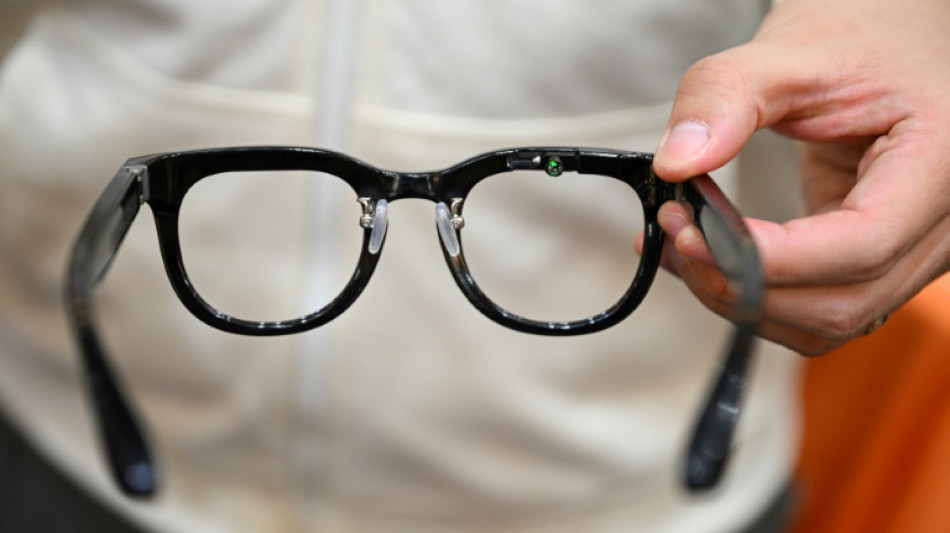
Smart glasses enter new era with sleeker designs, lower prices / Photo: © AFP

 Israeli rubble-clearing in Gaza could erase 'atrocity crimes' evidence: UN expert

 Scorching summer pushes French wine harvest to new historic low

 Pietersen joins England coaching team ahead of World Cup

 Germany's triumphant far-right AfD aims fire at Merz

 Fury claims Joshua bout is off, calls for Usyk trilogy

 British family bids to row back against suicide taboo

 China's teenage 223cm basketball player 'just a little girl'

 Tokyo's Shinjuku to ban more than half of vacation rentals

 Australian Rules limits contact training to reduce concussion

 Germany's Merz under pressure from far-right election triumph

 Nepal tunnel rescues face 'unprecedented' challenge

 Mourinho's Real Madrid European revival bid starts with Inter reunion

 Solomons PM survives attempt to oust government

 Ohtani 'unlikely' to pitch again this season, says Dodgers manager

 Driver thanks 'superhero' rival for saving him from flaming race car

 Can dogs sniff cancer? AI joins the hunt in India

 Shelton steams into US Open quarter-final clash with Alcaraz

 25 years on, America seeks to keep 9/11 memories alive

 'Trumpapalooza' tests Republican bet on unpopular US president

 Pegula tops Cirstea to reach US Open quarter-finals

 Australians could opt out of social media algorithms under new law

 Tiafoe tops Medvedev in straight sets at US Open

 Zverev seeks US Open last eight as Osaka faces Rybakina

 Alcaraz turns up heat to reach US Open quarters

 Gatti salvages Juve draw with AC Milan in Serie A

Producers of hi-tech connected eyewear are multiplying their innovations with increasingly discreet models in an attempt to make a difference in a highly competitive -- and fast-emerging -- market.
Live translation, GPS, cameras: glasses are quickly adopting new functionalities.
"There are so many of these smart wearables, and more of them are going on your face," said Techsponential analyst Avi Greengart at the Consumer Electronics Show (CES) in Las Vegas, where numerous smart glasses manufacturers showcased their latest innovations.
The industry has come a long way from its early days. Gone are the conspicuous protrusions of Google Glass and the bulky frames and cables of Epson's Moverio from the early 2010s.
Today's smart glasses, all paired with smartphone apps, increasingly resemble traditional eyewear. The Ray-Ban Meta, developed by Mark Zuckerberg's social media giant, currently leads the market with this new approach.
According to a recent MarketsandMarkets study, the sector's growth is "driven by advancements in augmented reality, artificial intelligence, and miniaturization technologies, which are pushing the boundaries of what these wearable devices can achieve."
However, integrating technology into fashionable frames requires careful compromise.
The Ray-Ban Meta, for instance, can capture photos and videos, play music, and provide information about objects in view, but doesn't offer augmented reality with superimposed images.
Meta representative Robin Dyer explained that while AR capabilities may come later, they would likely double the current price.
- 200 dollars -
Price is a major battleground in this market, particularly with the entry of Chinese manufacturers.
While Google Glass initially retailed for around $1,500 in 2013, today's smart glasses are approaching the price of premium conventional frames.
Meta's James Nickerson noted that their Ray-Ban collaboration starts at $300, just $50 more than standard Ray-Bans, offering "a cool camera" as a bonus.
Chinese startup Vue has pushed prices even lower, offering basic models with voice assistant and music capabilities for $200.
Some manufacturers, like XReal, focus on augmented reality, projecting smartphone, computer, or gaming console displays -- though this is a market for which Apple's VisonPro failed to create excitement last year.
For AR, recent advances help move away from the bulk of a virtual reality headset towards that of classic sunglasses, even if they require a cable to be connected to the device.
Meta's ambition is to launch its own pared down version, the Orion, currently in the test phase but not expected to be marketed until 2027 at the earliest.
- Chasing cool -
Companies like Even Realities and Halliday are pioneering ultra-thin frames that look identical to standard glasses while offering basic AR capabilities.
"If we want to make a good pair of smart glasses, we must first make a pair of cool glasses," emphasized Carter Hou, Halliday's second-in-command.
Halliday's $489 model, launching in March, displays text in the upper corner of the wearer's vision. Using AI, it can suggest responses during conversations, provide real-time translation, and function as a discrete teleprompter.
Even Realities has also taken a minimalist approach.
"We got rid of the speaker, we got rid of the camera," explained the company's Tom Ouyang. "Glasses are for the eyes, not the ears."
R.Buehler--VB