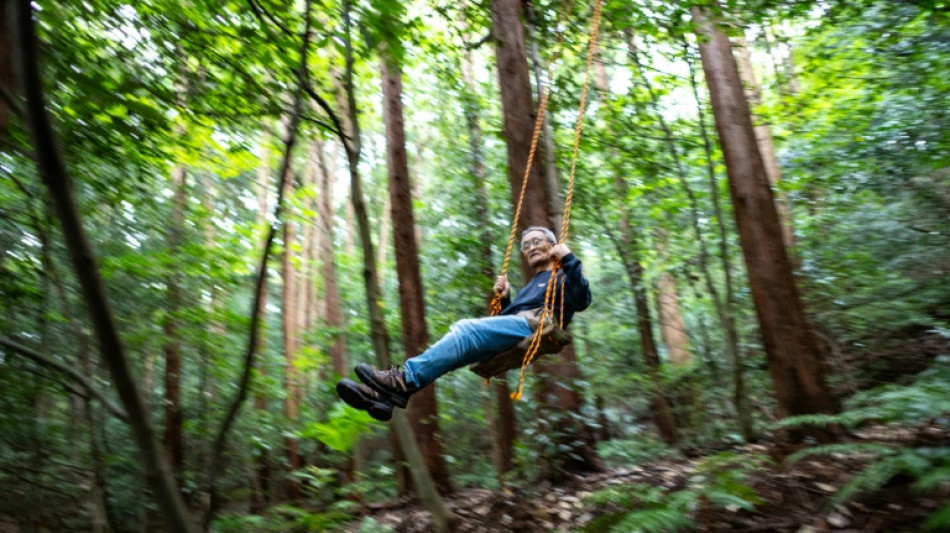
Japan 'poop master' gives back to nature / Photo: © AFP

 Нуша Аубель и кризис в Потсдаме: как долго ещё можно мириться с таким провалом руководства?

 England quick Archer in 'good place' after injuries

 Robots protest rampant AI in Poland

 Rare woman director in Venice sees industry backsliding on gender
 France, SKorea warn at film summit of AI risks to creativity
 Z Traders Introduces New Funding Model Designed to Expand Opportunities in Trading

 Lebanon says 12 killed in strikes as Israel vows to 'remove threats'

 Volkswagen plant to be converted for Israeli defence group

 Israeli rubble-clearing in Gaza could erase 'atrocity crimes' evidence: UN expert

 Scorching summer pushes French wine harvest to new historic low

 Pietersen joins England coaching team ahead of World Cup

 Germany's triumphant far-right AfD aims fire at Merz

 Fury claims Joshua bout is off, calls for Usyk trilogy

 British family bids to row back against suicide taboo

 China's teenage 223cm basketball player 'just a little girl'

 Tokyo's Shinjuku to ban more than half of vacation rentals

 Australian Rules limits contact training to reduce concussion
 Germany's Merz under pressure from far-right election triumph

 Nepal tunnel rescues face 'unprecedented' challenge
 Mourinho's Real Madrid European revival bid starts with Inter reunion

 Solomons PM survives attempt to oust government

 Ohtani 'unlikely' to pitch again this season, says Dodgers manager

 Driver thanks 'superhero' rival for saving him from flaming race car

 Can dogs sniff cancer? AI joins the hunt in India

 Shelton steams into US Open quarter-final clash with Alcaraz

When nature calls, Masana Izawa has followed the same routine for more than 50 years: heading out to the woods in Japan, dropping his pants and doing as bears do.
"We survive by eating other living things. But you can give faeces back to nature so that organisms in the soil can decompose them," the 74-year-old told AFP.
"This means you are giving life back. What could be a more sublime act?"
"Fundo-shi" ("poop-soil master") Izawa is something of a celebrity in Japan, publishing books, delivering lectures and appearing in a documentary.
People flock to his "Poopland" and centuries-old wooden "Fundo-an" ("poop-soil house") in Sakuragawa north of Tokyo, sometimes dozens of them a month.
There, in his 7,000-square-metre (1.7-acre) woodland -- about the size of a football pitch -- visitors get tips for open-air best practice.
"Noguso", as it is known in Japanese, requires digging a hole, a leaf or two for wiping, a bottle of water to wash up, and twigs to mark the spot.
The sticks ensure he doesn't use the same place twice and can later return to keep precise records of the decomposition process.
"Feel the back of these. Can you tell how soft they are?" he said, showing palm-sized silver poplar leaves picked from a branch.
"(It's) more comfortable than paper."
- 'Egocentric' -
Izawa is a former nature photographer who specialised in mushrooms before retiring in 2006.
His excrement epiphany came at age 20 when he saw a protest against the construction of a sewage plant.
"We all produce faeces, but (the demonstrators) wanted the treatment plant somewhere far away and out of sight," he says.
"People who believed they were absolutely right made such an egocentric argument."
He concluded that to alleviate his own conscience at least, outdoor defecating was the answer.
- Falling foul -
Toilets, toilet paper and wastewater facilities require huge amounts of water, energy and chemicals.
Letting soil do the work is much better for the environment, says Izawa, who believes more people should follow his lead.
Human waste -- more than other animals' -- can contain bacteria that are potentially harmful to the environment, and defecating outside is banned in Japan.
But since Izawa owns the forest around his centuries-old house, he has not fallen foul of the authorities.
He digs up old spots that he says show human stools are entirely and quickly broken down, unless they contain antibiotic medicines.
"Fungal activities degrade and transform things like dead animals, excrement and fallen leaves into nutritious earth, on which a forest grows," he says.
- Risky Business -
Izawa's iron beliefs have cost him dearly, not least his second marriage after an incident involving Machu Picchu, the popular tourist site in Peru.
He cancelled a leg of their honeymoon trip to the site after learning he would have to use the facilities.
"I jeopardised my wife and a trip to Machu Picchu just for a single 'noguso'," he says, laughing.
He believes that climate change and the growing interest in more sustainable ways of living may be winning him more attention, especially from young people.
Kazumichi Fujii, 43, a soil scientist at the Forestry and Forest Products Research Institute (FFPRI) in Japan, agreed.
"(It is) due to the Fukushima (nuclear) disaster, the Greta Thunberg movement... (and) distrust for the preceding generations and the desire for alternatives," Fujii said.
But Fujii warns Izawa that his methods may not be as safe as he thinks, particularly his habit of tasting the soil from Poopland to demonstrate how safe it is.
The city of Edo, as pre-modern Tokyo was known, used human excrement to fertilise farmland, but "some 70 percent of residents suffered from parasite infection," Fujii said.
"I must be seen as a hell of a freak," laughs Izawa. "But it is due to the human-centric society.
"In the whole ecological system, no other animal but humans use toilets...the human world is rather absurd to me."
He now strongly hopes that his body will also be decomposed in the forest instead of being cremated as is customary in Japan.
"I find the purpose of living in doing 'noguso'," he said.
H.Gerber--VB