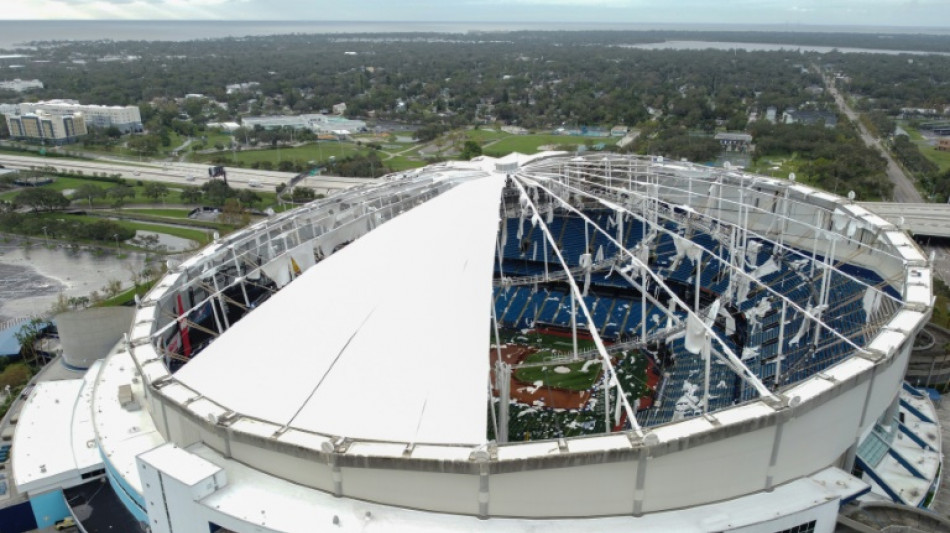
2024's record ocean heat revved up Atlantic hurricane wind speeds: study / Photo: © AFP/File

 Harrison, Skupski win US Open men's doubles title

 Verstappen fears overtaking will be 'tough' at Spanish GP

 Argentina revives plan for South Atlantic naval base amid Falklands tensions

 Yemen government forces say hit Houthis in Red Sea city

 Dismal Spurs stay goalless after Everton stalemate

 Fire at nursing home in Chile kills 16

 Frustrated Hamilton urges Ferrari to 'work harder'

 Zelensky ready to meet Putin at Miami G20 but Kremlin refuses

 Anthropic boss calls for AI slowdown, Altman and Musk agree

 England back on track after 'chaos', says Root

 Shelton chases history in US Open title tilt with top seed Zverev

 Norris 'masterpiece' snatches Spanish GP pole from Antonelli

 Mas on brink of Vuelta triumph as Landa claims stage 20

 No Kerr clash as Ingebrigtsen pulls out of Ultimate 1,500m

 Anthropic boss calls for slowing pace of AI development

 BRICS nations call for 'maximum restraint' in Middle East war

 England v Pakistan Test series: Three talking points

 Marquez snatches San Marino MotoGP sprint ahead of Bezzecchi

 Philippine ferry fire death toll climbs to 76 as identification process begins

 BRICS nations urge 'maximum restraint' in Middle East war

 Zelensky open to meeting Putin at G20 in Miami

 England survive scare to seal 3-0 sweep against Pakistan

 Trump says Irish unification would be 'fantastic'

 Bodies of Philippines ferry fire victims brought ashore as toll hits 35

 Flick warns Barca stars to keep focus after perfect start

Human-driven warming of ocean temperatures increased the maximum wind speeds of every Atlantic hurricane in 2024, according to a new analysis released Wednesday, highlighting how climate change is amplifying the destructive power of storms.
The study, published by the research institute Climate Central, found that all eleven hurricanes in 2024 intensified by nine to 28 miles per hour (14-45 kph) during the record-breaking ocean warmth of the 2024 hurricane season.
"Emissions from carbon dioxide and other greenhouse gases have influenced the temperatures of sea surfaces around the world," author Daniel Gilford said in a call with reporters.
In the Gulf of Mexico, these emissions made sea surface temperatures around 2.5 degrees Fahrenheit (1.4C) hotter than they would have been in a world without climate change.
This rise fuels stronger hurricanes.
The increased temperatures intensified storms like Debby and Oscar, which grew from tropical storms into full-fledged hurricanes.
Other hurricanes were pushed up a category on the Saffir-Simpson scale, including Milton and Beryl which escalated from Category 4 to Category 5 due to climate change, while Helene climbed from Category 3 to Category 4.
Each rise in category corresponds to a roughly fourfold increase in destructive potential.
Helene proved particularly devastating, claiming more than 200 lives, making it the second deadliest hurricane to strike the US mainland in over half a century, surpassed only by Hurricane Katrina in 2005.
The new analytical approach allows researchers to hone in on a given storm's track -- showing for example that, at Hurricane Milton's point of peak intensification before landfall, climate change made the warm sea surface temperatures 100 times more likely to occur than otherwise, and increased maximum wind speed by 24 mph.
Gilford and his colleagues also published a peer-reviewed study in the journal Environmental Research Climate examining hurricane intensities from 2019 to 2023. They found that 84 percent of hurricanes during that period were significantly strengthened by human-caused ocean warming.
While their two studies focused on the Atlantic Basin, the researchers said that their methods could be applied to tropical cyclones globally.
Climatologist Friederike Otto of Imperial College London, who leads World Weather Attribution, praised the team's methodology for advancing beyond previous research that primarily linked climate change to hurricane-related rainfall.
Otto warned that these climate supercharged storms are occurring with the world at just 1.3C (2.3F) above pre-industrial temperatures, and that the impacts are likely to worsen as temperatures rise beyond 1.5C (2.7F).
"The hurricane scale is capped at Category Five -- but we might need to think about, should that continue to be the case just so that people are aware that something is going to hit them that is different from everything else they've experienced before," she said.
I.Stoeckli--VB
