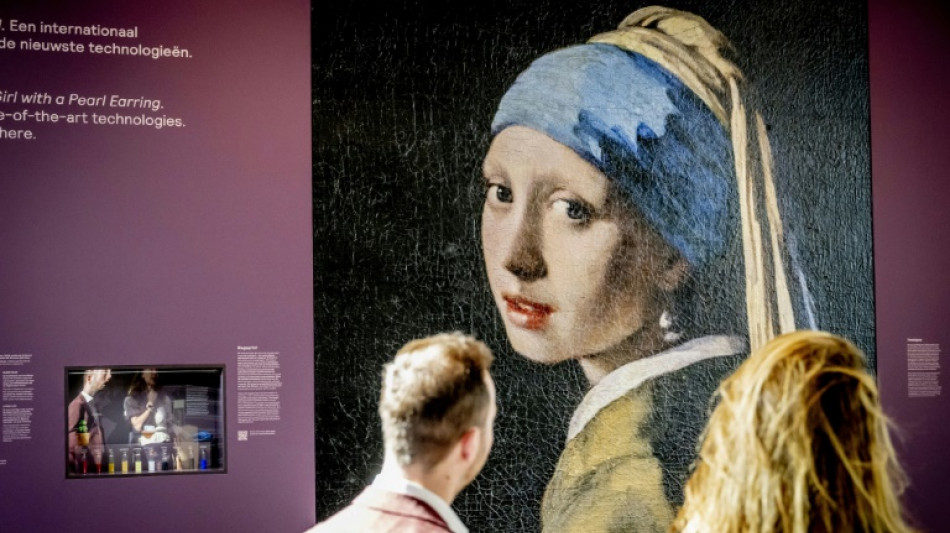
Scientists unlock secret of 'Girl With Pearl Earring' / Photo: © ANP/AFP

 Indians living in Japan on stand-by to house Asian Games athletes

 Trump signs bill authorizing sweeping Russia sanctions

 Protesters form human chain at Kennedy Center after Trump threat

 Death toll from attack at police HQ in Pakistan rises to 31

 Trump says Denmark to give US 'permanent control' over Greenland security

 Kennedy Center: future unclear for iconic Washington arts hub

 Trump claims 'infinite' Greenland security deal with Denmark

 Helicopters battle wildfire threatening Ecuador's capital

 Brentford batter Chelsea to undo Alonso's promising start

 Kane hits Bundesliga century as Bayern rout Union

 Trump says CNN, MS NOW, Politico banned from White House

 Hushing and hedging: US companies retreat on climate

 Springboks to face Fiji before 2027 Rugby World Cup

 Nigeria miners struggled to breathe in cell before 37 died: survivors

 McIlroy on the charge at PGA Championship as Reed withdraws

 McIlroy on the charge at PGA Championship

 Crisis-wracked Volkswagen warns of 10-bn-euro hit to profits

 Costa Rica's Grynspan tops third informal poll for UN chief: diplomat

 Stock markets retreat after central bank rate hikes

 Russia labels director of Cannes Grand Prix winner a 'foreign agent'

 Macron warns of Russian 'hybrid' threat after meeting presidential hopefuls

 UN holds third informal poll for new chief

 Kulusevski return can spark Spurs: De Zerbi

 Shakira to cap off world tour with Madrid 12-gig run

 Isolated Syrian-Druze city blames Damascus for shortages

Johannes Vermeer's "Girl With The Pearl Earring" is one of the world's most popular paintings -- and now scientists believe they know why, by measuring how the brain reacts when the work is viewed.
The Mauritshuis museum in The Hague, which houses the 17th century masterpiece, commissioned neuroscientists to measure brain output when viewing the portrait and other well-known works.
They discovered that the viewer is held captive by a special neurological phenomenon they called "Sustained Attentional Loop", which they believe is unique to the "Girl With The Pearl Earring".
The viewer's eye is automatically drawn first to the girl's own eye, then down to her mouth, then across to the pearl, then back to the eye -- and so it continues.
This makes you look at the painting longer than others, explained Martin de Munnik, from research company Neurensics that carried out the study.
"You have to pay attention whether you want to or not. You have to love her whether you want to or not," he said.
By measuring brainwaves, the scientists also discovered the precuneus, the part of the brain governing consciousness and personal identity, was the most stimulated.
"It was predictable that the Girl was special. But the 'why' was also a surprise to us," said De Munnik.
He said it was the first known study to use EEG and MRI brain scanning machines to measure the neurological response to artwork.
"The longer you look at somebody, the more beautiful or more attractive somebody becomes," he noted, which also explains the popularity of the Dutch master's subject.
"Why are you familiar with this painting and not with the other paintings? Because of this special thing she has."
- 'The brain doesn't lie' -
The scientists also compared the neurological response when looking at the genuine painting in the museum versus being confronted with a reproduction.
They found the emotional reaction experienced by the viewer was ten times stronger for an original than a poster.
To carry out the tests, scientists attached an eye tracker and cap to track brainwaves on 10 subjects that were shown the real paintings but also reproductions.
It shows the importance of seeing original art, said Mauritshuis Director Martine Gosselink.
"It's so important to engage with art, whether it's photography, or dance, or old masters from the 17th century," the director, 55, told AFP in an interview.
"It is important, and it really helps to develop your brain... The brain doesn't lie," she added.
Vermeer often drew the focus onto one spot in his works, with the surrounding details more blurred, she explained.
However, the "Girl With The Pearl Earring" has three such focal points -- the eye, mouth, and pearl -- and Gosselink said this set the work apart from other Vermeer paintings.
"Here we see somebody really looking at you, whereas all other paintings by Vermeer, you see someone writing or doing some needlework, or a person busy doing something," she said.
"But that's the big difference with this girl. She's watching you."
De Munnik, 65, said it would be interesting to carry out similar studies on other famous paintings, such as Da Vinci's Mona Lisa for example.
Mauritshaus director Gosselink alluded to a friendly rivalry between the two great works.
"People sometimes call (The Girl With The Pearl Earring) the Mona Lisa of the North, but I think times are changing, so maybe the Mona Lisa is the Girl of the South," she joked.
B.Wyler--VB