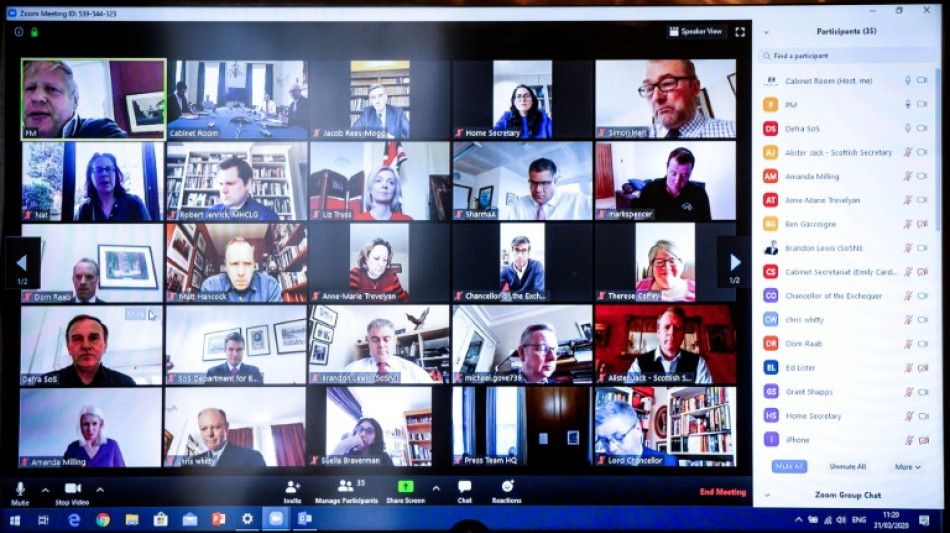
Zoom fatigue? Try some nature in your background: study / Photo: © 10 Downing Street/AFP/File

 UK agrees support for Saudi in struggle with Houthis: reports

 EU foreign policy chief calls for continued sanctions on Russia

 Flights scrapped, evacuations urged as Typhoon Dujuan wallops Japan

 Fonseca to take break from tennis

 A Cuban zoo, and its animals, in epic battle for survival

 Infantino proposes consulting federations to reform FIFA

 El Nino weather pattern enters record territory: scientist

 OpenAI calls for US to lead global effort on AI standards

 South African ostriches plucked alive for luxury fashion: report

 US networks halt Trump coverage in revolt over White House ban

 Paramount settles with US states to clear Warner Bros. mega-merger

 Climate crisis a job for world leaders, not just activists: UK FM

 US networks halt Trump coverage over White House ban

 French singer accuses Miley Cyrus of plagiarism

 EU fines Google 403 mn euros for location data breach

 'Best is yet to come,' says De la Fuente after Spain extension

 Why diesel prices are rising more than crude oil

 COP31 host says AI's climate footprint to be a summit priority

 Renewables hit record in 2025, but world must move faster: report

 US media outlets to sue Trump administration after White House ban

 Global stocks rally on lower oil prices, US-China hopes

 EU proposes energy rating for data centres

 Schoolgirl Yu scorches to second gold as doping case rocks Games

 Putin's party secures record score in Russia election

 Haupt Koleksiyonu: Paranın Biz İnsanlar Hakkında Anlattıkları

Feel drained after a long video call? Your tiredness could be partly linked to the background on your screen, according to a study published on Thursday which suggested trying an image depicting nature.
Whether for work meetings, distance learning at school or just catching up with friends and family, video calls have become a part of daily life for many people -- particularly since the Covid pandemic.
The amount of time spent communicating on these screens has given rise to a new phenomenon dubbed "videoconference fatigue", which can represent physical, emotional or cognitive exhaustion.
Several factors that contribute to videoconference fatigue have already been identified, such as rising anxiety from seeing oneself on a screen, double-tasking or just plain old connection problems.
Two researchers in Singapore were interested in testing another element that could play a role -- the virtual background people choose to conceal what is really behind them.
This could be important because existing research "suggests that during videoconferencing, users spend the vast majority of their time focusing on themselves", researcher Heng Zhang of Singapore's Nanyang Technological University told AFP.
Rather than focusing on the people they are talking to, it seems everyone just spends video calls checking themselves out.
When people select their background, "they are essentially choosing a 'new suit' for themselves," said Zhang, the co-author of the new study in the journal Frontiers in Psychology.
"The virtual background is not merely a decoration -- it influences how users perceive themselves and how they are perceived by others."
In the spring of 2023, the researchers conducted an online survey of 610 Singaporean users of Zoom, one of the world's most popular videoconferencing apps.
Similar to other apps, Zoom allows users to blur whatever is behind them -- say, a messy bedroom -- or replace it with images of offices, cityscapes, forests or whatever else they desire.
Users can also choose video backgrounds with moving elements, such as a beach where waves crash onto the shore or palm trees sway in the wind.
The study's participants, who ranged from the ages of 22 to 76 and worked from home three days a week, were asked to keep track of their backgrounds.
They then answered a bunch of questions about how they were affected by general, visual, social, motivational and emotional fatigue.
- Forest, mountains or beach -
Perhaps unsurprisingly, the backgrounds that featured moving videos were associated with the most fatigue.
"This is because video backgrounds are constantly changing, continuously presenting new information to users, consuming cognitive resources, and increasing cognitive load," the study said.
Users with a blurred background also recorded higher tiredness levels.
The researchers theorised that blurred backgrounds "can lead to negative emotions", pointing to previous studies which found something similar about grey backgrounds.
Another common background choice were ones featuring office or public spaces -- presumably chosen to portray professionalism.
But this "self-presentation effort" can be magnified during videoconferencing, leading to increased fatigue, the study said.
Backgrounds depicting nature, or more fun and wacky ones, were linked with the lowest levels of videoconference fatigue.
For work meetings, the researchers recommended people choose images of mountains, forests or beaches.
"These backgrounds not only help reduce fatigue but also allow users to present themselves in a more professional manner," Zhang said.
"This choice strikes a balance between psychological comfort and maintaining appropriate social etiquette."
T.Suter--VB