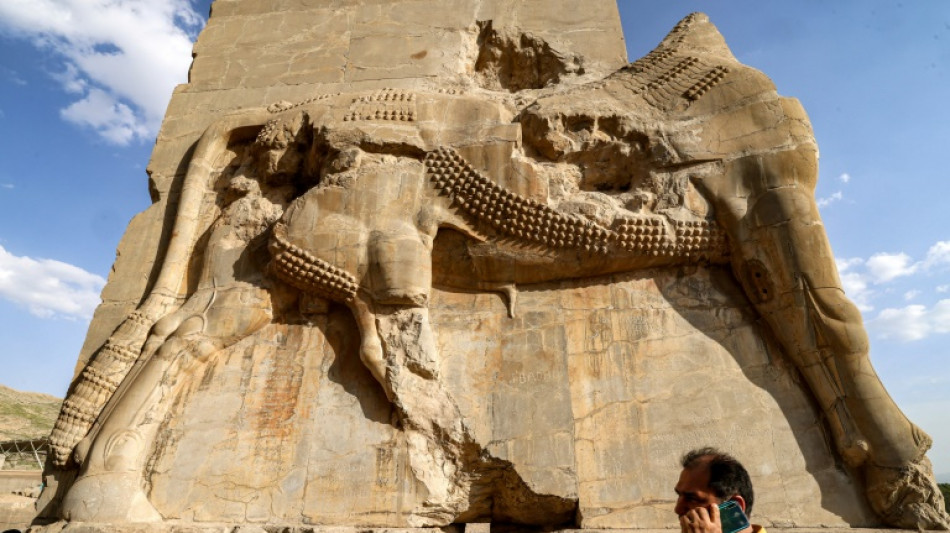
The stone-eaters that threaten Iran's ancient Persepolis / Photo: © AFP/File

 Marchand 'stressed' about racing Japanese rivals at LA Olympics

 Mobile boat clinics bring healthcare to India's remote islands

 Former India paceman Zaheer Khan named Chennai coach in IPL

 Six-year-old Chinese girl sets world record with Rubik's Cube
 Swimming prodigy Yu, 13, says 'interviews way harder than racing'

 Star coaches make their bows as Nations League returns

 Rams bounce back as Giants reel from Dart injury

 In Bangladesh, Pakistan's Jinnah photo stirs anger

 Two New Zealand naval ships transit Taiwan Strait

 Zidane gets down to work as France start new era

 Inside the Venezuelan prison meant to 'drive you insane'

 UK king braces as memoir by Diana's brother goes on sale
 No green light to lift EU sanctions on Russian oligarchs, talks to resume

 UK agrees support for Saudi in struggle with Houthis: reports

 EU foreign policy chief calls for continued sanctions on Russia

 Flights scrapped, evacuations urged as Typhoon Dujuan wallops Japan

 Fonseca to take break from tennis

 A Cuban zoo, and its animals, in epic battle for survival

 Infantino proposes consulting federations to reform FIFA

 El Nino weather pattern enters record territory: scientist

 OpenAI calls for US to lead global effort on AI standards
 South African ostriches plucked alive for luxury fashion: report

 US networks halt Trump coverage in revolt over White House ban

 Paramount settles with US states to clear Warner Bros. mega-merger

 Climate crisis a job for world leaders, not just activists: UK FM
Conservationists at Persepolis, Iran's most iconic ancient site, are waging a delicate battle against an unlikely adversary: tiny but persistent lichens eroding the millennia-old monuments.
The fight, which began years ago, is aimed at stopping the threat to the integrity of the site's structures and its intricate carvings from lichens, organisms that grow on surfaces like stone and can slowly break them down over time.
Built in the 6th century BC by Darius I, Persepolis has withstood destruction, looting, earthquakes, fires and harsh weather. It remains a source of pride for Iranians and a major tourist destination.
"It's an open-air museum reflecting 25 centuries of Middle Eastern life," said Alireza Asgari Chaverdi, director of the site located about 50 kilometres (30 miles) from the southern city of Shiraz.
"It is the foundation of Iran's history, culture and socio-cultural life."
A UNESCO World Heritage Site since 1979, Persepolis features colossal sculptures and intricate stone reliefs of ancient Persian kings, nobles and deities.
But these have suffered over the years from lichen, a combination of an algae and a fungus.
"This is the most serious problem, especially for carvings on stones," said Shahram Rahbar, a conservationist at the site.
"If we do nothing, these organisms could reduce these relics to dust within 50 to 100 years," he said as he treated lichen growth on one slab.
- Lost motifs -
Red lichen marks are now etched into many of the ancient relics at Persepolis.
The spread of lichens, which dissolve minerals and penetrate stone surfaces by more than 1.5 centimetres (.6 inches), is driven by industrialisation, acid rain and the harsh desert climate, said lichenologist Mohammad Sohrabi.
"We cover the lichens with a material and, after a week, repeat the process until they weaken enough to be removed with suction devices," said Rahbar.
Iran is home to more than 3,000 species of lichens, with 500 to 700 varieties growing on historical monuments, Sohrabi said, noting that some at Persepolis were over 1,700 years old.
"Many of Persepolis's intricate motifs have already been lost due to lichen activity," he said.
Beyond Persepolis, other sites in Iran, like the Bisotun inscription in Kermanshah province, have also been affected.
Bisotun, another UNESCO World Heritage Site, features a massive carved inscription recounting the conquests of King Darius I and has suffered significant degradation due to lichen growth.
- 'More important than our lives' -
At Persepolis, Rahbar and his team work relentlessly to combat the infestation.
"We destroy the lichens using modern techniques like lasers and substances that act like antibiotics," Rahbar said, describing what he called a "painstaking" process.
Public concern grew after an official highlighted a lack of funds for preserving Iran's historic sites.
Iran's deputy culture minister, Ali Darabi, said the annual budget for restoring each monument was only 130 million rials (about $220), while maintaining all registered historical monuments would require nearly $84 million a year.
As Mohsen, a 41-year-old retiree from Ghazvin, stood before a ruined column of the Apadana palace, he said, "Maintaining this site is more important than our lives."
Ghashghaei, an 82-year-old retiree visiting with his family, agreed.
For him, the site stands as a poignant reminder that "Iranians created an ancient civilisation," he said.
T.Egger--VB