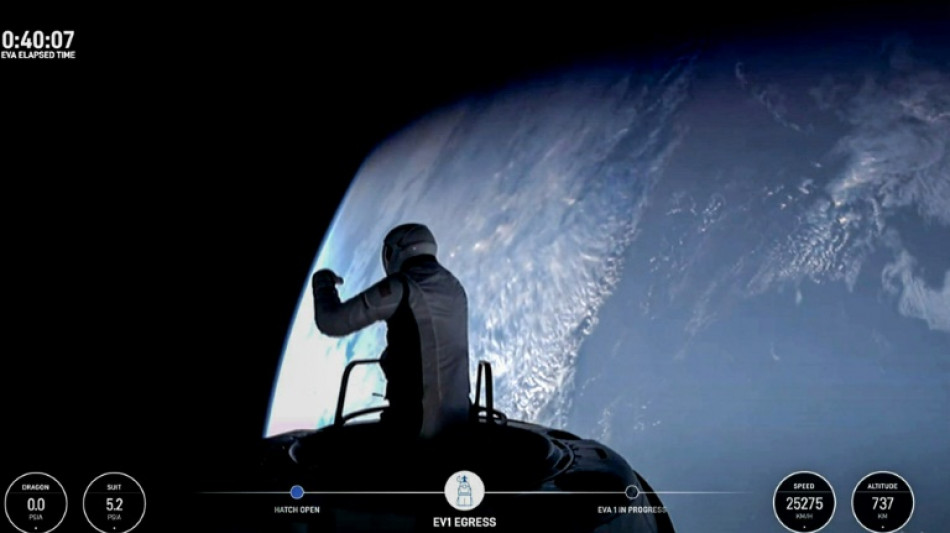
Historic private astronaut mission splashes down off Florida / Photo: © Polaris Program/AFP

 Arizona Superintendent Tom Horne to Leave Office, Plans Law Practice and Charter School

 Japan and Peru Mark 150 Years of Diplomatic Ties Amidst Trade and Investment Talks

 Ian Jackson Scores Game-High 22 Points After Rick Pitino's Prank Suspension

 Khan Welcomes Milburn’s Youth Employment Reforms Amid High NEET Rates

 Shinde Clarifies Torn Photo Controversy Amid Sonia Gandhi Book Protest

 BMW i3 vs Mercedes C-Class Electric vs Hyundai Ioniq 6: The Ultimate Premium EV Showdown

 BING X: 22,624.66 SNC have disappeared at BingX – how safe are tokens on BingX? Will BingX’s MiCAR licence be suspended?

 Urban Company Raises Rs 2,500 Crore via QIP to Expand InstaHelp
The SpaceX Polaris Dawn mission, which made history when its crew conducted the first spacewalk by non-government astronauts, splashed down off the coast of Florida early Sunday.
The Dragon spacecraft landed in the ocean at 3:37 am (0737 GMT), a webcast of the splashdown showed, with a recovery team deploying in the pre-dawn darkness to retrieve the capsule and crew.
The four-member team led by fintech billionaire Jared Isaacman launched Tuesday from the Kennedy Space Center, quickly journeying deeper into the cosmos than any humans in the past half century as they ventured into the dangerous Van Allen radiation belt.
They hit a peak altitude of 870 miles (1,400 kilometers) -- more than three times higher than the International Space Station and the furthest humans had ever traveled from Earth since the Apollo missions to the Moon.
Then on Thursday, with their Dragon spacecraft's orbit brought down to 434 miles, Isaacman swung open the hatch and climbed out into the void, gripping a structure called "Skywalker" as a breathtaking view of Earth unfolded before him.
"SpaceX, back at home we all have a lot of work to do, but from here, Earth sure looks like a perfect world," he told mission control in Hawthorne, California, where teams erupted in applause.
He went back inside after a few minutes and was replaced by a second astronaut, SpaceX engineer Sarah Gillis, who, like Isaacman, performed a series of mobility tests on SpaceX's sleek, next-generation suits.
Since Dragon doesn't have an airlock, the entire crew were exposed to the vacuum of space. Mission pilot Scott Poteet and SpaceX engineer Anna Menon remained strapped in throughout as they monitored vital support systems.
It marked a "giant leap forward" for the commercial space industry, said NASA chief Bill Nelson, as well as another triumphant achievement for SpaceX.
Though the company was only founded in 2002, it has outpaced its legacy competitors thanks in large part to founder Elon Musk's vast fortune and zeal to begin the colonization of Mars.
- Rousing violin solo -
Since completing their extravehicular activity, the crew have continued to carry out roughly 40 science experiments -- for example inserting endoscopic cameras through their noses and into their throats to image their airways and better understand the impact of long-duration space missions on human health.
They also demonstrated connectivity with SpaceX's Starlink internet satellite constellation by sending back to ground control a high-resolution video of Gillis playing "Rey's Theme" by "Star Wars" composer John Williams, on the violin.
Polaris Dawn is the first of three missions under the Polaris program, a collaboration between Isaacman and SpaceX.
Financial terms of the partnership remain under wraps but Isaacman, the 41-year-old founder and CEO of Shift4 Payments, reportedly poured $200 million of his own money into leading the 2021 all-civilian SpaceX Inspiration4 orbital mission.
The final Polaris mission aims to be the first crewed flight of SpaceX's Starship, a prototype next-generation rocket that is key to Musk's interplanetary ambitions.
A.Zbinden--VB