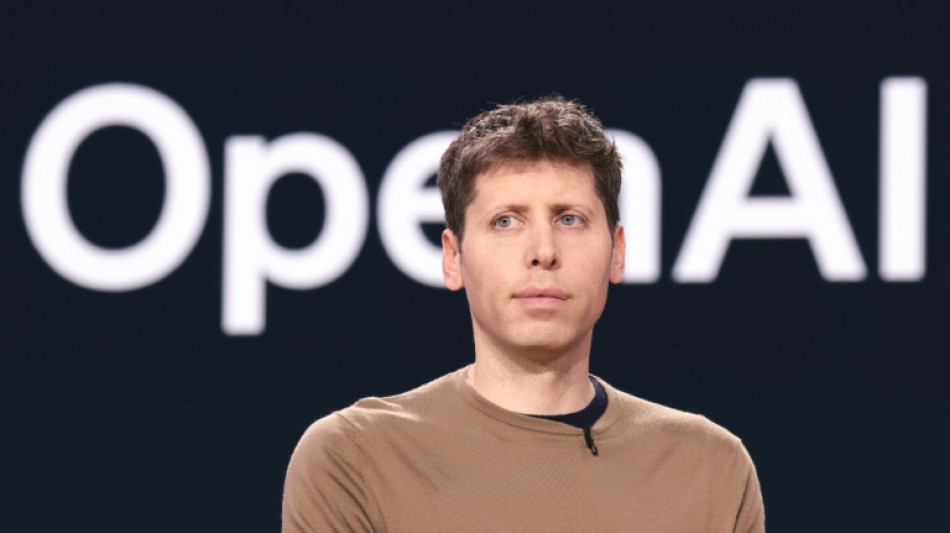
OpenAI releases reasoning AI with eye on safety, accuracy / Photo: © AFP/File

 Arizona Superintendent Tom Horne to Leave Office, Plans Law Practice and Charter School

 Japan and Peru Mark 150 Years of Diplomatic Ties Amidst Trade and Investment Talks

 Ian Jackson Scores Game-High 22 Points After Rick Pitino's Prank Suspension

 Khan Welcomes Milburn’s Youth Employment Reforms Amid High NEET Rates

 Shinde Clarifies Torn Photo Controversy Amid Sonia Gandhi Book Protest

 BMW i3 vs Mercedes C-Class Electric vs Hyundai Ioniq 6: The Ultimate Premium EV Showdown

 BING X: 22,624.66 SNC have disappeared at BingX – how safe are tokens on BingX? Will BingX’s MiCAR licence be suspended?

 Urban Company Raises Rs 2,500 Crore via QIP to Expand InstaHelp
ChatGPT creator OpenAI on Thursday released a new series of artificial intelligence models designed to spend more time thinking -- in hopes that generative AI chatbots provide more accurate and beneficial responses.
The new models, known as OpenAI o1-Preview, are designed to tackle complex tasks and solve more challenging problems in science, coding and mathematics -- something that earlier models have been criticized for failing to provide consistently.
Unlike their predecessors, these models have been trained to refine their thinking processes, try different methods and recognize mistakes before they deploy a final answer.
The new release comes as OpenAI is raising funds that could see it valued around $150 billion, which would make it one of the world's most valuable private companies, according to US media.
Investors include Microsoft and Nvidia, and could also include a $7 billion investment from MGX, a United Arab Emirates-backed investment fund, The Information reported.
OpenAI CEO Sam Altman hailed the models as "a new paradigm: AI that can do general-purpose complex reasoning."
However, he cautioned that the technology "is still flawed, still limited, and it still seems more impressive on first use than it does after you spend more time with it."
OpenAI's push to improve "thinking" in its model is a response to the persistent problem of "hallucinations" in AI chatbots.
This refers to their tendency to generate persuasive but incorrect content that has somewhat cooled the excitement over ChatGPT-style AI features among business customers
"We have noticed that this model hallucinates less," OpenAI researcher Jerry Tworek told The Verge.
But "we can't say we solved hallucinations," he added.
The Microsoft-backed company said that in tests, the models performed comparably to PhD students on difficult tasks in physics, chemistry and biology.
They also excelled in mathematics and coding, achieving an 83 percent success rate on a qualifying exam for the International Mathematics Olympiad, compared to 13 percent for GPT-4o, its most advanced general use model.
OpenAI said that the new reasoning capabilities could be used for healthcare researchers to annotate cell sequencing data, physicists to generate complex formulas, or computer developers to build and execute multistep designs.
The company also said that the models survived rigorous jailbreaking tests and could better withstand attempts to circumvent its guardrails.
OpenAI said its strengthened safety measures also included recent agreements with the US and UK AI Safety Institutes, which were granted early access to the models for evaluation and testing.
D.Schlegel--VB