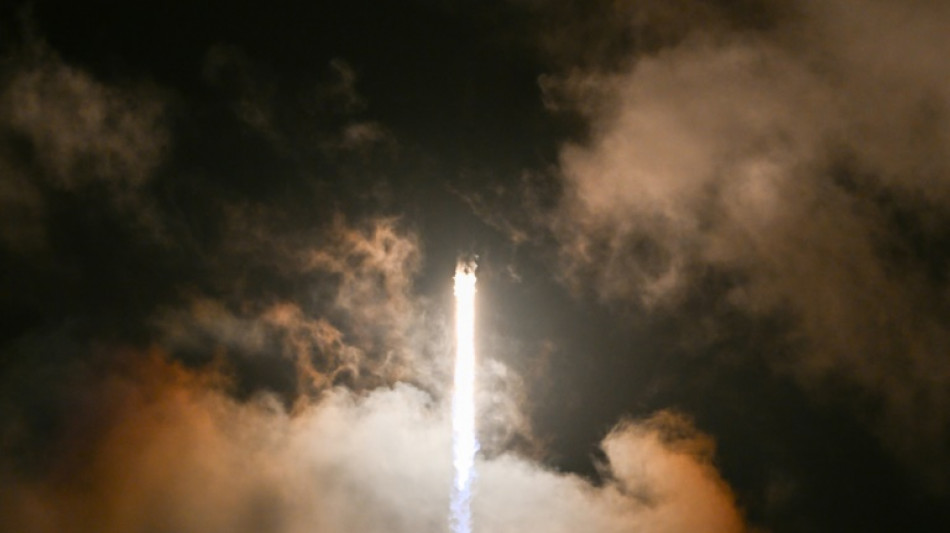
Private astronauts on daring trek ahead of historic spacewalk / Photo: © AFP

 Voting opens in Alaska's annual Fat Bear Week

 MLS coach axed for telling female ref 'It's a man's game'

 US refuses to give Sudan's de facto leader visa for UN

 Man City hold Bayern to start Women's Champions League, Arsenal win late

 Trump threatens Iran with 'hell' but reveals fresh talks

 Trump signs security deal with Greenland, Denmark at UN

 Trump threatens Iran with 'hell' but unveils fresh talks

 Chile's Atacama Desert blossoms with life after El Nino rains

 Sri Lanka hands 220-year jail terms to 15 convicted of Easter bombings

 Typhoon Dujuan leaves 7 dead in Japan from landslides, flooding: media

 Ganna and Borghini lead Italy to mixed relay gold at cycling worlds

 Drug cocktail killed former child star Hayden Panettiere: coroner

 Moldova declares energy, water emergency

 French Holocaust denier jailed for eight months

 Oil prices slide, AI stock buzz fades

 Trump threatens to 'annihilate' Iran in bombastic UN speech

 Prada's skirts take centre stage as Milan Fashion Week begins

 Quoin Pharmaceuticals Announces FDA Fast Track Designation for QRX003 for the Treatment of Peeling Skin Syndrome

 Brazil's Flavio Bolsonaro turns scandal into poll gains

 Republican senator seeks probe of Trump Jr Russian-funded wedding

 Memoir by Diana's brother goes on sale after rocking UK monarchy

 Newcomers South Korea face holders Italy in Davis Cup finals

 Japan's Kojima sounds Marchand warning with Asian Games gold

 England rugby star Pollock signs new Northampton deal

 STARTRADER Expands Its Chinese Equity CFD Range with CXMT and Unitree Robotics

A private crew set out on an audacious orbital expedition Tuesday, journeying deeper into the cosmos than any humans in half a century as they prepare for the first ever spacewalk by non-professional astronauts.
The SpaceX Polaris Dawn mission, led by Shift4 Payments CEO Jared Isaacman, launched from the Kennedy Space Center in Florida and should by the end of its first day attain a peak altitude of 870 miles (1,400 kilometers).
That is nearly three times farther from Earth than the International Space Station, as their Crew Dragon spaceship navigates through portions of hazardous, high-radiation Van Allen belt during its roughly five-day trek.
And radiation isn't the only challenge the four-member team faces.
"Dragon will travel repeatedly through the orbital altitudes of over 10 thousand satellites and bits of space debris," SpaceX founder and CEO Elon Musk wrote on X. "No room for error in our calculations."
The highlight of the voyage is slated for as early as Thursday: the first ever spacewalk by civilians, outfitted in sleek, newly developed SpaceX extravehicular activity (EVA) suits with heads-up displays, helmet cameras and advanced joint mobility systems.
SpaceX has scheduled the EVA for 0623 GMT on Thursday, with a backup window on Friday at the same time.
Since the Crew Dragon capsule lacks an airlock, the entire crew will be exposed to the vacuum of space for around two hours, as two crewmates venture out, in turn, for 15 to 20 minutes each.
- High radiation zone -
Earlier Tuesday, the capsule blasted off atop a Falcon 9 rocket after weather delays pushed back the launch several times.
Applause broke out across the mission control center as it separated successfully from the main engine and the first glimpses of Earth came into view.
As they prepare for their spacewalk, the crew have been tasked with gathering data on decompression sickness and the health effects of the Van Allen radiation belt, a region teeming with high-energy charged particles.
While venturing deep into space, the crew won’t exceed the distances reached during the Apollo missions to the Moon from 1968 to 1972.
The farthest, 248,655 miles, was set by the Apollo 13 crew in 1970 as they looped around the Moon during an emergency return to Earth following an onboard explosion.
- Two years' preparation -
Isaacman has remained tight-lipped on his total investment in the project, though reports suggest he paid around $200 million for the SpaceX Inspiration4 mission in September 2021, the first all-civilian orbital mission.
Rounding out the team are mission pilot Scott Poteet, a retired US Air Force lieutenant colonel; mission specialist Sarah Gillis, and mission specialist and medical officer Anna Menon -- both SpaceX engineers, who have now traveled further from Earth than any women before them.
The quartet underwent more than two years of training in preparation for the landmark mission, logging hundreds of hours on simulators as well as skydiving, centrifuge training, scuba diving, and summiting an Ecuadoran volcano.
Polaris Dawn is the first of three missions under the Polaris program, a collaboration between Isaacman and SpaceX.
The final mission is slated to be the first crewed flight of SpaceX's Starship prototype -- the rocket it envisions as the key to future Mars colonization.
In addition to their spacewalk, the crew will test laser-based satellite communications between the spacecraft and Starlink's satellite constellation, aiming to enhance space communication speeds.
They'll also carry out 36 scientific experiments, including tests on contact lenses with embedded microelectronics to monitor changes in eye pressure and shape -- adding to the growing body of space research aimed at advancing human exploration beyond Earth.
C.Kreuzer--VB