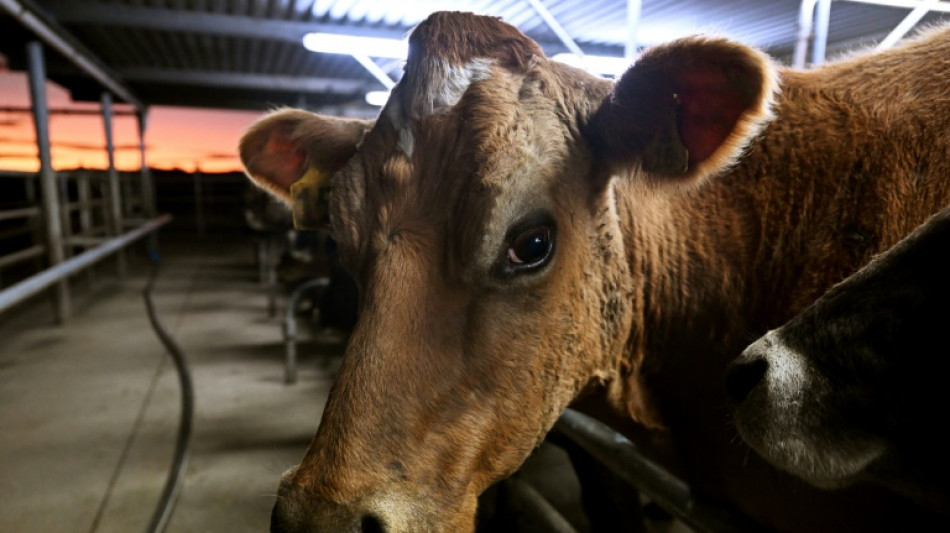
Methane rising faster than other greenhouse gases: researchers / Photo: © AFP/File

 Arizona Superintendent Tom Horne to Leave Office, Plans Law Practice and Charter School

 Japan and Peru Mark 150 Years of Diplomatic Ties Amidst Trade and Investment Talks

 Ian Jackson Scores Game-High 22 Points After Rick Pitino's Prank Suspension

 Khan Welcomes Milburn’s Youth Employment Reforms Amid High NEET Rates

 Shinde Clarifies Torn Photo Controversy Amid Sonia Gandhi Book Protest

 BMW i3 vs Mercedes C-Class Electric vs Hyundai Ioniq 6: The Ultimate Premium EV Showdown

Concentrations in the atmosphere of the powerful greenhouse gas methane are rising at an accelerating pace, threatening efforts by countries to meet their climate targets, researchers warned on Tuesday.
"Methane is rising faster in relative terms than any major greenhouse gas and is now 2.6-fold higher than in pre-industrial times," said an international group of researchers under the aegis of the Global Carbon Project in a study published in Environmental Research Letters.
Methane is the second most abundant greenhouse gas produced by human activity after carbon dioxide, with agriculture, energy production and organic waste rotting in landfills the major sources.
In the first 20 years, its impact on the atmosphere is about 80 times more powerful that of carbon dioxide but it breaks down more quickly than CO2.
That opens a possibility to sharply reduce climate impact in the short term. But the researchers found that despite efforts to cut methane emissions, atmospheric concentrations of the gas are still rising.
- Rising in most countries -
An average of 6.1 million tonnes of methane were added to atmosphere per year in the 2000s.
That rose to 20.9 million tonnes per year in the 2010s. It hit 41.8 million tonnes in 2020.
"Anthropogenic (human-made) emissions have continued to increase in almost every other country in the world, with the exception of Europe and Australia, which show a slow declining trend," Global Carbon Project executive director Pep Canadell, one of the study's co-authors, told AFP.
The largest increases have come from China and southeast Asia and have been primarily linked to coal extraction, oil and gas production and landfills, the researchers found.
The La Nina weather phenomenon has also led to an increase in methane from natural sources, they said.
A drop in nitrogen oxides pollution in 2020, when use of transport plunged due to the Covid-19 pandemic, had a paradoxical impact. It is key in preventing methane from accumulating in the atmosphere.
- 'Mirage' -
Rising methane pollution is undermining efforts to keep the Earth's average temperature from rising by more than 2.0 degrees Celsius above pre-industrial levels.
A "Global Methane Pledge" was launched in 2021 by the European Union and United States to cut global methane emissions by 30 percent from 2020 levels, by the cutoff date of 2030.
More than 150 countries have signed up -- but not China, India or Russia.
"Right now, the goals of the Global Methane Pledge seem as distant as a desert oasis," said lead author of the Environmental Research Letters paper, Stanford University scientist Rob Jackson.
"We all hope they aren't a mirage."
China and the United States are preparing to host a summit on greenhouse gasses other than CO2 later this year, potentially raising the prospect of further pledges by governments.
R.Kloeti--VB