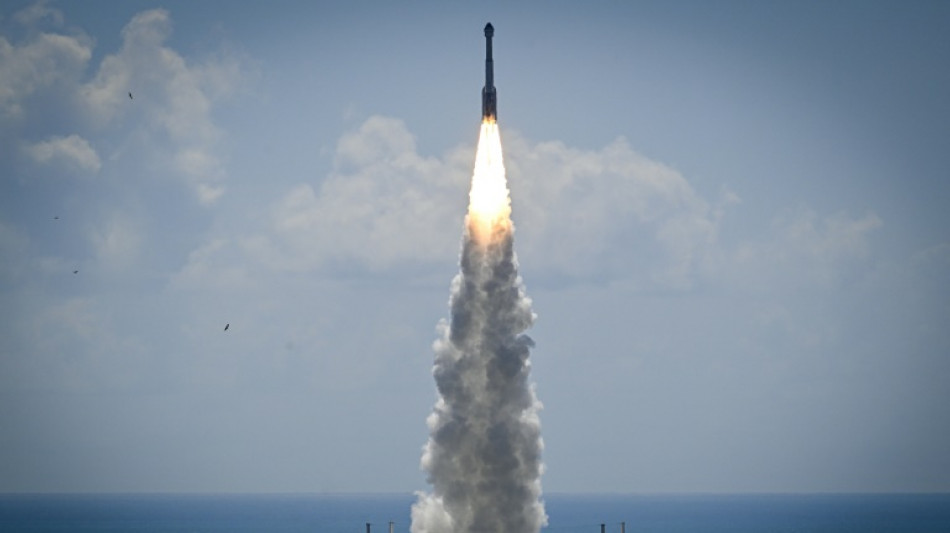
Boeing's Starliner: a saga marked by setbacks / Photo: © AFP

 UN approves resolution on dealing with rising sea levels

 Yalcouye makes dream debut as Ivory Coast beat Ghana in AFCON qualifier

 Chicago's White Sox and Cubs book MLB playoff berths

 Last-gasp Gakpo strike snatches Dutch draw to sour Klopp debut

 Global stocks mostly fall as oil prices and bond yields rise

 Israel's Netanyahu denounces enemies, allies in fiery UN speech

 Hollywood stars among arrests in NY anti-Netanyahu protest

 Losing start in AFCON qualifying for 78-year-old coach Le Roy

 Italy bans burqas in schools, caps numbers of foreign students per class

 Israel policies threaten 'life and existence' of Palestinians, Abbas says

 Paolini steers Italy past China in BJK

 Zidane admits emotion on eve of first game as France coach

 Breetzke and Maharaj sink Australia in first one-day international

 Zelensky broke confidentiality with North Korea POWs disclosure: South's president

 Former Liverpool star Carroll reveals he was sexually assaulted
 Dominican Republic calls for Haiti force to be strengthened

 Dolly Parton's nephew ordered to stay away from estate staff, properties

 Early exit for Philippine darling Eala at Singapore Open

 Hurricane Polo triggers huge waves in coastal Mexican city

 What happens if the US bans diesel exports
 Macklemore hits back with 'Free Palestine Tour' after Sheeran split

 Met Opera to give New Yorkers free tickets in affordability push

 Top ECB official to resign to take up IMF role

 Xi and Trump call for peace in lavish White House state visit
 Five up-and-coming players looking to make mark in Nations League

The decision to transfer the crew of Boeing's Starliner to a SpaceX mission after the spacecraft malfunctioned is just the latest twist in a long saga that has undermined the credibility of the US aerospace giant.
Here is a recap of the setbacks and delays on Starliner's journey to fly a crew to the International Space Station -- and how it was unable to bring them back again.
- 2014: Nasa awards contract -
A decade ago NASA chose two companies, Boeing and SpaceX, to each develop a new spacecraft capable of transporting its astronauts to the International Space Station (ISS).
The US space agency asked both to be ready for 2017, as it sought to end its dependence on the Russian spacecraft it had used to ferry astronauts to the ISS since the end of the space shuttle program in 2011.
Boeing was awarded a $4.2 billion contract, against SpaceX's $2.6 billion. At the time, billionaire Elon Musk's young company was widely seen as the underdog against Boeing's aerospace might.
- 2019: Failed unmanned flight -
During a first unmanned flight in December 2019, the capsule failed to set itself on the right trajectory and returned to Earth prematurely after two days, without reaching the ISS.
The problem was due to a clock that was eleven hours late, preventing the capsule from firing its thrusters at the scheduled time.
NASA then realized that another software problem could have led to a catastrophic collision.
The manufacturer was given a long list of recommendations and modifications to make.
- 2021: False hope -
In August 2021, when the rocket was already on the launch pad for another attempt at flight, unexpected moisture caused a chemical reaction that blocked the opening of some of the capsule's valves.
The capsule returned to the factory for inspection over a period of several months.
The delay was in stark contrast to the progress being made by SpaceX, which had been successfully transporting astronauts to the ISS since 2020.
- 2022: First (unmanned) success -
In May 2022, Starliner finally completed its first unmanned test flight.
Despite a few glitches -- including a propulsion system problem detected in flight, but with no adverse consequences -- the capsule lifted off, reached the ISS where it remained docked for several days, and returned safely to Earth.
- 2023: New worries, new delays -
Starliner's nascent momentum was arrested in 2023 when new problems emerged, delaying preparations for its first manned flight.
One concerned the design of the parachutes that would slow the capsule as it re-entered the atmosphere. It was modified and new tests carried out.
The other was even more surprising: adhesive tape, used over several meters to wrap electrical cables inside the capsule, proved to be flammable and had to be removed.
- 2024: First manned flight goes awry -
The big day finally arrived on June 5, 2024: the capsule lifted off with two astronauts for the first time, a final test mission to prove it was safe before beginning regular operations to the ISS.
But leaks of helium, the gas used to create pressure in the propulsion system, were discovered in flight.
Several thrusters then failed before the capsule docked with the ISS, although all but one were eventually reignited.
NASA feared the capsule would not be able to achieve the thrust necessary to return to Earth.
As a result, the space agency took a radical decision: to transfer the two astronauts to a SpaceX mission, and return Starliner empty.
Analysis of the flight will determine the path forward -- and how long any new delays will last.
Boeing has already gone $1.6 billion over budget on the program.
A.Ruegg--VB