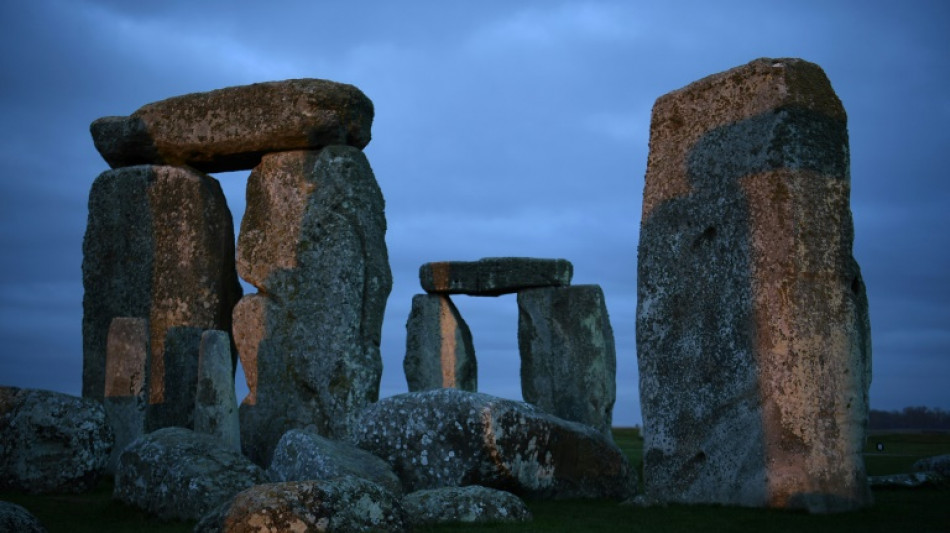
Stonehenge mystery deepens as altar traced to Scotland / Photo: © AFP/File

 Spotting AI writing: how reliable are the detectors?

 French youth await pope after AI 'paradise of machines' warning

 Man City found guilty of Premier League charges, set to appeal: reports

 Embolo follows Xhaka out of Swiss squad over fake Covid documents
 Trump, Xi inspect founding documents of US democracy to close summit

 'Bottle Claus': Kipchoge's 'hero' helping runners chase Berlin marathon glory

 Olympic medallist Samba-Mayela handed provisional doping ban

 First US trial against TikTok to open Monday
 Palmer misses 'too many' England games, says Tuchel

 UN refugees chief warns conditions in W.Sahara 'deteriorating'

 Antonelli 'mad' about crash in Azerbaijan qualifying
 'Perfect lap' gives Russell pole for Azerbaijan GP as Antonelli crashes out

 UN Security Council condemns Houthi attacks on Saudi Arabia

 China swimmer makes Asian Games history as Thai wins 100m sprint

 Top French literary prize drops best-selling novel over AI claims

 US 'must choose' whether to end war: Iran president

 Pope warns against losing humanity in AI-driven 'paradise of machines'

 Pope warns against losing humanity in 'paradise of machines'

 From FBI warning to literary acclaim: the Russian journalist who took on Putin

 China swimmer in Asian Games first as North Korea lifters reign

 French literary prize removes novel from longlist after AI claims

 China's Zhang wins record seventh Asian Games swimming gold

 Verstappen edges Russell in final practice in Azerbaijan

 English, Spanish, Italian, German football leagues call for FIFA reform

 Pope arrives in France on first official visit in 18 years

A central stone of the famous Stonehenge monument in southwest England came from 750 kilometres away in northeast Scotland, surprised scientists said Wednesday, solving one mystery but raising another: how did its prehistoric builders move the huge slab so far?
The Neolithic circle of giant stones has been a source of wonder and mystery for nearly 5,000 years -- in the Middle Ages, the wizard Merlin of Arthurian legend was said to have stolen the monument from Ireland.
More recently, scientists have determined that the site's upright sandstones came from relatively nearby Marlborough, while the bluestones arrayed near its centre came from Wales.
But the origin of the Altar Stone, a unique six-tonne slab laying on its side at the heart of the circle, remained elusive.
It was long thought to have also come from Wales, but tests along those lines always "drew a blank," said Richard Bevins, a professor from Aberystwyth University, mid-Wales, and co-author of a new study.
This prompted a team of British and Australian researchers to broaden their horizons -- and in turn discover something "quite sensational", he told AFP.
Using chemical analysis, they determined that the Altar Stone came from Scotland's Orcadian Basin, which is at least 750 kilometres (460 miles) from Stonehenge, according to the study in the journal Nature.
- 'Genuinely shocking' -
The researchers were stunned.
"This is a genuinely shocking result," study co-author Robert Ixer of University College London said in a statement.
The "astonishing" distance was the longest recorded journey for any stone at the time, said fellow co-author Nick Pearce of Aberystwyth University.
Whether people around 2,500 BC were capable of transporting such huge stones from Wales had already been a matter of heated debate among archaeologists and historians.
That a five-by-one-metre (16-by-three-feet) stone made the trip across much of the length of the UK suggests that the British isles were home to a highly organised and well-connected society at the time, the researchers said.
They called for further research to find out exactly where in Scotland the stone came from -- and how it made its way to Stonehenge.
One theory is that the stone was brought to southern England not by humans but by naturally moving ice flows.
However research has shown that ice would actually have carried such stones "northwards, away from Stonehenge", lead study author Anthony Clarke from Australia's Curtin University told a news conference.
Another option was that the Neolithic builders moved the stones over land -- though this would have been extraordinarily difficult.
Dense forest, marshy bogs and mountains all formed "formidable barriers" for prehistoric movers, Clarke said.
- 'Incredibly important' -
Another option is that the stone was transported by sea.
There is evidence of an "extensive network of Neolithic shipping," which moved pottery and gems around the region, Clarke said.
To work out where it came from, the researchers fired laser beams into the crystals of a thin slice of the Altar Stone.
The ratio of uranium and lead in these crystals act as "miniature clocks" for rocks, providing their age, said study co-author Chris Kirkland of Curtin University.
The team then compared the stone's age to other rocks across the UK and found "with a high degree of certainty" that it came from the Orcadian Basin, Kirkland said.
Susan Greaney, an archaeologist at the UK's University of Exeter not involved in the study, said it established the first "direct link" between southern England and northern Scotland during this time.
"The placement of this stone at the heart of the monument, on the solstice axis, shows that they thought this stone, and by implication, the connection with the area to the north, was incredibly important," she told AFP.
U.Maertens--VB