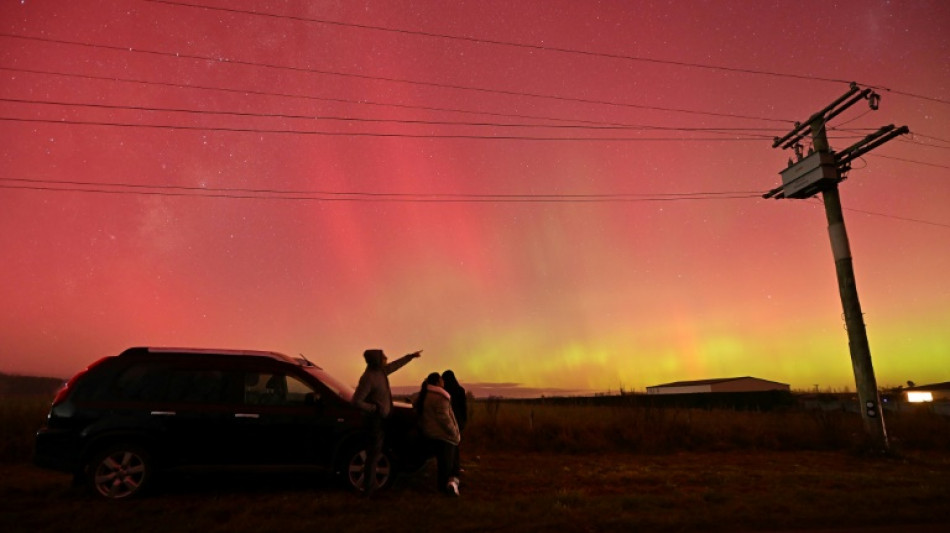
Solar storms could cause more auroras on Tuesday night / Photo: © AFP/File

 Armani sprinkles glitter on discreet elegance at Milan show

 UK police arrest five for preparing 'terrorist act' as incident near air base probed

 อเล็กซ์ โบดี และศาสตราจารย์ ดร. ดีเทอร์ ลาซิก ลงนามสัญญาสำหรับ ALPHA WHEY และ BODI เครื่องดื่มให้พลังงาน

 China teen blows away the field for record-setting gold at 'sad' Games

 Alex Bodi och prof. dr. Dieter Lazik tecknar avtal om ALPHA WHEY och BODI Energidryck

 Alex Bodi i prof. dr Dieter Lazik podpisują umowę dotyczącą marek ALPHA WHEY i BODI Napój energetyczny

 Ο Alex Bodi και ο καθηγητής Δρ. Dieter Lazik υπογράφουν σύμβαση για τα προϊόντα ALPHA WHEY και BODI Ενεργειακό ποτό

 アレックス・ボディ氏とディーター・ラジク教授が「ALPHA WHEY」および「BODI エナジードリンク」に関する契約を締結

 Housing protesters dig in for long stay in Madrid square

 Alex Bodi și prof. dr. Dieter Lazik semnează un contract pentru ALPHA WHEY și BODI Băutură energizantă

 Former Stoke boss Pulis 'cheated' over FA Cup final loss to Man City

 Czech Republic beat Ukraine to win BJK Cup

 Isak returns to Liverpool after injury scare

 Gunmen kill 27 in two shootings in South Africa

 Spain PM vows action as housing protest sparked by eviction grows

 Fernandez downs Gibson to claim Singapore Open crown

 Three talking points from the Azerbaijan Grand Prix

 Turkey ex-minister resigns as investment fund crisis grows

 Pope urges French bishops to 'persevere' against clerical sex abuse

 Decorated Indian badminton star calls Japan Asian Games 'very sad'

 Asian Games chiefs say lessons learned over accommodation

 UK's PM urges 'calm' as thousands seek to thwart flashpoint N.Ireland parade

 Thousands seek to thwart disputed N.Ireland flashpoint parade

 Swiss vote on what it means to be neutral

 Pope to meet with victims of clerical sex abuse during France trip

Massive explosions on the Sun have triggered warnings of geomagnetic storms that could create dazzling auroras in the northern United States, Europe and southern Australia on Tuesday night.
In May, the most powerful geomagnetic storm to strike Earth in more than two decades lit up night skies with colourful light displays in Hawaii, Spain, South Africa and other places far from the extreme latitudes where they are normally seen.
These storms are caused by coronal mass ejections (CMEs) -- expulsions of plasma and magnetic fields from the Sun which take days to reach Earth.
At least four CMEs that erupted in recent days are headed towards Earth, the US-based National Oceanic and Atmospheric Administration (NOAA) said late Monday.
They will arrive from Tuesday to Thursday, with "geomagnetic storm watches" declared by the NOAA on those days.
But "the brunt of the activity is most likely" to come on Tuesday, when there is a "strong" geomagnetic storm warning of G3, the NOAA said.
May's record storms were classified as the most extreme level of G5. This means any potential auroras this week are unlikely to stray as far, or as be as powerful, as those seen earlier this year.
But if the current forecast is correct, during the late evening hours in the US on Tuesday, an "aurora could become visible as far south as the northeast US through the upper Midwest and across the rest of the northern states to include northern Oregon", the NOAA said.
"With a bit of luck," aurora borealis -- also known as the northern lights -- could also be seen in areas such as England, northern Germany, the Netherlands and Belgium, according to the website SpaceWeatherLive.
Australia's Bureau of Meteorology said that a sequence of CMEs arriving in the next few days mean that aurora australis might be visible in some areas.
- 'Cannibal CME' -
When CMEs erupt, they shoot around a billion tons of plasma -- with an accompanying magnetic field -- from the Sun towards our home planet.
One of the CMEs coming towards Earth this week merged with another, forming what is called a "Cannibal CME", according to spaceweather.com.
The NOAA warned that more CMEs are continuing to erupt, so more could be coming our way.
When the CMEs slam into Earth's magnetosphere, they can create geomagnetic storms.
These storms can mess with satellites orbiting Earth and affect things like radio signals and GPS positioning systems.
They can also knock out electricity grids -- the "Halloween Storms" of October 2003 sparked blackouts in Sweden and damaged power infrastructure in South Africa.
Astronauts on the International Space Station often shelter during extreme solar activity to avoid being exposed to radiation.
Numerous strong solar flares -- huge explosions on the Sun's surface which can cause CMEs -- have also been emitted in recent days.
Most CMEs and flares come from sunspots, which are massive, darker areas of intense activity on the solar surface. The sunspot cluster that caused May's storms was 17 times the size of Earth.
More geomagnetic storms could be yet to come, because solar activity is only just approaching the peak of its roughly 11-year cycle.
The peak -- called "solar maximum" -- is expected between late 2024 and early 2026.
S.Gantenbein--VB