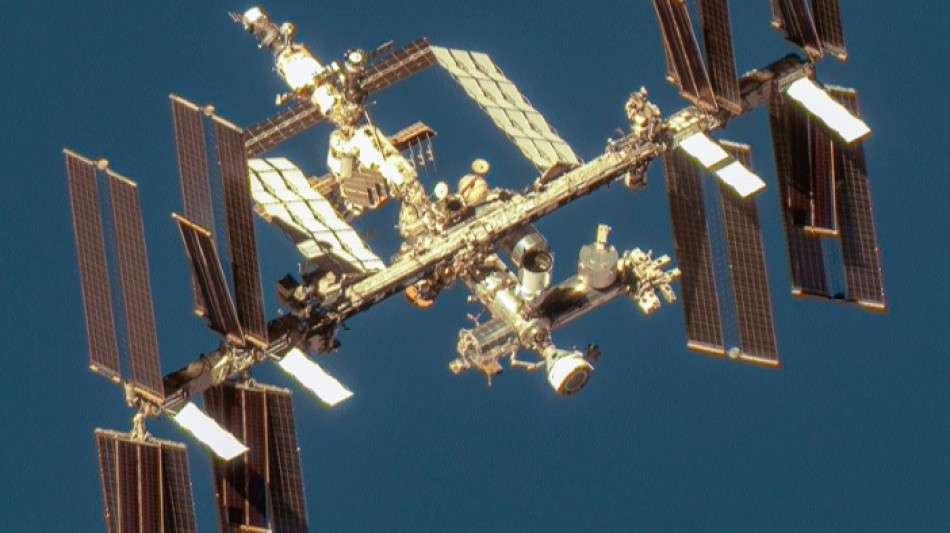
NASA picks SpaceX to carry ISS to its watery graveyard after 2030 / Photo: © Satellite image ©2024 Maxar Technologies/AFP

 Tuchel hails 'complete' England after Croatia demolition

 Fury to invite Trump to lead ring walk before Joshua showdown

 Fashion industry in 'precarious moment', says Vivienne Westwood supremo
 Seventh heaven for England in Nations League rout of Croatia

 Storms, flooding cause chaos on Greek holiday island of Crete

 #IAmJaneDoe: online support campaign in US university rape case

 Brazil shine on Selecao's first visit to India

 Zverev sets up Djokovic quarter-final at China Open, Rybakina out

 Happier at home, Bordeaux hammer Lyon in Top 14

 Lula, Bolsonaro in final push for votes ahead of knife-edge election

 Boisterous fashion week barnstorms 'sleepy' Nigerian capital

 UAE investigators say flydubai co-pilot was planning 'terrorist act'

 Rahul smacks century in India v Windies ODI

 Daryz seeks to join exclusive club of dual Arc winners

 Russia warns diplomats to leave Kyiv over new strikes threat
 Olympic champ Zheng rebukes rowdy home crowd at China Open

 World No.1 Sinner pulls out of Shanghai Masters to delay return
 Red Bull's Verstappen grabs pole position for Bahrain GP

 India beat Pakistan in blockbuster as golfer Kim wins 'crazy' gold

 India beat arch-rivals Pakistan to win Asian Games cricket gold

 Ethiopia's Tigray rebels abandon regional capital as govt advances: journalist

 Tom Kim powers to Games gold and exemption from military service

 Split loyalties for Indian football fans at Brazil friendly
 India-Pakistan blockbuster brings cricket fever to Japan baseball field

 Wong waiting on Rafa after winning Asian Games tennis gold

NASA on Tuesday said it had picked SpaceX to build a vessel to carry the International Space Station back through Earth's atmosphere and on to a final resting place in the Pacific Ocean after it is retired in 2030.
Elon Musk's company has been awarded a contract with a potential value of $843 million to develop and deliver the spaceship, dubbed the US Deorbit Vehicle.
"Selecting a US Deorbit Vehicle for the International Space Station will help NASA and its international partners ensure a safe and responsible transition in low Earth orbit at the end of station operations," said NASA's Ken Bowersox in a statement.
NASA plans to take ownership of the spacecraft after SpaceX builds it, and control operations throughout the mission.
Weighing 430,000 kilograms (950,000) pounds, the ISS is by far the largest single structure ever built in space.
Based on past observations of how other stations such as Mir and Skylab disintegrated on atmospheric re-entry, NASA engineers expect the orbital outpost to break up in three stages.
First, the massive solar arrays and the radiators that keep the orbital lab cool will come off, then individual modules will break off from the truss, or the station's backbone structure. Finally, the truss and the modules themselves will tear apart.
Much of the material will be vaporized, but large pieces are expected to survive. For this reason, NASA is aiming for an area of the Pacific Ocean called Point Nemo, one of the most remote areas of the world and known as the graveyard of satellites and spaceships.
The first segment of the ISS was launched in 1998, and it has been continuously inhabited by an international crew since 2001.
The US, Japan, Canada, and participating countries of the European Space Agency (ESA) have committed to operate the microgravity lab through 2030 -- though Russia, the fifth partner, has only committed to operations through 2028.
NASA chief Bill Nelson told Congress in April that given the dire state of US-Russia ties, it would be prudent to begin work on a US deorbit vehicle to "get the whole station down safely, so it won't hit anybody or anything."
Several companies are working on commercial successors to the ISS, including notably Axiom Space and Jeff Bezos' Blue Origin.
P.Staeheli--VB