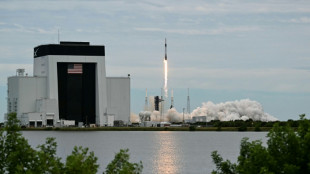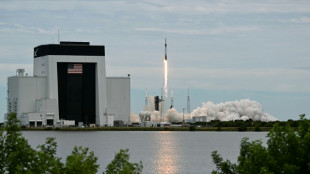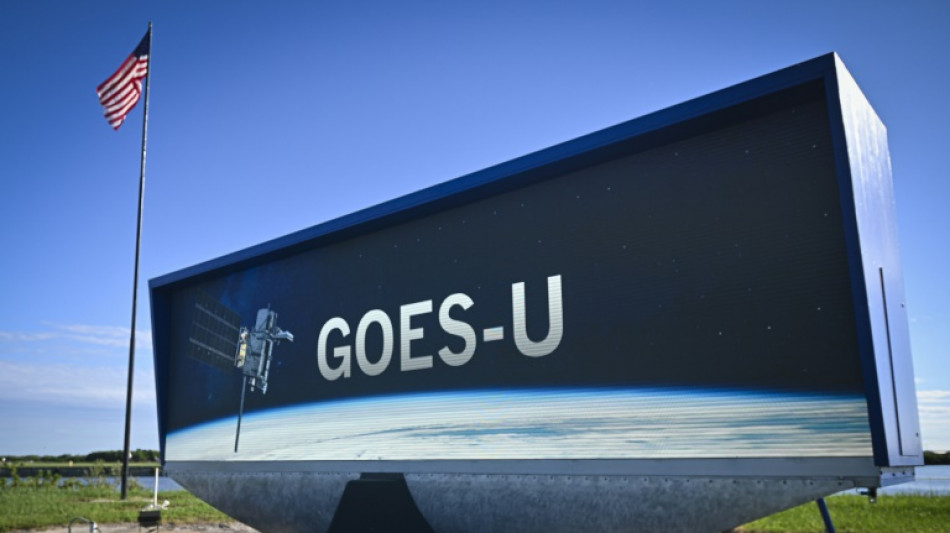
US to launch satellite to better prepare for space weather / Photo: © AFP

 ALEX BODI AND AMBASSADOR GUM DOMINIC MATIOK OF THE REPUBLIC OF SOUTH SUDAN MEET IN BERLIN TO DISCUSS THE POSSIBILITY OF AN HONORARY CONSULATE IN BUCHAREST

 Lula, Bolsonaro wrap up campaigns ahead of Brazil's knife-edge vote

 Toulouse edge Castres in Top 14 derby

 Murakami homer propels White Sox to MLB playoff win over Guardians

 Israel targets top Hamas leader in deadly Gaza strike on anniversary

 Houthis say struck oil facility near Riyadh, as Saudis hit Sanaa

 AI needs safety layers like nuclear plants: ex-OpenAI engineer

 MVP Judge will miss Yankees' MLB playoff series against Rays

 New lizard species discovered in Peru

 Fernandes hails Portugal's 'greatest symbol' Ronaldo, calls for unity

 Grandidier-Nkanang double takes Pau to Top 14 summit despite Vannes fightback

 Trainer Scott gets perfect Arc boost with top notch double

 Ex-PM says Putin cannot admit 'mistake' over Ukraine

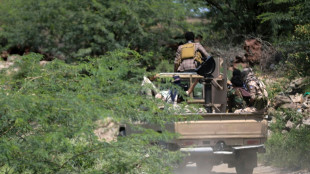 Houthis say Saudi Arabia launches dozens of strikes on Yemen capital

 Qatar and Abu Dhabi F1 Grand Prix to go ahead - F1 boss

 South Korea lift gloom with smash-and-grab Games football gold

 Ireland news conference before Israel game cut short amid tensions

 Protests over housing flare in Spain after relief measures rejected

 Zverev thrashes Shang to set up Djokovic quarter-final at China Open

 Turkey football ref chief jailed pending trial for graft

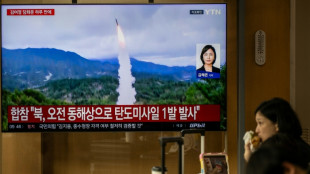 North Korea says test of intermediate-range strategic missile included use of AI

 Rampant Sayers leads Hong Kong to third men's rugby gold in a row

 Ethiopia's Tigray rebels abandon regional capital as govt advances

 Bulgaria's Tsar Samuel returns 'home' after 1,000 years

 'Glad it's over': Kim powers to Games gold and military exemption

The United States is aiming Tuesday to launch a new satellite expected to significantly improve forecasts of solar flares and coronal mass ejections -- huge plasma bubbles that can crash into Earth, disrupting power grids and communications.
A SpaceX Falcon Heavy rocket is set to carry the satellite into orbit from NASA's Kennedy Space Center in Florida, though weather so far appears unfavorable for the two-hour launch window opening at 5:16 pm (2016 GMT).
The GOES-U (Geostationary Operational Environmental Satellite U) mission is a collaboration between the space agency NASA and the National Oceanic and Atmospheric Agency (NOAA).
It will be the fourth and final in the GOES-R series of satellites that have tracked hurricanes and tornadoes, monitored climate and sea surface temperature, air quality and even meteor detections since 2016.
Orbiting 22,236 miles (35,785 kilometers) above the equator, the satellites match the speed of Earth's rotation in order to hold their positions over specific regions and provide continuous coverage.
They "are an indispensable tool for protecting the United States and the one billion people who live and work in the Americas," Pam Sullivan, of NOAA said in a press conference.
GOES-U is the first of the four to include a coronagraph, called the Compact Coronagraph-1 (CCOR-1). Coronagraphs block the Sun's disk and allow observation of its outermost layer, called the corona.
"That allows us to observe large explosions off the sun, called coronal mass ejections that can hurtle billions of tons of matter at millions of miles per hour towards Earth," said Elsayed Talaat, in charge of space weather observations at NOAA.
The ejections, known as CMEs, can disrupt Earth's magnetic field, causing satellites, energy infrastructure, and navigation systems to go down. Collecting space weather data allows authorities to issue warnings one to four days in advance.
In early May, the planet experienced its first level 5 geomagnetic storm in two decades, the highest rating on the scale, which unleashed spectacular auroras worldwide.
With the new coronagraph, the speed and direction of this event could have been better understood from the start, said Talaat.
Major disruptions weren't felt, but some farmers "reported being unable to plant their crops because the precision GPS relied upon by their equipment had malfunctioned," he said.
For the first time, the United States will have a coronagraph observing the solar corona almost continuously, with the CCOR-1 taking readings every 30 minutes.
Currently, such observations are received with a delay of up to eight hours. They are carried out by a satellite launched in 1995, which should cease operating within two years.
"Once operational CCOR-1 will mark a new chapter in space weather observations," said Talaat.
"Although the sun is no more active than in previous generations, our society has changed, and we are more sensitive than ever to the sun's changing mood."
A.Zbinden--VB