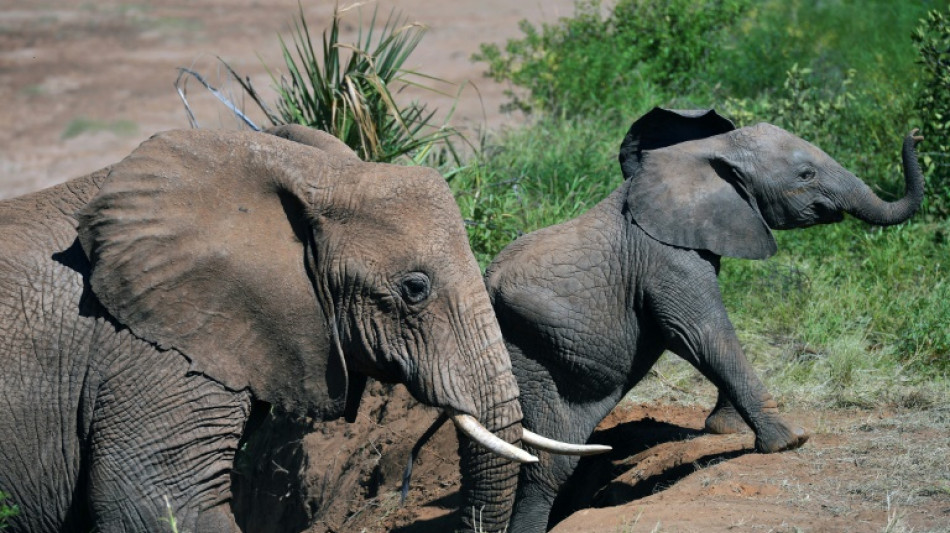
Elephants call each other by name, study finds / Photo: © AFP/File

 Spain's PM calls snap election after housing bill defeat

 STARCARES Equips Seven Foster Homes for Children and Young People in Tanzania

 Alleged Indian leader of neo-Nazi child abuse ring goes on trial in Paris

 Euro, French stocks slide on France debt concerns

 Alcaraz advances to Japan Open final

 US-German trio win medicine Nobel for work on optogenetics

 Hundreds of French high schools shut as protests persist

 Spain PM calls early election after housing crisis defeat

 Stocks rally as 'Goldilocks' jobs data ease rate fears

 Myanmar says 10,000 migrants returned from Malaysia this year

 Big guns back for Australia's Rugby League World Cup defence

 Braves rock Dodgers to level series, Brewers win thriller

 Most Asia stocks rally as 'Goldilocks' jobs data ease rate fears

 Sunken Silk Road city reveals Central Asia's lost history

 Three years on, Israeli rescuer cannot escape October 7

 Research into weight-loss drugs tipped for Nobel as award week opens

 US Supreme Court hears bid to shut the door on climate suits

 Chourio walk-off single lifts Brewers over Padres

 Chervon Names Claudio Chiappetta Vice President of Retail Sales for Chervon Canada

 Chervon Names Daniel L. Abbott Director of Sales - Western U.S.A.

 Flavio Bolsonaro leads Lula in near-done Brazil vote count

 Flavio Bolsonaro leads Lula in partial Brazil poll results

 Titan FX Launches Second “Dream Beyond Borders 2.0” Brand Commercial Featuring Keisuke Honda

 Patriots inflict first Bills defeat as Rams surge late

 Brazil's Indigenous back Lula as El Nino fuels forest fires

Elephants call out to each other using individual names that they invent for their fellow pachyderms, a study said on Monday.
While dolphins and parrots have been observed addressing each other by mimicking the sound of others from their species, elephants are the first non-human animals known to use names that do not involve imitation, the researchers suggested.
For the new study, a team of international researchers used an artificial intelligence algorithm to analyse the calls of two wild herds of African savannah elephants in Kenya.
The research "not only shows that elephants use specific vocalisations for each individual, but that they recognise and react to a call addressed to them while ignoring those addressed to others," lead study author Michael Pardo said.
"This indicates that elephants can determine whether a call was intended for them just by hearing the call, even when out of its original context," the behavioural ecologist at Colorado State University said in a statement.
The researchers sifted through elephant "rumbles" recorded at Kenya's Samburu National Reserve and Amboseli National Park between 1986 and 2022.
Using a machine learning algorithm, they identified 469 distinct calls, which included 101 elephants issuing a call and 117 receiving one.
Elephant make a wide range of sounds, from loud trumpeting to rumbles so low they cannot be heard by the human ear.
Names were not always used in the elephant calls. But when names were called out, it was often over a long distance, and when adults were addressing young elephants.
Adults were also more likely to use names than calves, suggesting it could take years to learn this particular talent.
The most common call was "a harmonically rich, low-frequency sound," according to the study in the journal Nature Ecology & Evolution.
- Say my name -
When the researchers played a recording to an elephant of their friend or family member calling out their name, the animal responded positively and "energetically," the researchers said.
But the same elephant was far less enthusiastic when played the names of others.
Unlike those mischievous parrots and dolphins, the elephants did not merely imitate the call of the intended recipient.
This suggests that elephants and humans are the only two animals known to invent "arbitrary" names for each other, rather than merely copying the sound of the recipient.
"The evidence provided here that elephants use non-imitative sounds to label others indicates they have the ability for abstract thought," senior study author George Wittemyer said.
The researchers called for more research into the evolutionary origin of this talent for name-calling, given that the ancestors of elephants diverged from primates and cetaceans around 90 million years ago.
Despite our differences, humans and elephants share many similarities such as "extended family units with rich social lives, underpinned by highly developed brains," Save the Elephants CEO Frank Pope said.
"That elephants use names for one another is likely only the start of the revelations to come."
E.Gasser--VB