France seeks to save Nazi massacre village from decay / Photo: © AFP

 Ronaldo opens door for Portugal return, apologises for walkout

 'Nobody seems to care': Russian city shrugs off plague reports

 Hundreds arrested in French school protests as Macron summons ministers

 WADA seeks tough anti-doping stance from Kenya

 German ex-spy chief arrested for suspected espionage, treason

 Furyk vows US will 'do more' to end Ryder Cup losing streak

 Iyer hits ton as India hammer West Indies in T20 opener

 Mandhana named India women's team captain after Kaur quits

 'The sound keeps coming back': children maimed in Ethiopia's Tigray clashes

 Paris Women's Fashion Week: the key trends

 i-payout Introduces a New Approach to Payments, Closing the Beneficiary Information Gap

 New Generation of Crypto Miners Released by ASICID

 New investor forecasts LIV Golf teams could be worth $100 mn each
 Shakira, Pique return to court over children visit arrangements

 Nobel physics prize hails 'ghostly messengers' from space

 France's Mistral unveils latest model in sovereign AI push

 Stocks climb as oil prices retreat

 Vstock Transfer Names Securities Industry Veteran Erica Goodstein General Counsel and Chief Compliance Officer

 Four Indonesian seamen return home after Somali pirate ordeal

 Crisis-striken Haiti postpones elections

 Germany arrests ex-spy chief on suspicion of giving secrets to foreign powers

 Djokovic wins China Open after de Minaur retires
 IMF warns cost-of-living shocks cause 'lasting deterioration' in affordability

 Alcaraz wins Japan Open for first title since injury return

 'We're working to keep football clean', Turkish minister says

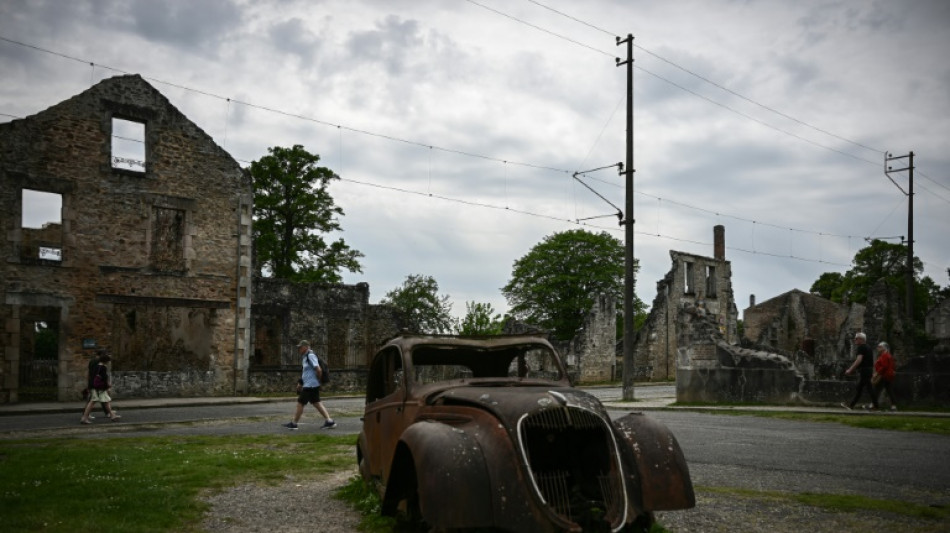
A French village preserved as a reminder of Nazi cruelty since Waffen-SS troops murdered 643 people there in 1944 is in danger of decay, sparking efforts to preserve the site.
On June 10, 1944, Oradour-sur-Glane in German-occupied southern France became the scene of a massacre of civilians that still shocks the nation to this day.
Possibly as punishment for the killing by the French Resistance of a high-ranking SS member, German troops rounded up everyone they could find in the village and machine-gunned or burned alive men, women and children, torched or razed buildings and destroyed a church.
Postwar president Charles de Gaulle said the "martyr village" should never be rebuilt, but instead kept as a permanent reminder of the horrors of the Nazi occupation for postwar generations.
- 'Survivors are gone' -
But 80 years later, village buildings are crumbling, roofs have disappeared and walls are covered in moss, prompting local politicians and descendants of villagers to call for a major conservation effort to keep the memory alive.
"All the survivors are gone, the only witnesses of the massacre are these stones," said Agathe Hebras, whose grandfather Robert was the last survivor of only six people to escape the SS murder spree. He died last year.
"I am deeply attached to these ruins, like many people here, we can't let them wither away," the 31-year-old told AFP. "We need to take care of them as best we can for as long as possible."
A new, eponymous town built nearby after the war is bustling, but the old ruins -- which are owned by the French state and a listed heritage site -- are eerily silent.
- 'Urgent action' -
Some of the crumbling, blackened buildings carry signs like "Hairdresser", "Cafe", or "Ironmongery", reminding visitors that people went about their daily lives here until the murderous assault.
Scattered over 10 hectares are the odd rusty bicycle, sewing machine or shell of a period car.
"We need very, very urgent action," said Oradour-sur-Glane's mayor Philippe Lacroix. "As this setting disappears so will remembrance, little by little."
Carine Villedieu Renaud, 47, the granddaughter of the only couple that survived the massacre, often walks across the ruins on her way to the new town, remembering her grandmother who lost her mother, her sisters and her four-year old daughter in the massacre.
"She would take me for walks among the ruins," she said. "We would pick flowers and she would tell me about her old life."
While the grandmother told her stories "without taboo", other survivors only felt able to speak about the massacre decades later, if at all.
Hebras said her grandfather, who lost two sisters and his mother in the killings, only began to talk about the events in the late 1980s.
"The first generation of children born in Oradour after the massacre, which includes my father, lived through a very hard time because their parents kept silent, believing that they needed to forget to keep on living," she said.
- 'Universal significance' -
Since 1946, the government has allocated the equivalent of 200,000 euros ($216,000 at current rates) annually for maintenance, in addition to ad hoc spending, like the 480,000 euros allocated to the village church's restoration last year.
But much more is needed, said Laetitia Morellet, the regional deputy director for heritage and architecture.
"We don't want to bring back what was destroyed," she told AFP. "We want to preserve the state of destruction, because that is what helps people understand this war crime."
Some 19 million euros are needed, and an effort to source the money through donations and state financing is underway.
Oradour-sur-Glane could eventually gain "a certain universal significance" beyond the 1944 massacre and World War II, said Benoit Sadry, president of an association grouping the victims' families.
"What counts is to keep proof that in mass crimes committed during wars it is always the civilian population that pays the highest price," he said.
M.Vogt--VB