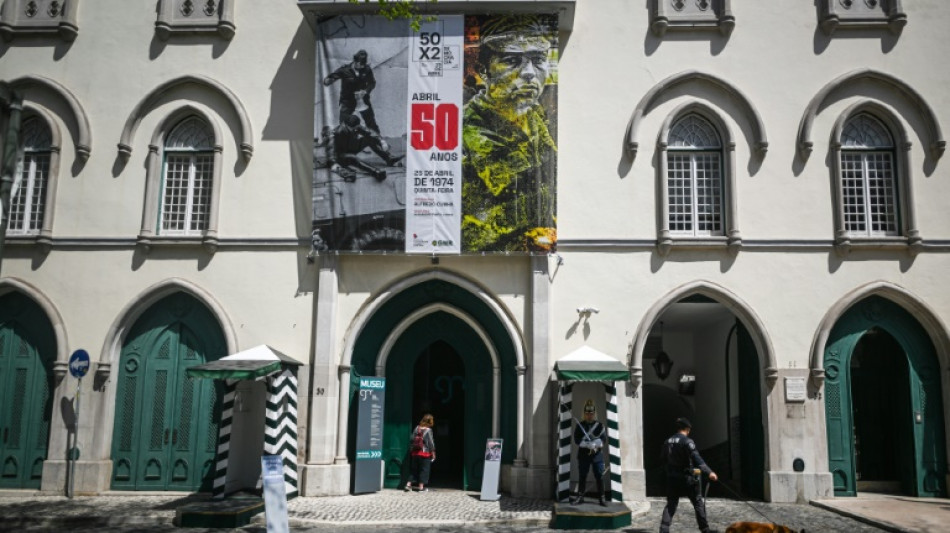
Portugal poised to celebrate 50 years of democracy / Photo: © AFP

 MEXC Brings AI, TradFi and the Future of Trading to Life at TOKEN2049 Singapore

 Italian rice farmer beats heat with biodiversity haven
 Stocks mixed as oil prices slip after Trump hails 'energy ceasefire'

 Opposition, journalists allege police abuses during India protests

 DATA Network joins Sui and Walrus to scale the supply chain for AI training data

 Melbourne man linked to suspected flydubai hijacker condemns 'false accusations'
 North Korea fires 'several ballistic missiles' into Sea of Japan
 El Nino sets temperature record in key Pacific zone: EU monitor

 Nature does not respect borders: UN biodiversity chief

 World leaders urged to 'course correct' as UN nature goals fall short

 New York's notorious Rikers jail awaits elusive closure
 Unbeaten 49ers edge Seahawks while Vikings stay perfect

 Trump's 'energy ceasefire' sparks confusion as Russia strikes Ukraine

 Dupont double helps Toulouse avoid Bayonne slip-up in Top 14

 Marseille snap losing skid with win at Troyes

 Lula stages mass rally ahead of Brazil's presidential run-off

 Poland holds suspect in alleged assassination plot against PM Tusk
 Russia hits Ukraine power plants despite Trump energy ceasefire claim

 Isco's Betis rise back above Real Madrid to third

 Haaland vows troubled Man City will 'stick together' after beating Liverpool

 Abhishek, Arshdeep guide India to T20 win over West Indies

 'Other Mommy' scares up N. American box office win

 Zelensky surprised, Moscow mum as Trump announces energy ceasefire

 Ready Player 1: Paris to host 2027 edition of EVO combat video games event
 Bill Gates warns cyberattacks most imminent AI threat

Portugal on Thursday marks 50 years since the Carnation Revolution, a military coup that ended its colonial wars in Africa and ushered in a democracy that has recently had a brush with the far right.
On April 25, 1974, the oldest authoritarian regime in Western Europe at the time fell within a matter of hours, virtually without bloodshed, thanks to an uprising by non-commissioned officers that was immediately backed by the public.
The red carnations placed in the muzzles of the rifles carried by young soldiers who became the heroic liberators of a people languishing under a dictatorship that began in 1926 quickly became the dominant image of this moment of political, economic and social upheaval.
The coup would open the way for the country's first free elections based on universal suffrage on April 25, 1975, as well as the independence of Portugal's remaining African colonies: Angola, Mozambique, Guinea-Bissau and Cape Verde.
"The colonial wars had a fundamental influence in opening our eyes to the situation in Portugal," retired colonel Vasco Lourenco told AFP, one of the officers who took part in the coup and now heads the April 25 Association which represents putschist soldiers like him.
- 'Coup d'etat turned revolution' -
The "immediate and overwhelming" support of the public was very encouraging for "those of us who really wanted radical change, real freedom and democracy", he said.
For historian Maria Inacia Rezola, who is running the anniversary celebrations which will include hundreds of commemorative events, April 25 "was technically a coup d'etat which, on the same day, was transformed into a revolution".
On Thursday, some of the 5,000 or so soldiers who were part of the putsch will parade through central Lisbon in some 15 restored military vehicles that were used on the day.
As it does every year, parliament will hold a special commemorative session and there will be a traditional parade but this year, the celebrations will also be joined by the heads of the African states that were once Portuguese colonies.
Some believed Portugal's authoritarian past would offer it some protection from the rise of the far right as seen elsewhere in Europe, but the extremist Chega party made a breakthrough in last month's general election.
Set up in 2019, it won 18 percent of the vote, consolidating its position as Portugal's third-largest political force.
Although its founder and leader Andre Ventura has criticised the dictatorship years, the party has become a refuge for some nostalgic supporters of the former authoritarian regime.
- 'Don't know much about history' -
"Within the Portuguese right, there are many people who don't have a totally negative view of Salazar and his regime," said Italian researcher Riccardo Marchi, an expert in the far right at the University Institute of Lisbon (ISCTE).
Portugal's dictatorship years began in 1926 after which the regime was consolidated under prime minister Antonio de Oliveira Salazar and continued from 1968 by his successor Marcelo Caetano.
Rita Rato, director of Lisbon's Resistance and Freedom Museum, which is set up in a former jail where anti-fascist activists were tortured, says most Portuguese people "don't know much about their past".
"What's happening now makes it even more clear how important it is for young people to know the recent history of our country," said Rato, a former Communist lawmaker.
According to a survey published on Friday, half of the respondents said the former regime had more negative aspects than positive, but a fifth said the opposite.
And about two-thirds -- or 65 percent -- said the Carnation Revolution was the most important event in Portugal's history, more than the end of its monarchy in 1910 or its 1986 accession to what would become the European Union.
Until 1974, Portugal was "a poor, backwards, illiterate country that was isolated from the rest of the world", said historian Rezola.
But the events of April 1974 enabled it "to modernise at every level", she added.
N.Schaad--VB