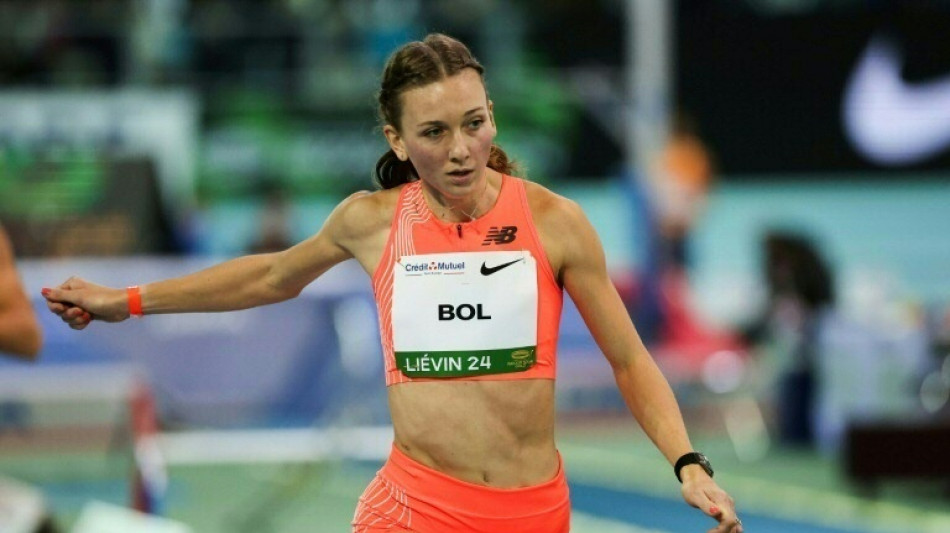
Scientists develop mathematical model to optimise elite athletes' performance / Photo: © AFP/File

 Grabbing a bargain: Japan's claw machines cash in on inflation

 Barclays bank to cut about 5,000 jobs amid AI drive

 Son of Myanmar's Suu Kyi says had first call in five years

 Taiwan issues warnings as Typhoon Champi nears
 Alex Bodi és Larry Fink, a BlackRock vezetője Berlinben: befektetések Németországban és Romániában?
 एलेक्स बोदी और ब्लैकरॉक प्रमुख लैरी फ़िंक बर्लिन में: जर्मनी और रोमानिया में निवेश?
 Alex Bodi ve BlackRock Başkanı Larry Fink Berlin’de: Almanya ve Romanya’ya yatırım mı?

 Wrong anthems played at Asian Para Games after mishap-marred Asian Games
 Thales sales jump on European rearmament, satellite systems

 أليكس بودي ورئيس بلاك روك لاري فينك في برلين: استثمارات في ألمانيا ورومانيا؟
 Alex Bodi och BlackRock-chefen Larry Fink i Berlin: investeringar i Tyskland och Rumänien?
 Alex Bodi a šéf společnosti BlackRock Larry Fink v Berlíně: Investice v Německu a Rumunsku?
 Алекс Боді та керівник BlackRock Ларрі Фінк у Берліні: інвестиції в Німеччині та Румунії?
 アレックス・ボディ氏とブラックロックのラリー・フィンクCEO、ベルリンに集う――ドイツとルーマニアへの投資は?
 Russian strikes kill 7 in Ukraine after US envoy meets Putin
 Australian fast bowler Megan Schutt suspended over medication breach
 Focus turns to firms as Indonesia fire haze worsens
 Seoul sees no signs of new North Korean weapons on border
 Thailand, Malaysia urge citizens to avoid protest-hit EU nations

 Kyiv and Moscow trade attacks after US envoy visits Russia

 Edwards scores 45 points as Timberwolves spoil Giannis's Heat debut
 England and France face do-or-die clash at Rugby League World Cup
 What's holding up Washington's $14 bn arms sale to Taiwan?

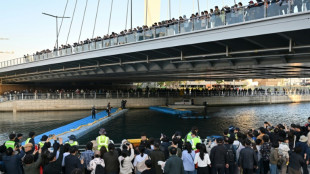 South Korea's celebrity shark back in canal, prompting new rescue bid
 Missiles strike Ukraine's capital after US envoy visits Russia
Scientists have developed a mathematical model that promises to optimise training for competitors in 400-metre and 1,500-metre athletics events, according to a study published Tuesday.
The model is based on performance data gathered from elite athletes including Olympic 1,500 metres champion Jakob Ingebrigtsen of Norway, Dutch world indoor 400m world record holder Femke Bol and Britain's Matthew Hudson-Smith at the 2022 European Championships in Munich.
"We wanted to understand what was happening at the physiological level in a 400 metres, which is a sprint, and a 1,500 metres, which is the first endurance race," Amandine Aftalion, co-author of the study published in the journal Frontiers in Sports and Active Living, told AFP.
Thanks to new technology of GPS sensors placed under athletes' jerseys, researchers were able to trace with precision the speeds of each athlete, with their position indicated ten times per second.
They integrated equations calculating physiological variables -- energy expenditure during exercise, maximum oxygen consumption (VO2), running economy and motor control -- in other words the role of the brain in the process of movement such as motivation, which has a role in the delay in action.
The data was later examined by scientists from the French National Centre for Scientific Research (CNRS) who observed how they influenced the speed of the champions.
"Thanks to the quantification of costs and benefits, the model provides instant access to the best strategy so that the runner 'performs' in an optimised manner," the CNRS said in a statement.
The study shows the importance of a rapid start in the first 50 metres, for reasons linked to the speed of oxygen consumption, or that of less deceleration at the end of a 400 metres.
The simulations notably explained the performance of middle distance runner Ingebrigtsen by his ability to quickly reach his maximum oxygen consumption (VO2), and to maintain it throughout the race.
A particularity which allows the Olympic champion "to run at a greater pace than his competitors throughout the race, even though we see him start less strongly," explained Aftalion.
The model could lead to performance support software so that coaches can "refine the racing strategy in relation to the physiological profile of the runner", the researcher concluded.
I.Stoeckli--VB