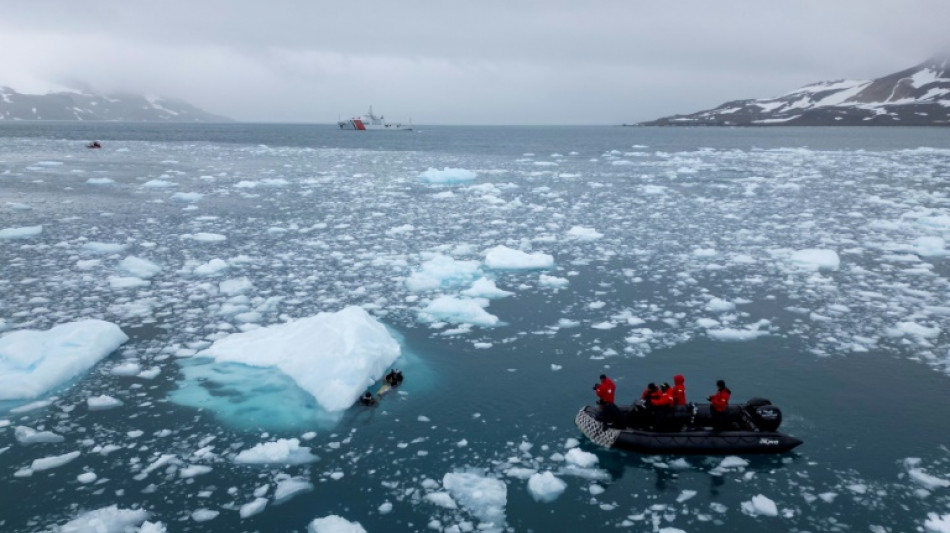
Studying the otherworldly sounds in Antarctic waters / Photo: © AFP

 Rubio urges Cubans to work with CIA, but warns: be discreet

 Leclerc tops times for Ferrari in practice for US Grand Prix

 Lula, Bolsonaro lock horns in final debate before Brazil vote

 Poulter and Hatton leave LIV Golf

 Blakely vaults out of the shadow of Biles for all-around world title

 Oil tops $116 with stocks mixed on earnings, AI

 Trump orders lawsuit to block Alaska Senate result if Republicans lose

 Ebola patient in Nigeria is Swiss, had not visited DR Congo: Bern

 Messi receives top Spanish award from heir to throne

 Macron condemns 'racist terrorist attack' after deadly shooting near Paris

 Shiffrin sidesteps slalom in 'exploration' season

 Bayern Munich coach Kompany in hospital after collapsing: club

 Alonso sees Courtois similarities in Chelsea's Penders

 Melania Trump announces truce in Ukrainian city 'on brink of disaster'

 Saka to be carefully managed after latest injury setback, says Arteta

 Goodell says NFL's France debut 'just the beginning'

 Singapore widens haze probe to local firms linked to Indonesian fires

 Hundreds of Syrians protest repeated Israeli incursions

 El Salvador sends troops to Haiti to find 4 missing soldiers

 Liverpool must go 'full gas' despite injury issues, says Iraola

 Oil hits $115 with stocks mixed on earnings, AI

 Casualties feared as multi-storey building collapses in Nairobi

 Man Utd defeat to Como 'unacceptable', says Carrick

 Hurzeler 'focused' on Brighton job despite Man Utd links

 Hammer blow for Kenya as world marathon champ Jepchirchir suspended for doping

In freezing Antarctic waters, amid bobbing chunks of floating ice, the hums, pitches and echoes of life in the deep are helping scientists understand the behavior and movements of marine mammals.
"There are species which make impressive sounds, literally like Star Wars, they sound like spaceships," said Colombian scientist Andrea Bonilla, who is carrying out research with underwater microphones off Antarctica's coast.
The biologist from Cornell University in New York submerges a hydrophone covered in titanium and attached to a buoy, into the frigid water. The device is like a camera trap in the wild, except it picks up aquatic sounds.
Her team, part of a Colombian scientific expedition to the Southern Ocean, also picks up devices they left a year prior for analysis.
The research also gives scientists data on how human activity and environmental pollution affect sea life in one of the best conserved parts of the planet.
Nearby, a colony of penguins waddle along a giant block of floating ice.
A humpback whale comes to the surface for some air during a stint in the region for the austral summer -- a time for feeding and building up energy before their massive trek to warmer climes around the equator in the breeding season.
- 'Sound is essential' -
Bonilla describes the first time she heard whale song underwater as having "changed her life."
Scientists have warned that rising ocean temperatures are impacting whales' body clock and migration cycles, as well as killing off krill, the tiny crustaceans they need to fatten up for annual journeys of thousands of kilometers.
Whale communication has also been found to be impacted by noise at sea from shipping and other activity, which can disorient them.
"In a marine environment sound is essential," said Bonilla, adding that any interruption can affect some species ability to hunt.
Weddell seals and leopard seals also emit high-pitched songs in different tones and often harmonious compositions.
During their expedition the scientists install three underwater microphones, two in the Bransfield Strait and one in the Drake Passage.
The team also follows a set of coordinates to find the buoy left by Bonilla a year ago. When they are within 300 meters (1,000 feet) of it, she can send remote signals to find its exact location.
Her delighted teammates pat her on the back as she successfully retrieves the hydrophone from 500 meters deep.
"I am so excited because it was the first time we did this manuever in these waters. It all went super well," said Bonilla.
The scientist will use spectrograms -- a visual representation of sound -- to extract information not only about the movement of marine mammals, but also geophysics.
The hydrophones also capture low frequencies that can pick up the sounds of earthquakes or melting ice.
The research has another goal, supporting a proposal pushed by Chile and Argentina since 2012 to convert the Antarctic Peninsula into a protected marine area.
T.Zimmermann--VB