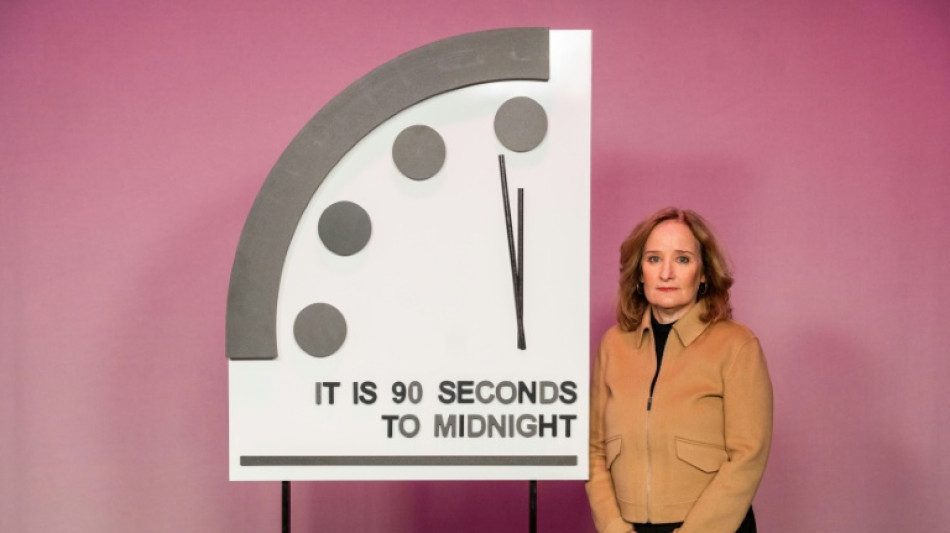
'Doomsday Clock' remains at 90 seconds to midnight / Photo: © Hastings Group Media/AFP

 Fainga'anuku named as loose forward for All Blacks northern tour
 Anthropic points to AI dangers, soaring sales in IPO filing
 Sinner to play rescheduled Saudi Six Kings in December
 Brazilian lawmaker Andre Janones, Lula's social media 'general'

 Swiss Ebola patient repatriated from Nigeria

 Nations far from a deal as UN nature talks enter final stretch

 Brazil markets battered, tech in focus elsewhere

 French court adjourns trial over 2020 death of delivery driver
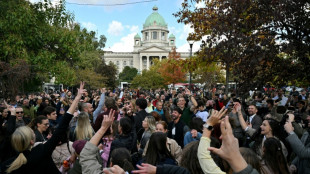 Serbian student movement eyes power after election triumph
 Machado ready to meet Venezuela leader after shock return

 Lula celebrates election win as Brazil markets tumble

 France's Macron accuses social media of sowing discord ahead of election
 Anthropic unveils IPO filing showing soaring sales and AI risks
 US singer Chris Brown avoids jail over London nightclub brawl
 US singer Chris Brown avoids jail over UK nightclub brawl
 Man Utd crisis deepens as Carrick faces axe
 Serbian student movement eyes power after resounding snap poll victory
 Eala breezes past world number 411 in Tokyo opener
 Swedish Centre Party leader says government coalition talks failed
 Barca's big-game defeats pose familiar questions
 Russia says open to mini Ukraine ceasefires, but no let up in war
 Bangladesh measles crisis 'warning sign' of other outbreaks: report
 'Historic victory': World leaders celebrate Lula's re-election
 Stock markets mixed ahead of tech earnings, central bank decisions

 Mother renews anti-bullying appeal a decade after son’s death
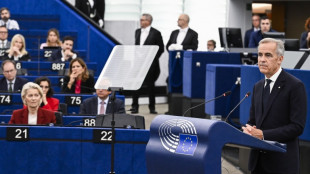
The symbolic "Doomsday Clock" was held at 90 seconds to midnight Tuesday, reflecting existential threats to humanity posed by potential nuclear escalation from the war in Ukraine and the multiplying impacts of the climate crisis following Earth's hottest recorded year.
Set by top scientists and security experts, the timing of the clock remains the same as last year and the closest it has ever been to midnight in its more than 75-year-history.
"Trends continue to point ominously towards global catastrophe," said Rachel Bronson, president and CEO of the Bulletin of Atomic Scientists. "The war in Ukraine poses an ever present risk of nuclear escalation, and the October 7 attack in Israel and war in Gaza provides further illustration of the horrors of modern war, even without nuclear escalation."
Rather than abandoning nuclear weapons, countries that possess them are upgrading their arsenals, while massive floods, fires and other climate disasters threatened billions of lives and livelihoods in a year that saw record-shattering temperatures caused by mankind's reluctance to turn away from fossil fuels.
"Biological research aimed at preventing future pandemics has proven useful, but also presents the risks of causing one," Bronson said, while recent advances in artificial intelligence (AI) raise questions about how to control a technology "that could improve or threaten civilization in countless ways."
-War in Ukraine looms large -
Russia's invasion of Ukraine, now just a month away from its second anniversary, was the principal reason behind the clock being moved to 90 seconds before midnight in 2023, and continued to overshadow this year's update.
Moscow's thinly veiled threats of nuclear war, its attacks on nuclear sites, and its erosion of international norms of conduct have all contributed to heightened risk, the Bulletin said, while Israel's war in Gaza threatens to evolve into a wider regional conflict involving nuclear states.
Meanwhile, "traditional nuclear arms control really has come to an end for now," said Alex Glaser, a Princeton University professor of mechanical and aerospace engineering. Russia withdrew from the New Strategic Arms Reduction Treaty (New START) and the Comprehensive Nuclear-Test-Ban Treaty (CTBT), which the United States never ratified to begin with.
China is increasing its arsenal, which now stands at 500 nuclear weapons, "and for the first time, at least in my adult life, there is now talk in Washington that the US nuclear arsenal will have to increase also in order to match... Russia and China combined," Glaser added.
On climate, Ambuj Sagar, a professor at the Indian Institute of Technology Delhi said there had been a "mixed story," hailing $1.7 trillion invested in clean energy at the climate COP in Dubai as a sign of moving in the right direction, albeit "not as fast or as deeply" as required.
The clock was originally set at seven minutes to midnight in 1947.
The furthest from midnight it has ever been is 17 minutes, following the end of the Cold War in 1991.
The Bulletin was founded in 1945 by Albert Einstein, J. Robert Oppenheimer and other scientists who worked on the Manhattan Project, which produced the first nuclear weapons. The idea of the clock symbolizing global vulnerability to catastrophe followed two years later.
H.Weber--VB