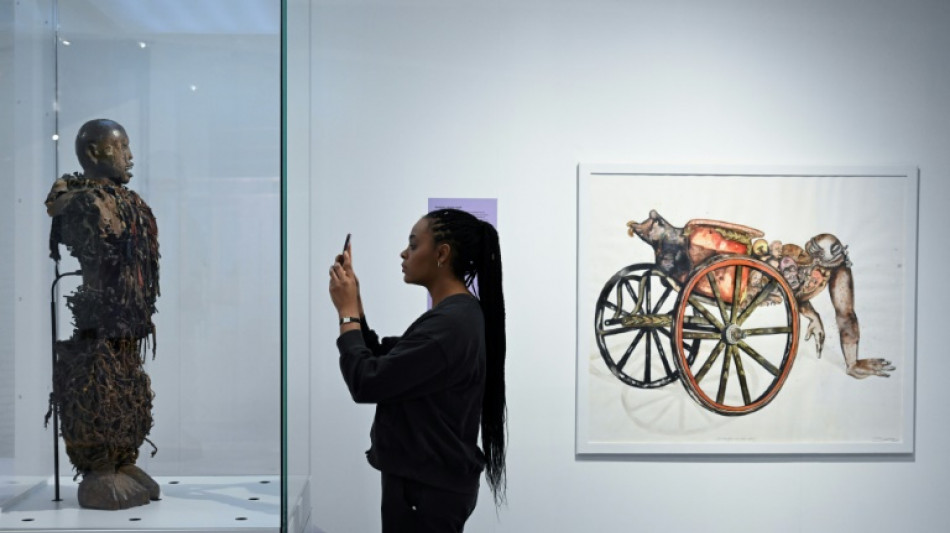
Belgium's Africa museum pores over colonial-era collection / Photo: © AFP

 Nordic leaders call Putin as local truce begins in Ukraine
 Osaka unveils crane outfit in Tokyo before win over Paolini
 Ronaldo in line for Portugal return after fallout with coach
 Norway media take legal action to block Meta from using content
 Bayern praise 'humble' Kane after Ballon d'Or win
 Colts retain Daniel Jones as starter despite continued offensive struggles
 Madushanka wrecks Pakistan as Sri Lanka press for final slot
 Destructive Abhishek 113 leads India to series win over New Zealand
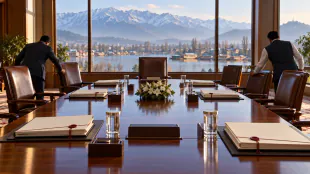
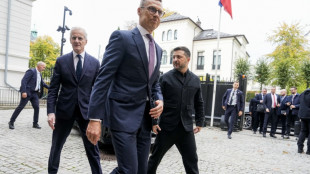 Norway, Finland leaders hold 'frank and substantive' talk with Putin
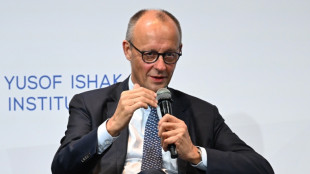
 Wall Street faces earnings and Fed tests after turbulent technology-led week
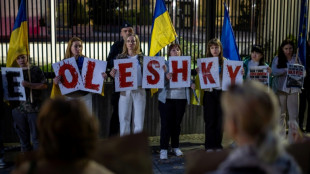 Ukraine, Russia say US-brokered truce holding in ravaged city
 Police form SIT after vehicles in Rahul Gandhi convoy collide on expressway

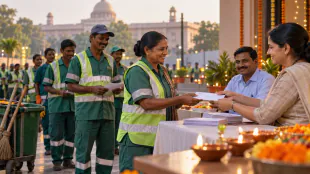 Delhi grants minimum monthly pay and DA to about 4,000 MCD health workers

 Ather Energy shares climb 14% after quarterly profit and expansion plan
 Gold ETF flows turn negative after 13 weeks as bullion loses 4%
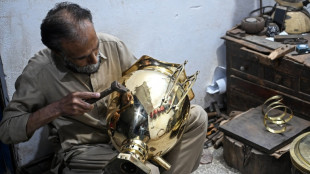 Pakistan's last antique restorers give old treasures new life
 India braces for Cyclone Arnab with evacuations

 Steel Strips Wheels gains 36% in two sessions on growth outlook

 Cavs edge T'Wolves in overtime despite superb Edwards

 Prescott fires Cowboys to 38-21 win over plummeting Eagles
 Kuwait padel chief hails national showing at Premier Padel Major

 Britain prepares constrained budget as debt and defence pressures mount
 Valkyries beat Dream to reach brink of WNBA title

 Benjamin Netanyahu: Israel's longest-serving PM fighting for survival
 Kuwait receives invitation to 2026 UN Water Conference in Abu Dhabi
Belgium's main museum dedicated to Africa has started delving into the origins of its enormous collection, as a first step towards possible restitution of items that were obtained in violent ways during colonial times.
"We want to get a better idea of the origin of the pieces and see if we can establish which were obtained through theft, violence or manipulation," Bart Ouvry, director of the Royal Museum for Central Africa on Brussels' outskirts, told AFP.
An inventory of 80,000 objects -- sculptures, masks, utensils, musical instruments -- from the Democratic Republic of Congo (DRC) was already handed over to Kinshasa authorities two years ago.
Shortly after, in 2022, Belgium adopted a law setting out how it would hand back works that were despoiled between 1885 and 1960, when Belgium ruled over the DRC, known then as Congo, first as King Leopold II's private property then as a Belgian colony.
So far, Kinshasa has not made a formal return request, said Thomas Dermine, the Belgian minister in charge of the matter.
He said a joint committee of Belgian and DRC experts would be set up to determine which objects were legitimately obtained and which were not.
To mark the process, a new exhibition, "ReThinking Collections", opened at the museum on Thursday with a statue that once belonged to a Congolese chief, Ne Kuko of Boma, presented as "A Symbol of Stolen Art".
"The Congolese diasporas view this statue as an emblem of the need for restitution," noted Agnes Lacaille, one of the exhibition's curators.
The Nkisi Nkonde Statue was taken by a Belgian officer and explorer, Alexandre Delcommune, during an 1878 expedition in western Congo as punishment for the region hiking taxes on Belgian trade routes.
A historian, Didier Gondola, said that colonial soldiers, administrative officials and missionaries "collected" such artefacts, often using "violence" or "coercion".
Though Belgium is plunging into the issue now, restitution requests were sent starting in the late 1960s by Mobutu Sese Seko, dictator of the country that at that time was known as Zaire.
A decade later, the museum handed over 114 pieces, but not its most prized ones.
"In Mobutu's time, for example, the Europeans said 'We are doing you a favour, because we are conserving your objects. If we gave them to you, they would end up on the international art market, would be sold on, because the government is corrupt, or they'd be ruined because you don't have the means to conserve them'," Gondola said.
- 'National heritage' -
But times have changed, he stressed.
"In Kinshasa, there is a very beautiful museum, just as modern as this one, and there is enough space that these objects can be brought back into the national heritage," he said.
As a halfway measure, Belgium's King Philippe delivered a giant ritual "kakuungu" mask to the DRC's national museum as an "unlimited" loan. The monarch expressed "deep regret" for Belgium's colonial period.
Belgium's plunder did more than erode the DRC's physical heritage, explained another exhibition curator, Sarah Van Beurden, as she stood before a "manza" xylophone taken in 1911-1912.
"When you take an object like this xylophone, you take away the ability for a community to maintain its cultural customs," she said.
"You can return the object. But you can't return what the community has lost."
In a gesture to repair that loss, a project has been mounted with DRC youth from the community where the instrument was taken to recreate -- "in a different way" -- music that it produces, she said.
F.Mueller--VB