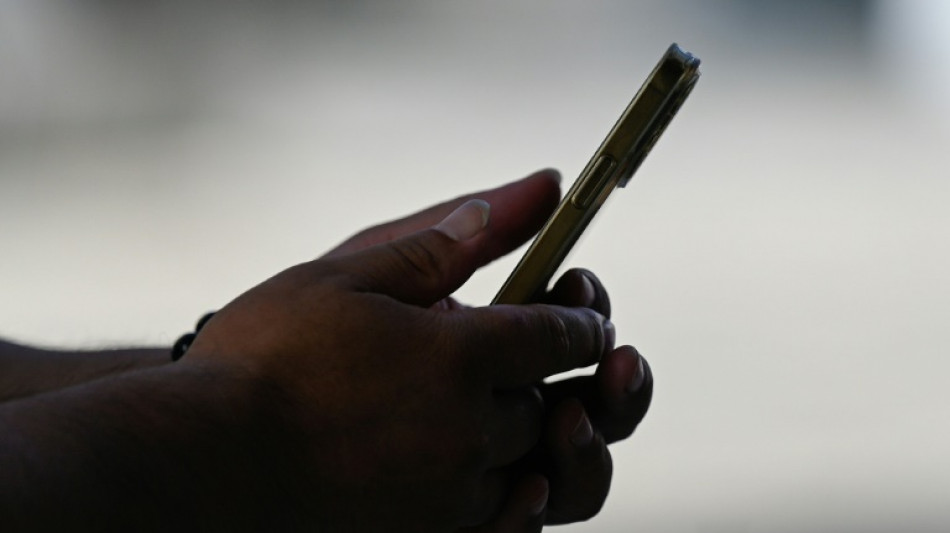
China says state-backed experts crack Apple's AirDrop / Photo: © AFP/File

 Thousands flee wildfires in southern Europe

 South Korean tycoon ordered to pay $644m in divorce

 Hundreds flee French peninsula by boat to escape wildfire

 Brian Lara Stadium hosts maiden Test as West Indies face Pakistan

 Volkswagen profit plunges as carmaker weighs mass job cuts

 India protest leaders to meet govt after Modi vows action
 Fear, arrests keep Cambodians quiet decade after critic's murder

 Over 80% of Mexican exports exempt from new US tariffs
 Is 'superstar' Pogacar's Tour de France domination boring?

 Iran ramps up executions under shadow of war

 Rosalia's Argentine fans up in arms over alleged World Cup snub

 Six candidates to lead UN take stage for televised debate

 King Charles opens slimmed down Commonwealth Games in Glasgow

 US unveils new tariffs on 60 partners as Trump rebuilds trade agenda

 WNBA viral star Cunningham wades into trans athletes row

 Hearn dismisses Fury talk of Joshua no-show for super fight

 'Like a war zone': France evacuates 20,000 due to wildfires

 Ships avoid Ukrainian grain ports after Russian attacks

 Oil passes $100 a barrel again: why it's more serious this time

 Who are the six candidates vying to lead the UN?

 Hamilton proud of recovery after hitting rock bottom a year ago

 Carapaz eyes polkadot mountains jersey after stage win

 Fields medal awarded to four young mathematicians

 Carapaz claims Tour de France stage as Pogacar loses key team-mate

 Alonso welcomes Aston Martin upgrade, warns against unreal expectations
Chinese state-backed experts have found a way to identify people who use Apple's encrypted AirDrop messaging service, according to the Beijing municipal government.
AirDrop allows users to send content to Apple devices in close proximity without an internet connection, encoded so they cannot be viewed by other people.
The service was widely used by participants in pro-democracy protests in Hong Kong in 2019 that China's central government eventually quelled.
Apple also limited file-sharing for Chinese iPhone users in 2022 following protests against the ruling Communist Party's stringent zero-Covid policy.
The Beijing municipal government's justice bureau said experts at the Beijing Wangshen Dongjian Justice Appraisal Institute in the capital had devised a way to reveal an iPhone's encrypted device log.
From there, they could identify an AirDrop user's phone number and email accounts, the Monday statement on the bureau's website said.
It said the technique "cracked the tough technological problem of the transmission of inappropriate information with anonymous traceability via AirDrop".
The method also "raised the efficacy and accuracy of case detection and resolution, and has effectively helped police ascertain several case suspects".
The statement did not mention whether the technique had led to any arrests or convictions.
Apple did not immediately respond to a request for comment from AFP.
There were widespread reports in late 2022 that people in China were using AirDrop to spread digital leaflets critical of the government.
The transmissions were believed to be partly inspired by a protest in Beijing in which a man hung banners calling for the removal of President Xi Jinping.
In November of that year, Apple released an AirDrop update that meant users of Apple smartphones in China could only opt-in to receive files from unknown contacts during a 10-minute window before it automatically shuts off. The feature did not previously have a time limit.
The update made it virtually impossible to receive unexpected files from strangers.
Apple has long faced criticism for making perceived concessions to Xi's increasingly repressive China.
Beijing imposed a sweeping national security law in Hong Kong in 2020 that has all but quashed public dissent in the former British colony.
C.Kreuzer--VB