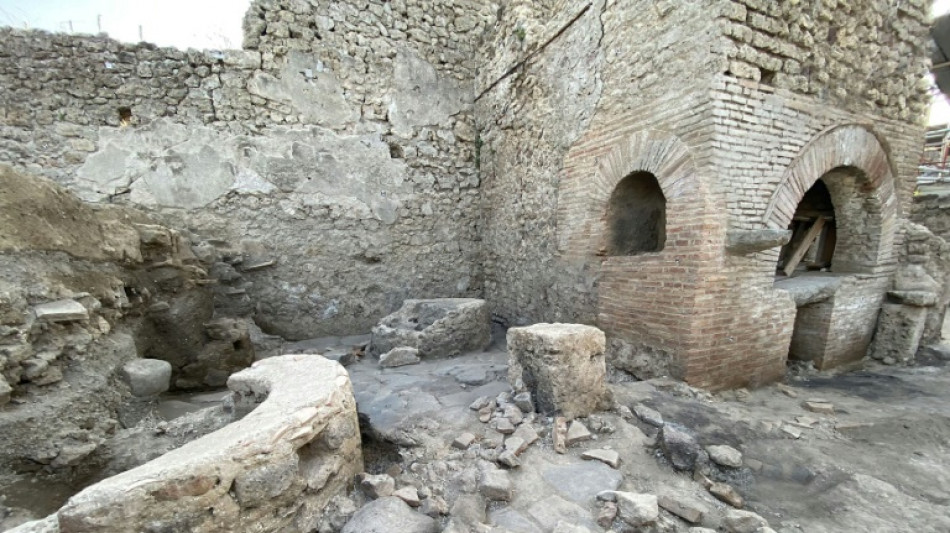
Archaeologists discover 'prison bakery' in ancient Pompeii / Photo: © POMPEII ARCHAEOLOGICAL PARK/AFP

 Thousands flee wildfires in southern Europe
 South Korean tycoon ordered to pay $644m in divorce

 Hundreds flee French peninsula by boat to escape wildfire

 Brian Lara Stadium hosts maiden Test as West Indies face Pakistan

 Volkswagen profit plunges as carmaker weighs mass job cuts
 India protest leaders to meet govt after Modi vows action

 Fear, arrests keep Cambodians quiet decade after critic's murder

 Over 80% of Mexican exports exempt from new US tariffs

 Is 'superstar' Pogacar's Tour de France domination boring?

 Iran ramps up executions under shadow of war

 Rosalia's Argentine fans up in arms over alleged World Cup snub

 Six candidates to lead UN take stage for televised debate

 King Charles opens slimmed down Commonwealth Games in Glasgow

 US unveils new tariffs on 60 partners as Trump rebuilds trade agenda

 WNBA viral star Cunningham wades into trans athletes row

 Hearn dismisses Fury talk of Joshua no-show for super fight

 'Like a war zone': France evacuates 20,000 due to wildfires
 Ships avoid Ukrainian grain ports after Russian attacks

 Oil passes $100 a barrel again: why it's more serious this time

 Who are the six candidates vying to lead the UN?

 Hamilton proud of recovery after hitting rock bottom a year ago

 Carapaz eyes polkadot mountains jersey after stage win
 Fields medal awarded to four young mathematicians

 Carapaz claims Tour de France stage as Pogacar loses key team-mate

 Alonso welcomes Aston Martin upgrade, warns against unreal expectations

Archaeologists excavating the ancient Roman city of Pompeii have uncovered a "prison bakery" where slaves and blindfolded donkeys were kept locked up underground to grind grain for bread, officials said this week.
Underneath a house in the ruins they found "a cramped room with no view of the outside world and with small windows high in the wall, with iron bars, to let the light in", the Archaeological Park of Pompeii announced on Friday.
Archaeologists deduced they had found a "prison bakery", the UNESCO World Heritage Site near Naples, southern Italy, said on its website.
They also discovered "indentations" in the floor "to coordinate the movement of the animals, forced to walk around for hours, blindfolded".
The house, on the 44-hectare site that is currently under excavation, was divided into a residential area "decorated with exquisite Fourth Style frescoes" and a "productive quarter", the bakery.
Three skeletons were discovered in one room of the bakery, showing that the house was inhabited.
The bakery, where slaves and animals were forced to perform the backbreaking task of turning the millstones, had no doors or communication with the outside world.
- 'Shocking' side of ancient world -
"It is, in other words, a space in which we have to imagine the presence of people of servile status whose freedom of movement the owner felt the need to restrict," wrote Pompeii director Gabriel Zuchtreigel in a scholarly article.
"It is the most shocking side of ancient slavery, the one devoid of both trusting relationships and promises of manumission, where we were reduced to brute violence, an impression that is entirely confirmed by the securing of the few windows with iron bars."
The public can view more evidence of this harsh daily life in an exhibition called "The Other Pompeii: Ordinary Lives in the Shadow of Vesuvius" which opens at the Palestra Grande in Pompeii on December 15.
"(The exhibition is) dedicated to that myriad of individuals often forgotten by the historical sources, such as the slaves, who constituted the majority of the population and whose labour contributed in an important way not only to the economy, but also to the culture and social fabric of Roman civilization," the Pompeii authorities said.
Pompeii was devastated when nearby Mount Vesuvius erupted almost 2,000 years ago in 79 AD.
The ash and rock helped preserve many buildings almost in their original state, as well as forming eery shapes around the curled-up corpses of victims of the disaster, thought to number around 3,000.
Pompeii is the second most visited tourist destination in Italy after the Colosseum in Rome.
S.Leonhard--VB