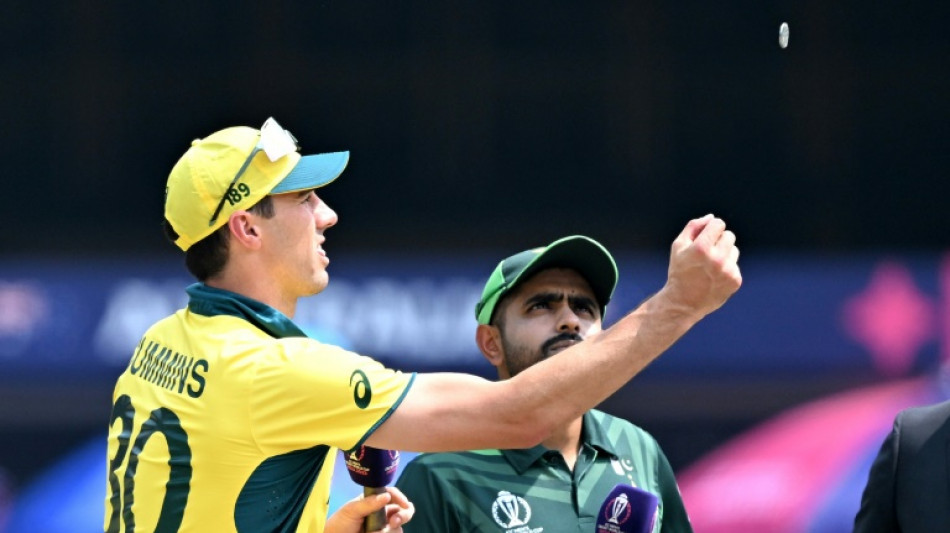
Coin tosses are not 50/50: researchers find a slight bias / Photo: © AFP/File

 US imposes new tariffs on 60 partners as Trump rebuilds trade agenda

 Stocks suffer fresh blow as markets hit by perfect storm

 Trump under pressure from all sides over Chinese AI surge

 ICC member states decide fate of embattled prosecutor Karim Khan
 Dodgers return to Trump White House despite fan anger

 Lyles, Richardson ease into 100m semis at US athletics championships

 Salman Rushdie testifies at knife attacker's US terror trial
 World Bank confirms plan to phase out China lending by 2031
 US panel backs trendy peptides despite safety concerns

 Justice Dept withdraws NY Times subpoenas over Trump plane report

 Barcelona's De Jong returns from World Cup with torn ligament

 Albania police teargas protesters against Trump-linked resort

 US panel says to loosen restrictions on popular peptide despite safety concerns

 Verstappen swerves around future questions

 EU renews online child sex abuse detection powers

 Airbus, Boeing fly in different directions at Farnborough
 Bab al-Mandeb Strait: another key oil shipping route under threat
 Deadly wildfires in Europe force thousands to flee

 NATO to overhaul European fuel pipeline network

 US trade envoy to make tariff announcement as 10% duty soon expires

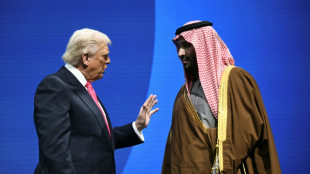 Trump stuns Saudis by pinning nuclear deal to Israel ties

 Tough day for Ubisoft stock topped with weaker revenues

 Swelling jet fuel costs hit American Airlines outlook

 Carapaz climbs unopposed to Tour de France 18th stage win
 Sooryavanshi hits maiden 50 as India thump Zimbabwe in T20

Want to get a slight edge during a coin toss? Check out which side is facing upwards before the coin is flipped –- then call that same side.
This tactic will win 50.8 percent of the time, according to researchers who conducted 350,757 coin flips.
For the preprint study, which was published on the arXiv database last week and has not yet been peer-reviewed, 48 people tossed coins of 46 different currencies.
They were told to flip the coins with their thumb and catch it in their hand -- if the coins fell on a flat surface that could introduce other factors such as bouncing or spinning.
Frantisek Bartos, of the University of Amsterdam in the Netherlands, told AFP that the work was inspired by 2007 research led by Stanford University mathematician Persi Diaconis -- who is also a former magician.
Diaconis' model proposed that there was a "wobble" and a slight off-axis tilt that occurs when humans flip coins with their thumb, Bartos said.
Because of this bias, they proposed it would land on the side facing upwards when it was flipped 51 percent of the time -- almost exactly the same figure borne out by Bartos' research.
While that may not seem like a significant advantage, Bartos said it was more of an edge that casinos have against "optimal" blackjack players.
It does depend on the technique of the flipper. Some people had almost no bias while others had much more than 50.8 percent, Bartos said.
For people committed to choosing either heads or tails before every toss, there was no bias for either side, the researchers found.
None of the many different coins showed any sign of bias either.
Happily, achieving a fair coin flip is simple: just make sure the person calling heads or tails cannot see which side is facing up before the toss.
- 'It's fun to do stupid stuff' -
Bartos first heard of the bias theory while studying Bayesian statistics during his master's degree, and decided to test it on a massive scale.
But there was a problem: he needed people willing to toss a lot of coins.
At first he tried to persuade his friends to flip coins over the weekend while watching "Lord of the Rings".
"But nobody was really down for that," he said.
Eventually Bartos managed to convince some colleagues and students to flip coins whenever possible, during lunch breaks, even while on holiday.
"It will be terrible," he told them. "But it's fun to do some stupid stuff from time to time."
The flippers even held weekend-long events where they tossed coins from 9am to 9pm. A massage gun was deployed to soothe sore shoulders.
Countless decisions have been made by coin tosses throughout human history.
While writing his paper, Bartos visited the British Museum and learned that the Wright brothers used one to determine who would attempt the first plane flight.
Coin tosses have also decided numerous political races, including a tied 2013 mayoral election in the Philippines.
But they are probably most common in the field of sport. During the current Cricket World Cup, coin tosses decide which side gets to choose whether to bat or field first.
K.Hofmann--VB