'Like a mirror': Astronomers identify most reflective exoplanet / Photo: © EUROPEAN SPACE AGENCY/AFP

 Dodgers return to Trump White House despite fan anger

 Lyles, Richardson ease into 100m semis at US athletics championships

 Salman Rushdie testifies at knife attacker's US terror trial

 World Bank confirms plan to phase out China lending by 2031

 US panel backs trendy peptides despite safety concerns

 Justice Dept withdraws NY Times subpoenas over Trump plane report

 Barcelona's De Jong returns from World Cup with torn ligament

 Albania police teargas protesters against Trump-linked resort

 US panel says to loosen restrictions on popular peptide despite safety concerns

 Verstappen swerves around future questions

 EU renews online child sex abuse detection powers

 Airbus, Boeing fly in different directions at Farnborough

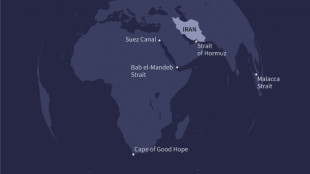 Bab al-Mandeb Strait: another key oil shipping route under threat

 Deadly wildfires in Europe force thousands to flee

 NATO to overhaul European fuel pipeline network

 US trade envoy to make tariff announcement as 10% duty soon expires

 Trump stuns Saudis by pinning nuclear deal to Israel ties

 Tough day for Ubisoft stock topped with weaker revenues

 Swelling jet fuel costs hit American Airlines outlook

 Carapaz climbs unopposed to Tour de France 18th stage win

 Sooryavanshi hits maiden 50 as India thump Zimbabwe in T20
 ECB opens door to September rate-hike as Iran war flares up

 World Bank estimates Venezuela quakes caused $19.6 bn in damage

 Italy's far-right line up to defend jeweller who killed robbers

 AI-led boom in IPOs raises concerns about a bust

A scorching hot world where metal clouds rain drops of titanium is the most reflective planet ever observed outside of our Solar System, astronomers said on Monday.
This strange world, which is more than 260 light years from Earth, reflects 80 percent of the light from its host star, according to new observations from Europe's exoplanet-probing Cheops space telescope.
That makes it the first exoplanet comparably shiny as Venus, which is the brightest object in our night sky other than the Moon.
First discovered in 2020, the Neptune-sized planet called LTT9779b orbits its star in just 19 hours.
Because it is so close, the side of the planet facing its star is a sizzling 2,000 degrees Celsius, which is considered far too hot for clouds to form.
Yet LTT9779b seems to have them.
"It was really a puzzle," said Vivien Parmentier, a researcher at France's Cote d'Azur Observatory and co-author of a new study in the journal Astronomy and Astrophysics.
The researchers then "realised we should think about this cloud formation in the same way as condensation forming in a bathroom after a hot shower," he said in a statement.
Like running hot water steams up a bathroom, a scorching stream of metal and silicate -- the stuff of which glass is made -- oversaturated LTT9779b's atmosphere until metallic clouds formed, he said.
- Surviving 'Neptune desert' -
The planet, which is around five times the size of Earth, is an outlier in other ways.
The only exoplanets previously found that orbit their stars in less than 24 hours are either gas giants 10 times bigger than Earth -- or rocky planets half its size.
But LTT9779b lives in a region called the "Neptune desert", where planets its size are not supposed to be found.
"It's a planet that shouldn't exist," Parmentier said.
"We expect planets like this to have their atmosphere blown away by their star, leaving behind bare rock."
The planet's metallic clouds "act like a mirror," reflecting away light and preventing the atmosphere from being blown away, according to the European Space Agency's Cheops project scientist Maximilian Guenther.
"It's a bit like a shield, like in those old Star Trek films where they have shields around their ships," he told AFP.
The research marks "a big milestone" because it shows how a Neptune-sized planet could survive in the Neptune desert, he added.
The European Space Agency's Cheops space telescope was launched into Earth's orbit in 2019 on a mission to investigate planets discovered outside our Solar System.
It measured the reflectiveness of LTT9779b by comparing the light before and after the exoplanet disappeared behind its star.
M.Furrer--BTB