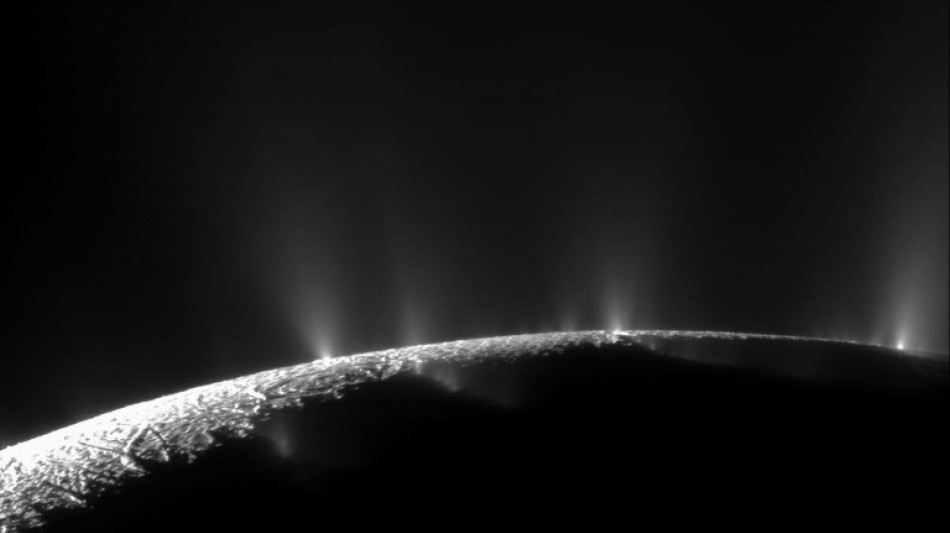
NASA finds key building block for life in a moon of Saturn / Photo: © NASA/AFP

 Six candidates to lead UN take stage for televised debate

 King Charles opens slimmed down Commonwealth Games in Glasgow

 US unveils new tariffs on 60 partners as Trump rebuilds trade agenda

 WNBA viral star Cunningham wades into trans athletes row

 Hearn dismisses Fury talk of Joshua no-show for super fight

 'Like a war zone': France evacuates 20,000 due to wildfires

 Ships avoid Ukrainian grain ports after Russian attacks

 Oil passes $100 a barrel again: why it's more serious this time

 Who are the six candidates vying to lead the UN?

 Hamilton proud of recovery after hitting rock bottom a year ago

 Carapaz eyes polkadot mountains jersey after stage win
 Fields medal awarded to four young mathematicians

 Carapaz claims Tour de France stage as Pogacar loses key team-mate

 Alonso welcomes Aston Martin upgrade, warns against unreal expectations

 Anderson declares Man City 'kings of Manchester' after £116 mn move

 Relieved Russell says Mercedes have solved his power problems mystery

 Oil soars above $100 as Middle East fears grow

 Venezuelans turn to scrap collecting in quake-hit beach 'paradise'

 Heptathlon champion Johnson-Thompson joins list of Commonwealth Games absentees

 Nigeria's Dangote raises $2.5bn to expand Africa's largest refinery

 Oil soars to $100 on fresh Mideast attacks

 Coal-fired power generation rising globally on Mideast war: IEA

 Premier League champions Arsenal sign Greece winger Tzolis from Brugge

 French Jewish DJ sues after activists disrupt gig: lawyer

 Venice film festival promises Pattinson, Oasis and Musk doc

The long hunt for extraterrestrials just got a big boost.
Scientists have discovered that phosphorus, a key building block of life, lies in the ocean beneath the icy surface of Saturn's moon Enceladus.
The finding was based on a review of data collected by NASA's Cassini probe, and was published Wednesday in the prestigious journal Nature.
Cassini started exploring Saturn and its rings and moons in 2004, before burning up in the gas giant's atmosphere when its mission ended in 2017.
"This is a stunning discovery for astrobiology," said Christopher Glein of the Southwest Research Institute, one of the paper's co-authors, adding: "We have found abundant phosphorus in plume ice samples spraying out of the subsurface ocean."
Geysers on Enceladus' south pole spew icy particles through cracks on the surface out into space, feeding Saturn's E ring -- the faint ring outside the brighter main rings.
Scientists previously found other minerals and organic compounds in the ejected ice grains, but not phosphorus, which is an essential building block for DNA and RNA, and is also found in the bones and teeth of people, animals, and even ocean plankton.
Simply put, life as we know it would not be possible without phosphorus.
While geochemical modeling had previously found it was likely phosphorus would also be present, and this prediction was published in an earlier paper, it is one thing to forecast something and another to confirm, said Glein.
"It's the first time this essential element has been discovered in an ocean beyond Earth," added first author Frank Postberg, a planetary scientist at Freie Universitat Berlin, in a NASA statement.
To make the new discovery, authors combed through data collected by Cassini's Cosmic Dust Analyzer instrument, and confirmed the findings by carrying out laboratory experiments to show that Enceladus' ocean has phosphorus bound inside different water-soluble forms.
Over the past 25 years, planetary scientists have discovered that worlds with oceans beneath a surface layer of ice are common in our solar system.
These include Jupiter's moon Europa, Saturn's largest moon Titan, but even the more distant body, Pluto.
While planets like Earth that have surface oceans need to reside within a narrow window of distance from their host star to maintain the right temperatures for life, the discovery of worlds with subsurface oceans expands the number of habitable bodies that might exist.
"With this finding, the ocean of Enceladus is now known to satisfy what is generally considered to be the strictest requirement for life," said Glein.
"The next step is clear –- we need to go back to Enceladus to see if the habitable ocean is actually inhabited."
S.Keller--BTB